Crater Health District Lifts Recreational Advisory for Gravelly Run and James River

July 18, 2025
Media Contact: Brookie Crawford, brookie.crawford@vdh.virginia.gov

Crater Health District Lifts Recreational Advisory for Gravelly Run and James River
Public Can Resume All Recreational Activities


 HOPEWELL, Va. – Effective immediately, Crater Health District is lifting the recreational advisory for Gravelly Run and sections of the James River from the Old City Point Waterfront Park in Hopewell downstream to the Berkley due to a discharge of untreated sewage.

As the sewage moved down river, it diluted and degraded due to flushing, turbid water movement and increased flow resulting from rain events. With the cessation of the discharge on Saturday and the time period that has passed since the recreational advisory was issued, water quality in Gravelly Run and the James River over the extent of the advisory area, is no longer considered a public health threat as a result of the sewage discharge.

This advisory was issued out of an abundance of caution in response to an incident on July 11, during which the Hopewell Water Renewal wastewater treatment plant discharged an estimated million gallons of untreated sewage due to a power failure in a portion of the treatment plant caused by damage to electrical wiring.

The overflow was stopped at approximately 3:30 p.m. Saturday, July 12, after the plant operators set up emergency pumps and generators. The treatment plant returned to normal operations on July 16 after completing repairs to the damaged electrical wiring.

VDH has observed no evidence of impacts to drinking water at this time.

To stay safe while recreating in natural waters the public should:

  • Never swallow untreated water and don’t swim if your skin has cuts or open wounds.
  • Wash hands frequently, including after swimming and before preparing and eating food.
  • Shower or bathe after swimming to wash off possible germs and contaminants.
  • Check the water and the area around it before swimming. Avoid going in water if there is a green film on the water or if the water is cloudier than usual. Avoid swimming near storm drains or livestock.
  • Avoid swimming if you are vomiting or have diarrhea.
  • Avoid swimming in natural waterways for three days following rain events. Heavy rain picks up anything it comes in contact with, including germs from overflowing sewage, polluted storm water, and runoff from land.
  • Avoid any area of the waterbody where there is water with a foul or chemical odor, dead or dying fish, or discolored water.
  • If taking fish caught from natural waters, remove the skin from filets and dispose of viscera and internal organs. Cook filets to proper temperature and clean knives and cutting boards with soapy water. Follow posted fish consumption advisories.
  • Check with your healthcare provider before swimming in oceans, lakes, rivers, and other natural bodies of water if your body’s ability to fight germs is already affected by other health problems or medicines.

Visit www.SwimHealthyVa.com for ways to stay safe while recreating in natural waterbodies.

# # #


Virginia Health Officials Issues Fish Consumption Advisory for Chickahominy Watershed

May 9, 2025
Media Contact: Brookie Crawford, brookie.crawford@vdh.virginia.gov

Virginia Health Officials Issues Fish Consumption Advisory for Chickahominy Watershed
Contaminants Identified in Creek Chubsucker, Chain Pickerel, Largemouth Bass and Sunfish Species

RICHMOND, Va. – Effective immediately, the Virginia Department of Health (VDH) is issuing a fish consumption advisory for the Chickahominy Watershed due to elevated perfluorooctane sulfonate (PFOS) levels in specific fish species. The affected species include creek chubsucker, chain pickerel, largemouth bass, and sunfish.

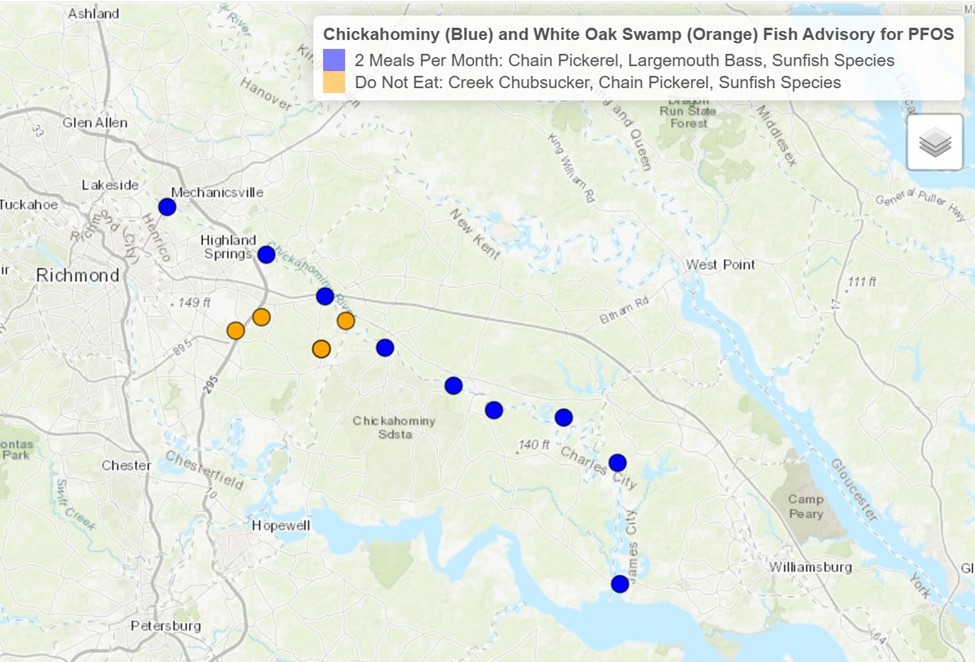
Fish tissue samples show elevated PFOS levels in certain fish species. These amounts exceed the amount considered safe for long-term human consumption. The samples, collected from November 2021 through September 2023, are from the Chickahominy River and White Oak Swamp.

VDH advises eating no more than two fish meals per month from the Chickahominy River. VDH advises against eating any of the specified fish meals from White Oak Swamp. See the table below for consumption recommendations by species.


Creek Chubsucker

Photo of a Creek Chubsucker fish

Chain Pickerel

Photo of a Chain Pickerel fish

Largemouth
Bass
Photo of a Largemouth Bass fish

Sunfish

Photo of a Sunfish

Chickahominy River

N/A

≤ 2 Meals*/Month ≤ 2 Meals/Month

≤ 2 Meals/Month

White Oak Swamp

No Meals

No Meals N/A

No Meals

*Meal is defined as 8 ounces of fish.

The advisory is for the Chickahominy River/Lake and the White Oak Swamp and all tributaries. For the Chickahominy River, the advisory extends from the confluence of the Chickahominy River with the James River, upstream to the State Route 360 bridge at the Henrico-Hanover County line near Mechanicsville. For the White Oak Swamp, the advisory extends from the confluence of White Oak Swamp and the Chickahominy River, upstream to the headwaters of White Oak Swamp and White Oak Swamp Creek near the Richmond International Airport.A map outlining the area under the fish consumption advisory for the Chickahominy Watershed

The health effects of PFOS exposure can include increased cholesterol or changes in liver enzymes. It can also lower antibody response to some vaccines. It can cause pregnancy-induced hypertension and preeclampsia, and a decrease in birth weight.

Fish consumption advisories alert people to contaminants present in affected fish species. They do not prohibit people from eating fish. Children and women who are pregnant or who may become pregnant have an increased health risk. Nursing mothers and young children should not eat fish from this advisory area.

Currently, this advisory area poses no health risk for recreational activities. Swimming, water skiing, and boating can continue in the advisory area.

Cleaning or cooking fish does not remove or reduce PFOS. To reduce potential harmful effects, VDH recommends the following precautions:

  • Eat smaller, younger fish (within the legal limits). Younger fish are less likely to contain harmful levels of contaminants.
  • Eat fewer or smaller servings of fish.
  • Try to eat different species of fish from a variety of sources (i.e., different creeks, rivers and streams).

For more information, visit the VDH Fish Consumption Advisory page.

# # #

VDH Lifts Recreational Water, Fish Consumption Advisories for Mountain Creek, Dockery Creek, Roanoke River to Lake Gaston

July 24, 2024
Media Contact: Brookie Crawford, brookie.crawford@vdh.virginia.gov

VDH Lifts Recreational Water, Fish Consumption Advisories for Mountain Creek, Dockery Creek, Roanoke River to Lake Gaston
No public health impacts are present.

RICHMOND, Va. – Effectively immediately, the Virginia Department of Health (VDH) is lifting the recreational water and fish consumption advisories for Mountain Creek, Dockery Creek, and the Roanoke River, to include Lake Gaston, to the North Carolina state line.

VDH considered several factors prior to lifting these advisories to protect public safety, to include field observations from environmental field staff, weather conditions (rainfall), and surface water sampling to monitor concentrations of contaminants. The Department of Environmental Quality (DEQ) and the Environmental Protection Agency (EPA) have been testing these creeks and river since the event to assist in the evaluation of the impacts of these chemicals on public health. Based on the above factors, recreational use and fish consumption activities may resume.

The advisories were issued out of an abundance of caution due to a release of chemicals from an industrial fire in South Hill on July 6. Runoff from water used to extinguish the fire created a plume which traversed along the nearby Dockery and Mountain creeks. Chemicals stored at the facility included fuel, fertilizers, herbicides and many others. The site has since been fully contained eliminating chemicals from the incident entering the environment.

For updates on the situation, please visit the South Hill Warehouse Fire incident webpage.

VDH has observed no evidence of impacts to drinking water at this time.

Swimming or other activities in any natural body of water always pose some health risk because the water is not disinfected. Children under the age of five years, older adults, and those with weakened immune systems are at higher risk of contracting illness from natural bodies of water.

To stay safe while recreating and fishing in state waters the public should:

  • Never swallow untreated water and don’t swim if your skin has cuts or open wounds.
  • Wash hands frequently, including after swimming and before preparing and eating food.
  • Shower or bathe after swimming to wash off possible germs and contaminants.
  • Check the water and the area around it before swimming. Avoid going in water if there is a green film on the water or if the water is cloudier than usual. Avoid swimming near storm drains or livestock.
  • Avoid swimming if you are vomiting or have diarrhea.
  • Avoid contact swimming in natural waterways for three days following rain events. Heavy rain picks up anything it comes in contact with, including germs from overflowing sewage, polluted storm water, and runoff from land.
  • Avoid any area of the waterbody where there is water with a foul or chemical odor, dead or dying fish, or discolored water.
  • If taking fish caught from natural waters, remove the skin from filets and dispose of viscera and internal organs. Cook filets to proper temperature and clean knives and cutting boards with soapy water. Follow posted fish consumption advisories.
  • Check with your healthcare provider before swimming in oceans, lakes, rivers, and other natural bodies of water if your body’s ability to fight germs is already affected by other health problems or medicines.

For more information on recreational water safety, visit www.SwimHealthyVA.com.

 #  #  #


VDH Lifts Portion of Recreational Water, Fish Consumption Advisories for Meherrin River

July 18, 2024
Media Contact: Brookie Crawford, brookie.crawford@vdh.virginia.gov

VDH Lifts Portion of Recreational Water, Fish Consumption Advisories for Meherrin River
Advisories Remain in Place for Mountain Creek, Dockery Creek, Roanoke River to Lake Gaston

RICHMOND, Va. – The Virginia Department of Health (VDH) is lifting portions of the recreational water and fish consumption advisories issued in response to a chemical storage facility fire on July 6. The portion of the advisory being lifted is for a section of the Meherrin River that starts at Route 138 (Union Mill Road) flowing Southeast through the Town of Lawrenceville and the City of Emporia to the North Carolina state line.

The advisory is being lifted for this section of river because the presence of chemicals is no longer at levels that pose a health risk. The concentrations of chemicals in the waterways have diluted due to recent rainfall as it has traveled downstream.

Recreational Advisory Map
Advisories Remain in Place for Mountain Creek, Dockery Creek, Roanoke River to Lake Gaston

The recreational and fishing advisories will remain in place for the headwaters of Mountain Creek near South Hill to the Meherrin River at Route 138 (Union Mill Road). Additionally, the advisory also remains in place for the headwaters of Dockery Creek to its confluence with the Roanoke River to the south and extends to the North Carolina State line which includes portions of Lake Gaston. For the safety of people and pets, VDH is advising that recreational water activities, such as swimming, wading, tubing, canoeing, kayaking, and boating should be avoided in the area still under recreational water and fish consumption advisories. VDH recommends not consuming any fish taken from these waterways under the current advisory effective Saturday, July 6 until further notice.

The advisories were issued out of an abundance of caution due to runoff from water used to extinguish an industrial fire in South Hill Saturday, July 6.  Chemicals stored at the facility include fuel, fertilizers, herbicides, and many others. For updates on the situation, please visit the Department of Environmental Quality website.

VDH and the Virginia Department of Environmental Quality are actively monitoring the situation. Due to the variety of chemicals involved VDH is still learning what adverse health effects someone may experience. Ingesting, touching, or breathing chemicals released during the incident are ways the public may be exposed. It is advised to stay away from the impacted area and the areas under advisory, and to contact your medical practitioner if you feel like you have been affected.

To prevent recreational water illnesses due to exposure to chemical release events, people should:

  • Avoid contact with the waterbodies noted above and observe advisory signage posted at waterbody access points.
  • Avoid any area of the waterbody where there is water with a foul or chemical odor, dead or dying fish, or discolored water.
  • Promptly wash skin with soap and water if you cannot avoid contact with water in the vicinity.
  • Rinse or wash items that come into contact with the water, including clothing, fishing gear, life vests, ropes and paddles.
  • Seek medical care and notify your practitioner of the waterbody exposure if you experience adverse health effects after contact with the waterbody.

For more information on recreational water safety, visit www.SwimHealthyVA.com.

For additional questions, contact VDH’s Call Center at 877-829-4682 (Option 2), The VDH Call Center is available Monday–Friday (except holidays) from 8 a.m. to 5 p.m.

 #  #  #

 VDH Issues Advisories for Recreational Water, Fish Consumption for Lick Creek in Wise and Russell Counties

July 12, 2024
Media Contact: Linda Scarborough, linda.scarborough@vdh.virginia.gov
Or Brookie Crawford, brookie.crawford@vdh.virginia.gov

 VDH Issues Advisories for Recreational Water, Fish Consumption for Lick Creek in Wise and Russell Counties
Public Advised to Avoid Contact with Contaminated Water

ST. PAUL, Va. – The Virginia Department of Health (VDH) is issuing a recreational water advisory for Lick Creek from the 628 bridge to the confluence with the Clinch River. For the safety of people and pets, VDH is advising that recreational water activities, such as swimming and wading, be avoided in this area of the waterway. VDH is also issuing a fish consumption advisory, recommending not consuming any fish taken from the Lick Creek headwaters to its confluence with the Clinch River. Advisories are effective Friday, July 11 until further notice.

The advisories are issued out of an abundance of caution due to an ongoing release of an unknown substance with unknown origin. While the substance being released is suspected as human sewage, other contaminants such as oil/petroleum cannot be ruled out at this time.

Due to the uncertainty of the substance being release which is ongoing, VDH is still learning what adverse health effects someone may experience. Touching the liquid substance, which is a dark liquid with a strong sewage odor, or consuming contaminated fish taken from the waterway, are ways the public may be exposed. It is advised to stay away from the impacted area and to contact your medical practitioner if you feel like you have been affected.

VDH has observed no evidence of impacts to drinking water at this time.

To prevent recreational water illnesses due to exposure to chemical release events, people should:

  • Avoid contact with Lick Creek from the 628 bridge to the confluence with the Clinch River and observe advisory signage posted at waterbody access points.
  • Avoid any area of the waterbody where there is water with a foul or chemical odor, dead or dying fish, or discolored water.
  • Promptly wash skin with soap and water if you cannot avoid contact with water in the vicinity.
  • Rinse or wash items that come into contact with the water, including clothing, fishing gear, life vests, ropes and paddles.
  • Follow the fish consumption advisories in place for impacted waterways and to avoid eating any fish with oily residue, lesions, or odor.
  • Seek medical care and notify your practitioner of the waterbody exposure if you experience adverse health effects after contact with the waterbody.

For more information on recreational water safety, see “Safely Enjoy Virginia’s Natural Waters” and other materials at www.SwimHealthyVA.com.

 #  #  #

 VDH Adds Meherrin, Roanoke Rivers to Recreational Water, Fish Consumption Advisories

July 11, 2024
Media Contact: Brookie Crawford, brookie.crawford@vdh.virginia.gov

 VDH Adds Meherrin, Roanoke Rivers to Recreational Water, Fish Consumption Advisories
Public Advised to Avoid Contact with Contaminated Water

RICHMOND, Va. – The Virginia Department of Health (VDH) is extending its recreational water advisory and its fish consumption advisory to include the Meherrin and Roanoke rivers. For the safety of people and pets, VDH is advising that recreational water activities, such as swimming, wading, tubing, canoeing, kayaking, and boating should be avoided. Additionally, VDH recommends not consuming any fish taken from these waterways effective Saturday, July 6 until further notice.

The advisories are issued out of an abundance of caution due to a release of chemicals from an industrial fire in South Hill Saturday, July 6. The advisories are extended to include the Meherrin River from its confluence with Mountain Creek to the North Carolina state line and the Roanoke River (Lake Gaston) from its confluence with Dockery Creek to the North Carolina state line. The advisories for Dockery and Mountain creeks remain in effect.

Map of advisory area
The fish consumption and recreation advisory extends from the location of the warehouse fire off Route 1 in South Hill to two impacted watersheds (Roanoke River and Meherrin River).

On the afternoon of July 6, an industrial fire occurred at a chemical storage facility located in the center of the town of South Hill. Runoff from water used to extinguish the fire has polluted nearby Dockery and Mountain creeks and has flowed downstream into the Meherrin and Roanoke rivers. Chemicals stored at the facility include fuel, fertilizers, herbicides, and many others. For updates on the situation, please visit the Department of Environmental Quality website.

Due to the variety of chemicals involved VDH is still learning what adverse health effects someone may experience. Ingesting, touching, or breathing chemicals released during the incident are ways the public may be exposed. It is advised to stay away from the impacted area and to contact your medical practitioner if you feel like you have been affected.

To prevent recreational water illnesses due to exposure to chemical release events, people should:

  • Avoid contact with the waterbodies noted above and observe advisory signage posted at waterbody access points.
  • Avoid any area of the waterbody where there is water with a foul or chemical odor, dead or dying fish, or discolored water.
  • Promptly wash skin with soap and water if you cannot avoid contact with water in the vicinity.
  • Rinse or wash items that come into contact with the water, including clothing, fishing gear, life vests, ropes and paddles.
  • Seek medical care and notify your practitioner of the waterbody exposure if you experience adverse health effects after contact with the waterbody.

For more information on recreational water safety, visit www.SwimHealthyVA.com.

For additional questions, contact VDH’s Call Center at 877-829-4682 (Option 2), The VDH Call Center is available Monday–Friday (except holidays) from 8 a.m. to 5 p.m.

 #  #  #

 VDH Issues Recreational Water, Fish Consumption Advisories for Dockery and Mountain Creeks

July 9, 2024
Media Contact: Brookie Crawford, brookie.crawford@vdh.virginia.gov

 VDH Issues Recreational Water, Fish Consumption Advisories for Dockery and Mountain Creeks
Public Advised to Avoid Contact with Contaminated Water

RICHMOND, Va. – The Virginia Department of Health (VDH) is issuing a recreational water advisory and a fish consumption advisory for Dockery and Mountain creeks. For the safety of people and pets, VDH is advising that recreational water activities, such as swimming, wading, tubing, canoeing, kayaking, and boating should be avoided. Additionally, VDH recommends not consuming any fish taken from these waterways effective Saturday, July 6 until further notice.

The advisories are issued out of an abundance of caution due to a release of chemicals from an industrial fire in South Hill Saturday, July 6. The advisories extend from the location of the fire off Route 1 in South Hill to approximately 10 miles north and south of the two impacted watersheds (Roanoke River and Meherrin River). From Route 1 in South Hill; the headwaters of Dockery Creek to its confluence with the Roanoke River to the south and the headwaters of Mountain Creek to the Meherrin River at Route 138 (Union Mill Road) to the north.

On the afternoon of July 6, an industrial fire occurred at a chemical storage facility located in the center of the town of South Hill. Runoff from water used to extinguish the fire has polluted nearby Dockery and Mountain creeks. Chemicals stored at the facility include fuel, fertilizers, herbicides and many others. For updates on the situation, please visit the Department of Environmental Quality website.

VDH has observed no evidence of impacts to drinking water at this time.

Due to the variety of chemicals involved VDH is still learning what adverse health effects someone may experience. Ingesting, touching, or breathing chemicals released during the incident are ways the public may be exposed. It is advised to stay away from the impacted area and to contact your medical practitioner if you feel like you have been affected.

To prevent recreational water illnesses due to exposure to chemical release events, people should:

  • Avoid contact with the waterbodies noted above and observe advisory signage posted at waterbody access points.
  • Avoid any area of the waterbody where there is water with a foul or chemical odor, dead or dying fish, or discolored water.
  • Promptly wash skin with soap and water if you cannot avoid contact with water in the vicinity.
  • Rinse or wash items that come into contact with the water, including clothing, fishing gear, life vests, ropes and paddles.
  • Seek medical care and notify your practitioner of the waterbody exposure if you experience adverse health effects after contact with the waterbody.

For more information on recreational water safety, see “Safely Enjoy Virginia’s Natural Waters” and other materials at www.SwimHealthyVA.com.

 #  #  #