The Virginia Department of Health (VDH) would like your help to further our understanding of tick ecology in Virginia. Our goal is to better understand which ticks are biting humans as well as the spatial distribution of Virginia's tick species of public health concern.
Your participation in this survey helps the VDH better understand tick encounters in the state!
If you find a tick on yourself or another person, follow the steps outlined on this page to participate.
- We do not identify ticks from out of state, or any ticks collected from an animal.
- This survey provides the tick identification results back to the user at no cost, and tick data is shown on the ‘Project Results’ tab.
- We will also share with you some information on common tickborne diseases in the state and which tick species can spread them – which can help you talk with your healthcare provider.
- Please see the Frequently Asked Questions at the bottom of the page for more information.
If you have questions about the survey please email: va.ticksurvey@vdh.virginia.gov
** We do not test submitted ticks for diseases. This is only used for tick species identification **
Step 1: Find and safely remove ticks
|
|
|
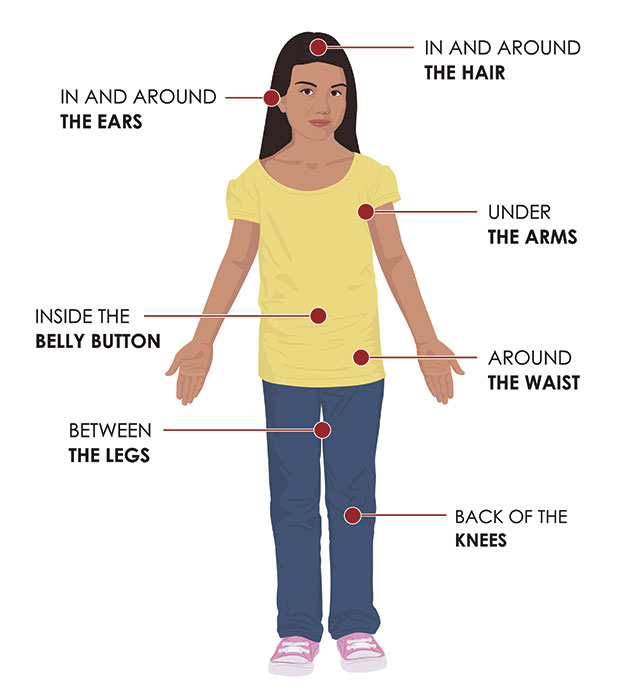
- After outdoor activity, inspect clothes and body for ticks. Remember to check in armpits, in and around ears and hair, belly button, backs of knees, and in between legs. Inspect children, clothing, and gear. Although VDH is not accepting ticks removed from pets, do not forget to check your furry family members as well.
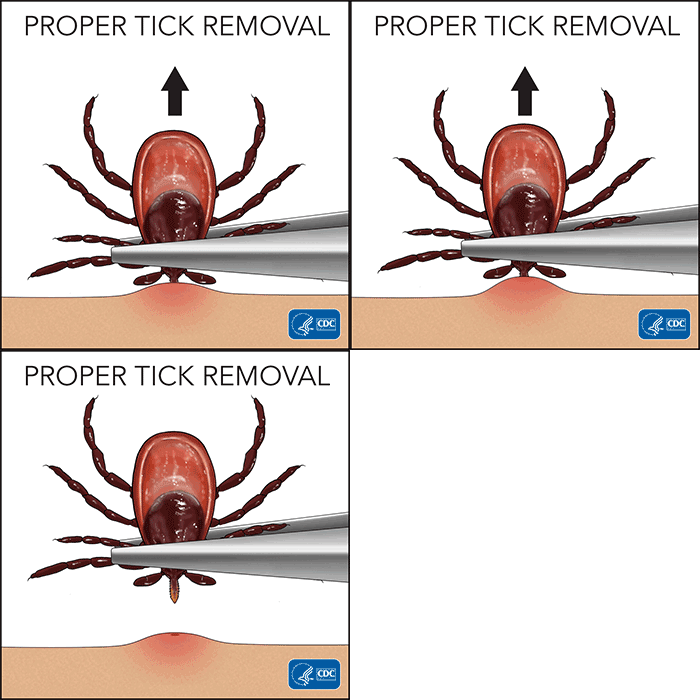
- If you find a tick- use a tweezer to grasp the tick as close as possible to the skin.
- Pull upwards, with steady even pressure, until the tick releases to avoid breaking the mouthparts of the tick or rupturing the tick's body.
- After tick removal, clean the skin and bite area with rubbing alcohol or soap and warm water.
- Save your tick in a bag or small container with rubbing alcohol to kill and sanitize the tick. Follow the instructions in Step 2 to submit for identification. Never crush a tick with your fingers.
- Note when your tick exposure occurred in case an illness develops in the following days to weeks.
Step 2: Complete Tick Survey
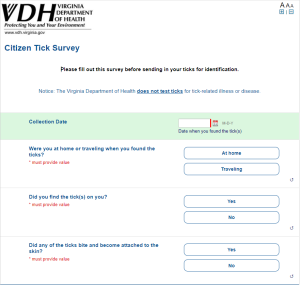
Our quick 'Tick Survey' can be completed on a computer or mobile device. We will ask questions related to where in Virginia you were when you found the tick, where on the body it was, and contact information for us to send the identification. To access the survey, please click on the survey image or scan the QR code with your smartphone below:
![]() |
![]() |
Step 3: Submit tick photos to VDH (Optional)
Important Note: We have included the option to upload photos of your tick(s). Please note, photo quality may impact our identification ability. Make sure to fill out the survey and follow the directions below.
How to take and submit pictures of your tick(s):
Step 1) Place the tick on a light-colored background and make sure you have good lighting. Clear two-sided tape can be used to secure the tick to keep it in focus.
Step 2) Move your camera or smart phone close to the tick and adjust the focus and so that the picture is not blurry. You may need to back away from the tick and use the digital zoom on your phone or camera to get the best picture possible.
You want to have a large picture of the tick with as much detail as possible (this helps with identification).
Step 3) Take picture #1
Step 4) Flip the tick over so the opposite side is now upwards.
Step 5) Follow Step 2 for taking a picture.
Step 6) Take picture #2
Step 7) Repeat this process for each tick.
Step 8) Submit pictures along with your survey ID # from your completed survey and hit the submit button:
Tick Picture Upload Form
"*" indicates required fields
Photograph Tips:
If the tick is swollen, concentrate your picture on the tick's “face” and shield area.
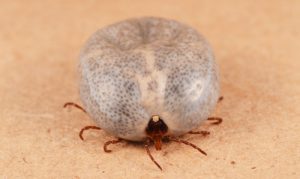
Photograph by Lyle Buss
If the tick is flat, concentrate the picture to include the entire top of the tick.
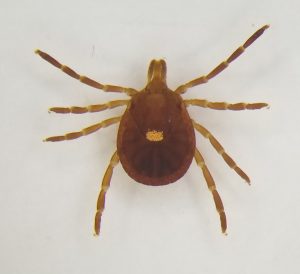
Photograph by Joshua Bernick
Step 4: Submit the tick specimen(s) to VDH
To submit tick(s) to VDH, place the tick(s) inside a sealed, zipper locked, bag or leak-proof container. Place the bag or container in an envelope, ideally a protective bubble envelope. There is no need to add alcohol or preservative when submitting the tick. Include a note clearly labeled with your email address and survey submission number (emailed after survey completion). VDH does not cover the cost of shipping, and the tick will be destroyed after it is received and identified.
Address to:
ATTN: Joshua Bernick
VDH Office of Epidemiology
109 Governor St, 2nd Floor
Richmond, VA 23219
Step 5: What to expect after tick submission
Upon completion of the survey, expect an automated email with your survey ID, to be included upon submission of your tick(s), and other helpful information.
Expect to be emailed the results of the tick species within 10-14 days of submission. Check out our interactive map to view data gathered by all participants!
FAQ
What is citizen science?
Citizen science involves the public in scientific research. VDH is interested to better understand tick ecology throughout the Commonwealth. Our small entomology team frequently travels to collect ticks by dragging methods. However, we look to expand our knowledge as to which species bite humans - critical information to understand disease risk. We look forward to your involvement and appreciate your participation in these efforts.
Which diseases can ticks transmit and which ticks are common in VA?
Visit the tick identification webpage for information about ticks and tick-borne diseases in Virginia.
Do you test my tick for diseases/pathogens?
At this time, we only provide species identification and do not test ticks that are submitted to us for diseases.
I completed the survey. Now what?
Our entomology team reviews online submissions and mailed-in specimens Monday-Friday. We will identify the tick, upload the identification to the survey (life stage(s), species), and an automatic response will be sent to return this information to you. In the email, it will also contain information on the tickborne diseases we find most in Virginia and which tick species they are associated with. It is important to note that we do not test submitted ticks for diseases.
Is this only available in the summer?
This service is available year-round, and you may submit multiple surveys/ticks.
What happens to the tick(s) that I sent in?
Our entomology team will identify the species, notify you of the species within 2-14 days, and destroy the specimen after a period of time.
I found a tick on me, but it didn’t bite me. Can I still send it in?
Yes! We will identify ticks found on a person, whether or not they have become embedded (bitten).
I found a tick on my dog/cat/horse. Can I send it in?
This survey is designed to just collect information on human/tick encounters. We are beginning to partner with some veterinary clinics around the state to look at animal/tick encounters