Virginia EMS Blog

EMS Week 2026

Happy Emergency Medical Services (EMS) Week, May 17-23, 2026! EMS for Children Day, May 20, focuses on the pediatric patient and the specialized care required when providing treatment to them.

Join us in recognizing the inspiring contributions of Virginia’s extraordinary EMS providers, as we thank them for their dedication to serving their neighbors and communities, and improving outcomes, together.

This year’s National EMS Week theme is, “Improving Outcomes, Together.” This concept extends beyond medicine and focuses on a collective responsibility to invest in the providers who are dedicated to serving their communities and saving lives.

Additionally, each day of EMS Week will feature a special area of focus. Learn more about EMS Week at: https://emsweek.org/.

The 2026 National EMS Week themed days are as follows:

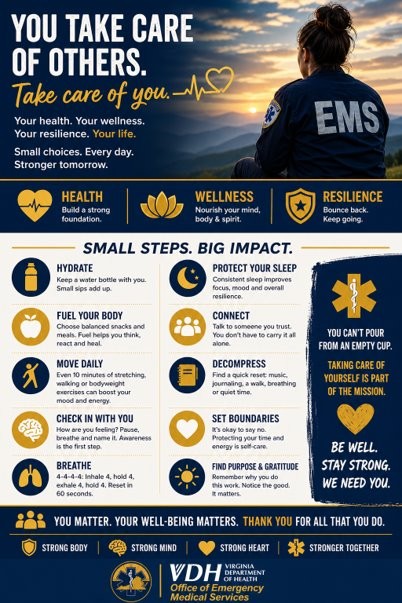
  • Sunday is “Health, Wellness, and Resilience Day” to promote the health, wellness and resilience of EMS providers and patients.
  • Monday is “Education Day” to highlight both public education programs and EMS provider education;
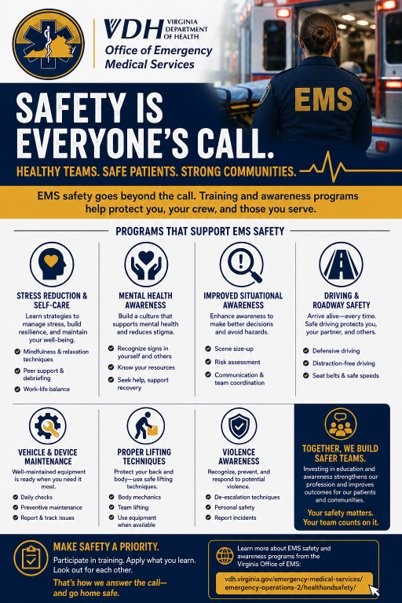
  • Tuesday is “EMS Safety Day” to promote safety for the EMS provider, the patient and the public;
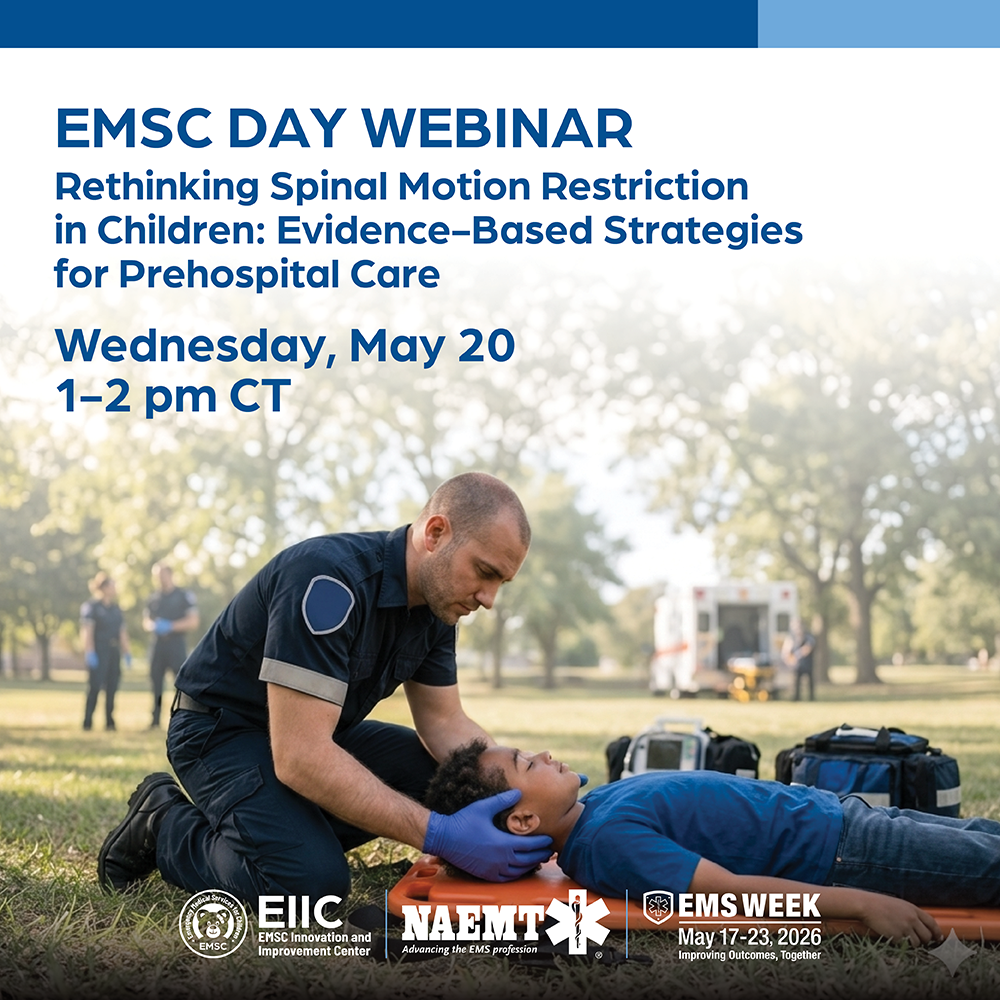
  • Wednesday is “EMS for Children Day” to highlight the special needs of the pediatric patient;

    This year, EMSC is hosting a free webinar on managing cervical spine injuries in children,
    NAEMT-EIIC Rethinking Spinal Motion Restriction in Children: Evidence Based Strategies for Prehospital Care Webinar
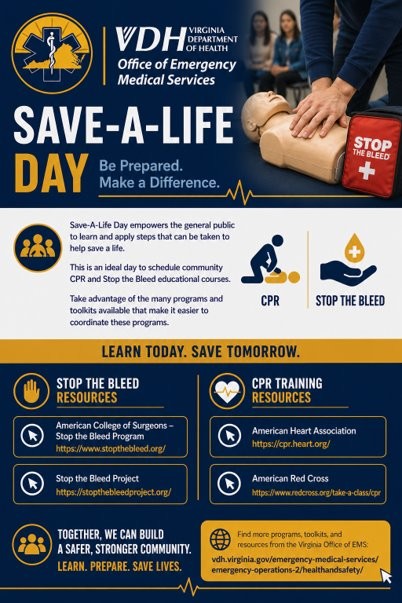
  • Thursday is “Save-A-Life Day”/”National Stop the Bleed” to promote CPR and Stop the Bleed, which is citizen bleeding control education, “Until Help Arrives” – active bystander training, public CPR programs and other related education programs;
  • Friday is “EMS Recognition Day” to recognize your local EMS heroes and those saved by the EMS system.
  • Saturday is “EMS Remembrance Day” to honor EMS personnel who have died in the line-of-duty and to recognize the ultimate sacrifice they made for their communities.

U.S. Dept. of Transportation’s Safe Streets and Roads for All (SS4A) Grant Opportunity

The Virginia Office of Emergency Medical Services would like to ensure that all EMS agencies are aware of a significant federal funding opportunity currently available through the U.S. Department of Transportation’s Safe Streets and Roads for All (SS4A) Grant Program.

Grant Overview:
NHTSA has communicated that local agencies have until May 26, 2026, to apply for SS4A funding. This program makes $1 billion available nationally to support projects that improve public safety infrastructure. Importantly, applications that include initiatives related to public safety infrastructure improvements and whole blood program implementation will receive priority consideration.

Why This Matters for EMS Agencies:
This funding presents a valuable opportunity for EMS agencies to advance critical safety initiatives, enhance response capabilities, and support programs that directly impact patient outcomes and community safety.

Recommended Action:
EMS agencies are encouraged to review the program details as soon as possible and consider submitting an application prior to the deadline. Complete information about the SS4A program, eligibility, and application requirements is available at: https://www.transportation.gov/grants/SS4A

Next Steps:
Please share this information within your organization and begin coordinating internally if you intend to pursue this grant. 

Resources:
NHTSA’s Office of EMS Webinar – Safe Streets and Roads for All Grants: Preparing a Strong FY26 Post-Crash Care Application

New Way to Get Help with EMS Education Questions and Issues

EMS providers can now get help more easily with education questions and issues by using a new online support system. 

Starting mid-March, a new form called the EMS Education Support Request Form became available. It helps track questions and issues to make sure they get to the right people. You can find the form on the Virginia Office of EMS’ (OEMS) website by clicking the link for Accreditation, Certification & Education. 

This change makes getting help clearer and easier for EMS providers,” said Deputy Director of Professional Standards and Accountability Cam Crittenden, RN. “We want to support EMS providers and keep finding better ways to help.

The system uses teamwork to make sure questions go to the right OEMS staff. It also improves organization and communication. 

The OEMS website also has lots of helpful resources to answer frequently asked questions. Regional EMS Offices are also great places to get assistance. If you still need answers, the support system is there to help with just a few clicks.

National Public Safety Telecommunicators Week – A Letter from the OEMS Director

grey background with text that says, "across the Commonwealth, dedicated public safety telecommunicators answer the call 24/7"

Dear Public Safety Telecommunicator,   

Every call answered is a moment that matters. During National Public Safety Telecommunicators week, we recognize the extraordinary individuals across our nation’s public safety answering points (PSAPs) who serve as the vital first link in emergency response.  

This week, we honor the professionals whose skill, compassion and resilience make a profound difference every single day. Whether managing routine calls or navigating life-threatening emergencies, telecommunicators demonstrate unwavering dedication to public safety and community well-being. The work you do is both demanding and essential. It requires precision, emotional strength and the ability to adapt instantly to rapidly evolving situations. You are the bridge between those in need and the field responders traveling to their aid, often offering reassurance and clarity when it is needed most. Your professionalism and commitment do not go unnoticed.   

Over the past year, the challenges facing emergency communications have continued to evolve. From increased call volumes to advancing technologies and changing community needs, PSAP teams have remained steadfast in embracing innovation and continuing to deliver exceptional service under pressure. We recognize that behind every headset is a person who carries the weight of each call. Your resilience, teamwork and dedication to excellence are the foundation of effective emergency response systems across the Commonwealth of Virginia. Your contributions strengthen not only your agencies, but the entire public safety ecosystem.  

As we celebrate with you this week, my staff at the Virginia Office of EMS and I want to express our deepest gratitude for the critical role you play. Your work saves lives, supports first responders, and brings calm to uncertainty. You are truly the first, first responder. Thank you for your service, commitment and continued drive toward excellence to keep Virginians safe.   

With heartfelt appreciation, 

Maria Beermann-Foat, PhD, NRP
Director
Virginia Office of EMS 

A Commonwealth United by Purpose

A Commonwealth United by Purpose
By: Mohamed G. Abbamin, MPA
Senior Policy Analyst
Virginia Office of Emergency Medical Services


Women Leading with Purpose  

As Virginia recognizes Women’s History Month, the Commonwealth’s public health and emergency medical services system finds itself in a historic moment of leadership and alignment. 

From the Executive Mansion to the State EMS Advisory Board, women are shaping the direction of Virginia’s emergency and public health infrastructure at every level. 

The election of Governor Abigail Spanberger as the first woman to serve as Governor of Virginia marked a defining milestone in the Commonwealth’s history. Her administration reflects a renewed commitment to service-driven policy, representation, and community-centered leadership. 

Within the Virginia Department of Health (VDH), this new chapter continues under the leadership of State Health Commissioner B. Cameron Webb, MD, JD, whose medical and legal background reinforces a whole-of-system approach to public health and emergency preparedness. That framework aligns public health, healthcare systems, emergency medical services, and community partners into a coordinated structure designed to strengthen system resilience, advance health equity, and enhance the Commonwealth’s ability to prevent, respond to, and recover from public health and medical emergencies. 

Within the Office of Emergency Medical Services (OEMS), Dr. Maria Beermann-Foat recently completed her first year as Director. Her career spans service as an EMT, paramedic, training chief, operations battalion chief, and quality management division chief. Her leadership reflects operational depth, clinical expertise, and a commitment to transparency and accountability. 

Supporting this work is Deputy Commissioner Stephanie Dunkel, who oversees Population Health and Preparedness and ensures strategic alignment across VDH’s emergency response and public health systems. 

Within the State EMS Advisory Board, Dr. Paula Ferrada now serves as Chair, with Beth Matish serving as Vice Chair. Their appointments represent a significant moment in Virginia EMS history, reinforcing the depth of expertise and leadership guiding the statewide system. 

Structural Reform in Action 

Leadership alignment coincides with one of the most significant governance realignments in Virginia EMS history. 

As of January 1, 2026, contracts for the Commonwealth’s seven designated EMS regions went into effect, completing the transition from eleven regional councils to a streamlined seven-region structure. 

This reform was rooted in extensive stakeholder engagement and system-level assessment. The objective was deliberate: strengthen coordination, improve administrative alignment, ensure equitable regional representation, and enhance long-term sustainability. 

The transition includes a defined ramp-up period, allowing regions to establish operational presence across their full geographic areas, finalize contract deliverables, and maintain continuity of services. OEMS coordinators continue working alongside both new and transitioning councils to ensure a structured and supported implementation.  This measured approach reinforces operational continuity while strengthening equity in representation and consistent service delivery across the Commonwealth. 

A System Grounded in Engagement 

Under Director Beermann-Foat’s leadership, Year One focused on a comprehensive assessment of Virginia’s EMS environment, identifying structural and operational opportunities for improvement. 

Year Two shifts toward deeper engagement within statewide systems, with emphasis on partnership across the newly structured regions. Collaborative initiative development and strengthened coordination across the EMS continuum are central priorities. 

VDH recognizes that system improvement is not achieved solely through policy updates. It requires sustained engagement with those delivering care on the ground, including clinicians, educators, administrators, volunteers, and regional leaders. 

The mission remains clear: To reduce death and disability from sudden illness or injury by planning and developing a comprehensive, coordinated statewide EMS system that delivers high-quality emergency medical care. 

What has evolved is how leadership, governance, and regional execution align to meet that mission. 

Purpose in Motion 

Virginia’s progress in EMS is not simply structural. It is cultural. 

The Commonwealth is building a system rooted in collaboration, transparency, and accountability. Leadership across VDH and the EMS community reflects both experience and representation, reinforcing a unified direction for the future. 

As we recognize Women’s History Month, we also recognize the broader workforce whose dedication sustains Virginia’s EMS system every day. 

With new executive leadership, a strengthened public health framework, and historic representation across EMS governance, Virginia enters this chapter with confidence and clarity. 

A Commonwealth united by purpose is not merely adapting to change. 

It is leading it.