
January 22, 2026
Media Contact: Dr. Zelalem Attlee, Zelalem.Attlee@vdh.virginia.gov
The Rappahannock-Rapidan Health District Shares Two Ways You Can Prevent Cervical Cancer
January Marks Cervical Health Awareness Month
WARRENTON, Va.– Cervical cancer is highly preventable, yet thousands of women die from it each year in the United States. The Rappahannock-Rapidan Health District encourages you to take two simple steps to prevent cervical cancer. Vaccination and screenings help save lives.
“January is Cervical Health Awareness Month, a reminder that cervical cancer is largely preventable through regular screening and HPV vaccination,” said Rappahannock-Rapidan Health District Director J. Carr, M.D. “Early detection saves lives, and we encourage all eligible individuals to take advantage of these proven, life-saving services.”
Human Papillomavirus (HPV) Vaccination
The HPV vaccine protects against the HPV types that cause 90% of all cervical cancer. It also protects against five other cancers. The HPV vaccine works best before exposure to the virus and is recommended for routine vaccination at ages 11 or 12 years of age.
Vaccination can also start as early as nine years old. People aged 26 years and younger who are not fully vaccinated can still get the vaccine. Some adults age 27 and older may choose to get vaccinated and should talk to a healthcare provider. Please talk to a healthcare provider about the HPV vaccine and its cancer prevention benefits.
Cervical Cancer Screening
The HPV test and the Pap test can help prevent cervical cancer or find it early. The HPV test detects high risk types of human papillomavirus, the cause of most cervical cancers. The Pap test (or Pap smear) looks for abnormal cervical cells.
When to get screened depends on a woman’s age:
- For 21- to 29-years-olds, a Pap test only is recommended every three years.
- For 30- to 65-year-olds you have three testing options that range from three to five years. Talk to your healthcare provider about the right option for you:
- An HPV test only, every five years.
- Co-testing with an HPV test and a Pap test, every five years.
- A Pap test only, every three years.
- For women over 65, please contact your healthcare provider to determine what testing schedule is best for you.
The Rappahannock-Rapidan Health District offers HPV vaccination. HPV vaccination and cervical cancer screening dates are by appointment (see below).
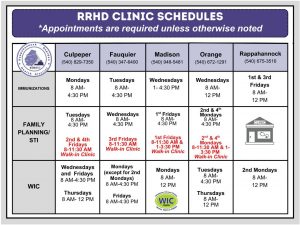
The FDA has also approved two self-swab tests for use in a doctor’s office, as well as an at home test called the Teal Wand. These tests may make screenings more accessible, especially for women in rural and marginalized areas. Talk to your healthcare provider to see if a self-swab test is a good option for you.
If cost is an issue, VDH can help.
- Every Woman’s Life provides free breast and cervical screening tests to low-income, uninsured Virginians.
- Virginia Vaccines for Children(VVFC) provides the HPV vaccine at no cost for eligible pre-teen or teen children. Use the provider finder to find a VVFC provider or call 800-568-1929 or 804-864-8055.
Taking these preventative steps now isn’t just smart, it could save your life. Contact the Rappahannock-Rapidan Health District at www.rrhd.org for more information about cervical cancer, the HPV vaccine or cervical cancer screenings.
# # #