
Drinking Water ♦ Shellfish Closures ♦ Recreation
On January 19, a sewer line in Montgomery County, Maryland, collapsed, causing an overflow of more than 200 million gallons of wastewater into Potomac River. On January 24, DC Water completed a bypass to reroute wastewater around the collapsed section of pipe and back into the sewer system. In the beginning of February, additional overflows occurred.
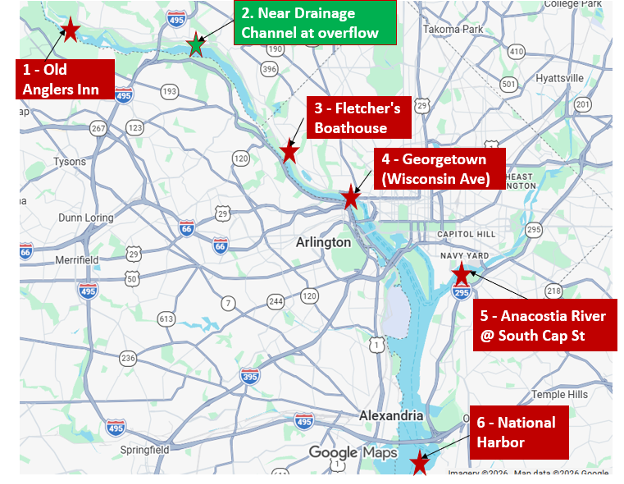
DC Water is handling the repairs to the pipe. Updates on repairs can be found on the DC Water page. Maryland has regulatory authority over the Potomac River for issuing shellfish closures and recreational advisories as well as water quality monitoring.
The Virginia Department of Health (VDH) is working with the Maryland Department of the Environment (MDE) and the Maryland Department of Health (MDH). VDH has a long-standing relationship with these agencies navigating pollution events and water quality monitoring in the Potomac River and have been in constant communication since the event occurred.
The Virginia Department of Environmental Quality is conducting regular water quality testing to assess the impacts of this spill as it continue to prioritize the safety and well-being of Virginians.
Shellfish Closures
At this time, Virginia shellfish growing areas are not impacted by the sewage spill.
On February 17, VDH staff conducted a routine seawater sampling run for shellfish growing areas from Colonial Beach to the 301 Bridge, collecting 36 water samples in total. Based on the laboratory analyses, there was no elevated fecal coliform bacteria concentrations, with the vast majority of the samples were at or below the detection limit for the test.
VDH collected an additional 37 routine samples on February 26, further downstream in Westmoreland County near Coles Point, at shellfish growing areas including Lower Machodoc, Gardner, Jackson and Bonum Creeks. These samples also showed no elevated bacterial concentrations.
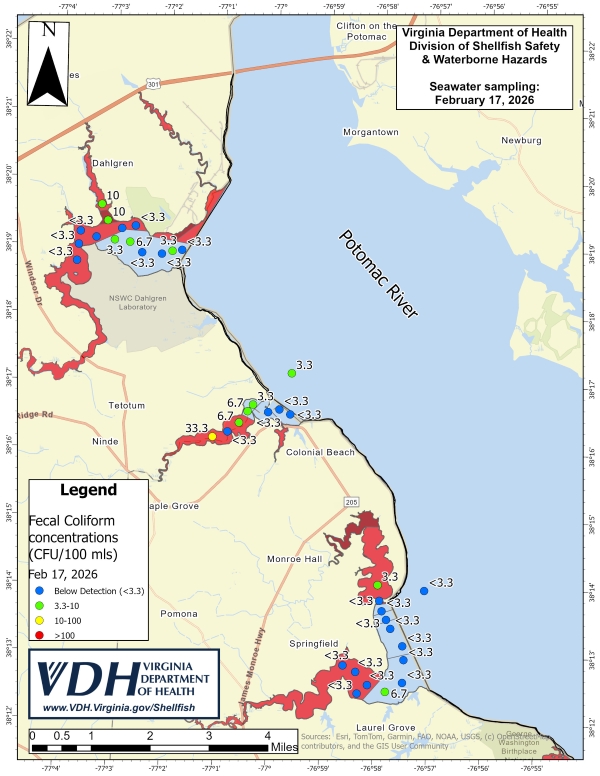
Please note, the areas shown in red are shellfish harvesting condemnations that existed prior to the Potomac River spill. More information on those closures is available at the links below:
https://www.vdh.virginia.gov/content/uploads/sites/20/cond001A-036.pdf
https://www.vdh.virginia.gov/content/uploads/sites/20/cond001-088.pdf
https://www.vdh.virginia.gov/content/uploads/sites/20/cond003-001.pdf
On March 10, MDE lifted the shellfish closure that was issued January 25.