March 5, 2026
Media Contact: Brookie Crawford, brookie.crawford@vdh.virginia.gov
VDH Partially Lifts Potomac River Recreational Water Advisory
Advisory Remains in Place North of Chain Bridge
RICHMOND, Va. – Effective immediately, the Virginia Department of Health (VDH) is partially lifting the recreational water advisory for the portion of the Potomac River from the Route 120 Chain Bridge to the Governor Harry W. Nice Memorial Bridge (Route 301) in King George County. The advisory remains in place upstream, from the American Legion Memorial Bridge (I-495) to the Route 120 Chain Bridge.
The advisory was issued February 13, out of an abundance of caution, due to a sewage spill in the Potomac River that occurred January 19, and subsequent reports of a sewage discharges in early February. The situation has been actively monitored by Virginia, Maryland and DC.
Water quality sampling results collected by the Virginia Department of Environmental Quality (DEQ) on February 17, 25, 26, and 27 indicate bacteria concentrations in the Potomac River are at levels acceptable for all recreational water use. Swimming or other activities in any natural body of water always pose some health risk because the water is not disinfected. Children under the age of five years, older adults, and those with weakened immune systems are at higher risk of contracting illness from natural bodies of water.
The advisory will remain in place for the 4.7-mile portion of the Potomac River from the American Legion Memorial Bridge (I-495) in Fairfax County to the Route 120 Chain Bridge at this time. Water quality sampling results collected by the Washington DC Department of Energy and Environment and DC Water continue to show higher values of E. coli near the spill site. For the safety of people and pets, VDH is advising Virginia residents to avoid recreational water activities in this area of Potomac River, such as swimming, wading, tubing, white-water canoeing or kayaking, where full-body submersion is more likely to occur.
To prevent recreational water illnesses due to exposure to sewage spill events, people should:
- Avoid contact with water in the advisory area and observe advisory signage posted at waterbody access points.
- Avoid any area of the water body where water has a foul odor, dead or dying fish, or discolored water.
- Promptly wash skin with soap and water if you cannot avoid contact with water in the vicinity.
- Rinse or wash items that come into contact with the water, including clothing, fishing gear, life vests, ropes and paddles.
- Seek medical care and notify your practitioner of the waterbody exposure if you experience adverse health effects after contact with the waterbody.
- When harvesting fish or crabs, discard skin, organs, cook the meat to proper temperature, and clean cutting boards and cutting implements with warm soapy water.
VDH has observed no evidence of impacts to drinking water at this time.
For updates on the repair status, visit DC Water. For updates on Virginia impacts and to find links to the Maryland and DC agencies responding to this incident, please visit www.vdh.virginia.gov/news/potomac-sewage-spill/.
# # #
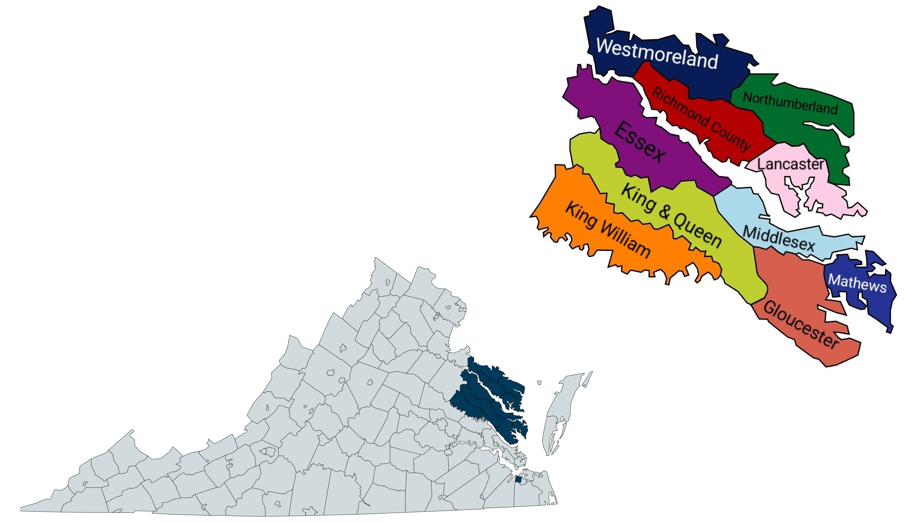
THE THREE RIVERS HEALTH DISTRICT is the 10 county Virginia Department of Health district for Virginia’s beautiful Northern Neck and Middle Peninsula. This 2,000 square mile area is located between the waters of the Potomac, Rappahannock, and York Rivers and borders the Chesapeake Bay on the east. Our public health professionals serve a population of approximately 140,000, including 3 Native American reservations, 9 incorporated towns, and a large number of visitors.