
The Virginia Department of Health (VDH) monitors and reports data on drug overdose deaths. Data can be used to inform drug overdose prevention programs or policies.
Data are from death certificates. Data on this dashboard present the number of deaths by drug class for Virginia and neighboring states. Learn more about the definition of a drug overdose death. Learn more about death certificate data at the National Center for Health Statistics website.
Any questions regarding drug overdose data can be sent to overdose@vdh.virginia.gov.
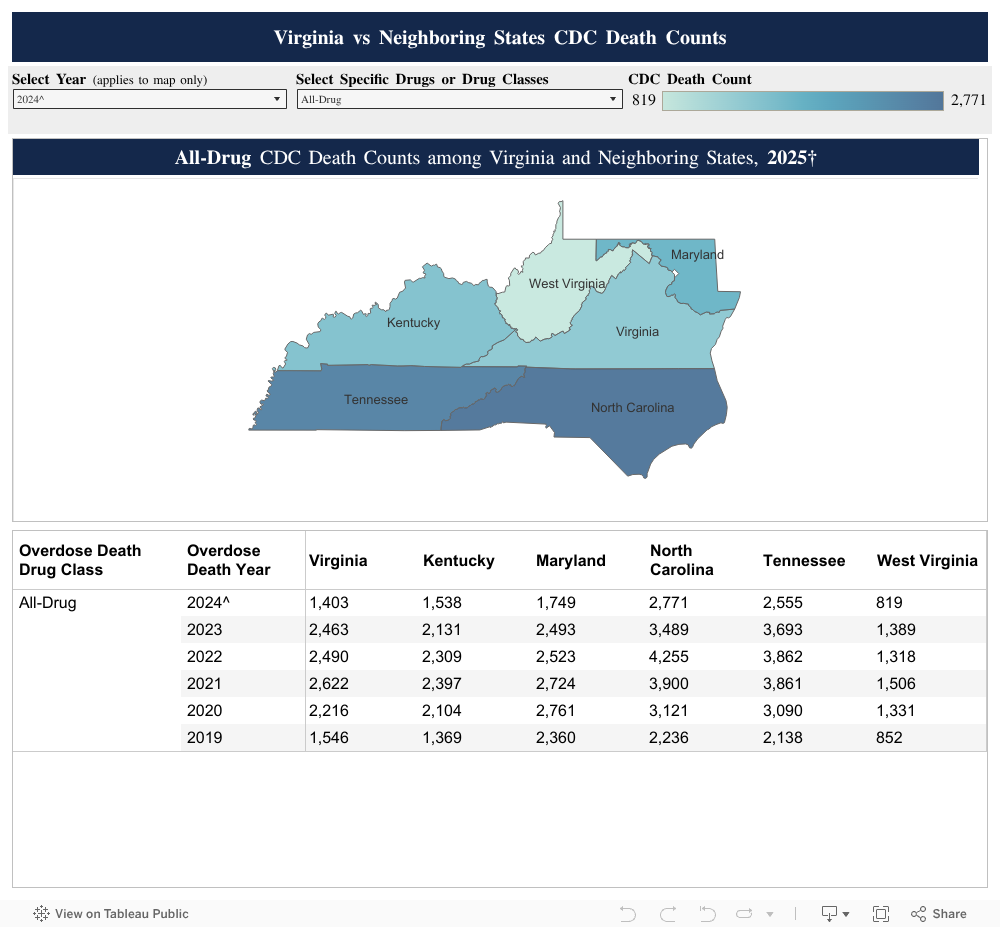
Death investigations need weeks or months to complete. This is because drug testing is needed to classify a death as a drug overdose. Toxicology testing takes time. Deaths may first be assigned as “pending” on the death certificate while an investigation is happening. The status is updated when the investigation is complete. Data may also be delayed while waiting for finalized data from out-of-state records and/or National Center for Health Statistics (NCHS) edits.
Data by drug class are not mutually exclusive. This means that a death can involve more than one drug. For example, a death that includes an opioid and cocaine would be counted in both categories.
| All-Drug | All-Drug class includes any death due to drug overdose. Does not include alcohol- or gas/vapor-only overdoses. |
| Any Opioids | Opioids are a class of drugs that include heroin, illegally-made fentanyl, and pain medications available legally by prescription, such as oxycodone, hydrocodone, codeine, morphine, prescribed fentanyl, and many others. |
| Fentanyl and Other Synthetic Opioids | Fentanyl is a very powerful opioid. Synthetic opioids are man-made. Fentanyl can be prescribed in the form of transdermal patches or lozenges to treat severe pain. Illegally-made fentanyl is sold through illicit drug markets for its heroin-like effect. Most drug overdose deaths are due to illicit fentanyl. |
| Natural, Semi-Synthetic and Synthetic Opioids | Natural opioids come from the poppy plant and include morphine and codeine; Semi-synthetic opioids include drugs such as oxycodone, hydrocodone, hydromorphone, and oxymorphone; and synthetic opioids (other than methadone) are made in a laboratory and include drugs such as fentanyl and tramadol. |
| Prescription Pain Relievers: Natural, Semi-Synthetic and Methadone | Prescription pain relievers include medications that can be prescribed by a healthcare provider. Methadone is a man-made (synthetic) opioid that can be prescribed to reduce pain or to treat opioid use disorder (OUD). |
| Natural and Semi-Synthetic Opioids | Natural opioids come from the poppy plant and include morphine and codeine, and semi-synthetic opioids include drugs such as oxycodone, hydrocodone, hydromorphone, and oxymorphone. |
| Methadone | Methadone is a man-made (synthetic) opioid that can be prescribed to reduce pain or to treat opioid use disorder (OUD). |
| Heroin | Heroin is an illegal opioid drug processed from morphine and certain poppy plants. |
| Benzodiazepine | Benzodiazepines are drugs that calm the nervous system, known as sedatives. They are often used to prevent seizures and treat anxiety disorders, insomnia, and other conditions. Examples include alprazolam (Xanax®), diazepam (Valium®), and lorazepam (Ativan®). |
| Psychostimulant | Psychostimulants are a subset of stimulants, drugs that speed up the body’s systems. These include illegal drugs, such as methamphetamine, ecstasy, and prescription stimulants like methylphenidate (Ritalin® or Concerta®). This category does not include cocaine. |
| Cocaine | Cocaine is a type of stimulant drug. Cocaine deaths are counted separately. |
The CDC has a glossary of commonly used terms related to opioids and drug overdose.
Final death data for the prior year are finalized in the fall of the current year. Current year data are updated quarterly on the third Monday of the following months: April, July, October, and January.
The death certificate drug overdose death definition uses ICD-10 medical coding for underlying cause of death.
Rates are the number of drug overdose deaths per 100,000 Virginia residents. Population estimates are sourced from the CDC National Center for Health Statistics bridged-race files.
Data are provided from sources believed to be reliable and accurate at that point in time. Please see Virginia Code §32.1 for more information.
Frequently Asked Questions about drug overdose deaths data sources at VDH
For additional information about drug overdose and substance use, email overdose@vdh.virginia.gov.