Virginia Office of Emergency Medical Services Launches New Logo to Reflect Unified Commitment to Virginia’s EMS System

The Virginia Department of Health (VDH), Office of Emergency Medical Services (OEMS) recently launched its new logo to reflect a unified identity and strengthened commitment to Virginia’s EMS providers, system partners and the communities they serve.  

The refreshed logo honors OEMS’ core values and responsibility to ensure quality prehospital care to all people in Virginia, while aligning with VDH’s main brand identity and vision. The new OEMS logo also highlights the future of EMS in Virginia, as it moves toward a more accountable and sustainable office and EMS system.  

A lot of thought and care went into the symbolism of this logo, which is steeped in EMS tradition, including the Star of Life and the Rod of Asclepius – all images that are synonymous with the EMS profession and the healthcare field. The logo also highlights the state of Virginia to illustrate inclusiveness and care for all people in the commonwealth.  

OEMS will begin transitioning to the new logo immediately, along with the seven designated OEMS regions. However, full implementation is expected to take several months, as we phase out our legacy logo during this time.  

Check out the Branding Guide.


Learn more about the logo symbolism

The colors of the new Virginia Office of EMS (OEMS) logo – the navy blue color symbolizes authority and trust. It’s the traditional EMS uniform color. You can find this color on almost every public safety uniform in the nation. It is also part of the official navy blue branding for the Virginia Department of Health (VDH).

The silver color visible around the star of life and in the Rod of Asclepius symbolizes professionalism and polish. It represents the professionalism of our EMS providers, and like polishing silverware, when it starts to show some signs of age or tarnishing, we polish it, we make it better. We make it shiny and new and bright. In EMS, this means everything from the training that we do, the policies that we enact, the procedures that we advance, or the systems that we design.

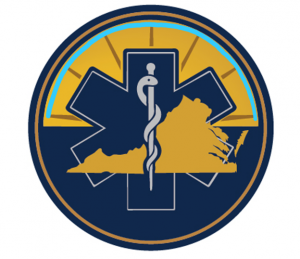
The gold color indicates a bright future, aiming for excellence and quality. Gold is often associated with gold medal winners, champions, and the sunrise, which points to a bright, positive, and progressive drive for the future. It indicates ambition and possibility.

The Elements of the Logo

  • The Star of Life – The star of life is the official symbol of EMS. This is the central focus of OEMS, and everything that the OEMS does is for the EMS system.
  • The Virginia State Map – The next element is the state of Virginia’s map silhouette. This represents all people in Virginia. It represents that all people in Virginia rely on the EMS system in their time of need. The map is embedded within the star of life, because EMS is designed to be the protector and savior of all Virginians in their time of need. The Rod of Asclepius (the snake and staff) overlays the Virginia map to show the State is enveloped within the EMS system.
  • The Seven Rays – The seven rays represent the seven EMS regions. This is a core part of the Virginia EMS system and how we will continue to operate in the future. Additionally, OEMS will soon determine the seven organizational values guiding the culture of OEMS, so the rays will hold a double meaning. The Virginia EMS system has transitioned to seven EMS regions (from the original 11), and they work hand in hand with OEMS to ensure that all of our goals and objectives meet our state EMS plan and that they’re achieved.
  • Radiating Arc – There’s a radiating arc from the center and through the rays. This indicates hope for the future journey ahead, maneuvering future direction and building momentum. The arc mimics the rising sun which indicates a bright future. The radiating pattern represents a centralized plan, unity and collaboration. It spreads from the center of the system and reaches all corners of Virginia. This is how we get forward momentum and where the sky is truly the limit.
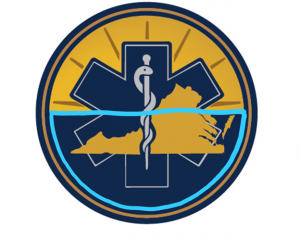
  • Horizon – The half circle horizon indicates visualizing the path ahead and the future of Virginia EMS. It represents the future journey starting from the present. And like the horizon line that we see every day, we can see it, but it’s not quite clear. It’s not quite defined, but we know it’s there and we’re walking towards it. The star of life is centered on the horizon, with all points starting in that center space and moving forward.
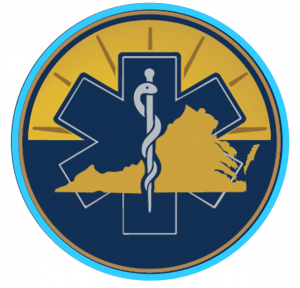
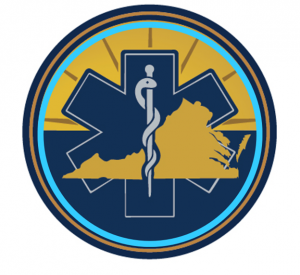
  • The Emblem – The circle design was purposeful. Circles are continual. They never end. It indicates unity, equity and collaboration across the system. The symbolism of equity because there are no sides and there are no corners, which means we treat all just as important as the other.There are concentric circle borders from the inside border to the outside border. These indicate the patient and the provider, agency and locality, the state, and then the nation. Starting from the inside main circle body, this symbolizes the patient that relies upon the EMS system and is the center of why we exist. The first circle border outside of that symbolizes the providers, agencies and localities, that take care of that patient who are closest to the patient’s needs.
  • VDH and OEMS Name – The next layer is the state layer. That’s the VDH and OEMS layer and we’re here to support and help. And lastly, just like all important healthcare systems, we are part of a much bigger national system. The national system helps us to drive the system forward, because we’re all very busy doing what we do that sometimes we lose that 10,000 foot view from a much grander level.

Additional Logo Components

Another key component is that VDH and OEMS are a unified government health care system. EMS is a medical care system that’s just in the prehospital setting. Regardless of the service delivery model, the focus is on the patient and ensuring that they get the highest level of quality care, regardless of where they are in the State.

OEMS has taken this last year and will continue throughout the coming years to integrate within VDH and to be in alignment with the national vision of EMS, as outlined in the EMS Agenda for the Future 2050. Because that document outlines EMS moving from a reactionary industry where someone has experienced an event and then they call for help to a proactive industry where we try to prevent the 911 call from happening to start with.

The Seven EMS Regions

The seven EMS regions have their own lockup logo based off the core OEMS design, because they are doing work on behalf of the State office. This is one unified State system, therefore the regions will now be officially known and referred to as OEMS regions (OEMS Region 1, OEMS Region 2, etc.) instead of by the 501c3 contracting entity granted the designation for the contract cycle.

These regional partners are doing the important work on behalf of the State EMS Office, and it can’t be stressed enough how important that is. We rely on our regional partners for their expertise and assurance that local needs are being met while we work together to address equity and quality across all regions. The regional work has already started. We’ve already started taking approaches with our communication and our current collaborations to build this new future.

The Virginia Office of EMS has moved!

The Virginia Office of EMS has officially moved to its new location downtown. Our office is open and you can visit us at 109 Governor Street, Richmond, VA 23219. We are located on the mezzanine level.

There is no public parking on site, so visitors will need to locate parking nearby. Additionally, entry to the Madison building is secured, so visitors will be required to have identification and an appointment with OEMS staff to enter the building.

We look forward to serving you at our new location. We can also be reached by phone at 804-888-9100 (Main Office) or through email (view our Staff Listing).

Virginia Office of EMS Announces Seven Newly Designated EMS Regions  that will Provide an Efficient and Effective Regional EMS Delivery System

As part of the Virginia Department of Health’s (VDH) Office of Emergency Medical Services’ (OEMS) ongoing work to enhance Virginia’s Emergency Medical Services (EMS) System, we are announcing the recent transition to seven EMS Regions, effective January 1, 2026. This transition is designed to improve the efficiency of EMS operations, reduce administrative costs and improve funding distribution.  

The EMS Region contracts were initiated through a competitive request for applications (RFA) for the development and implementation of an efficient and effective statewide regional EMS delivery system for VDH, per the Code of Virginia §32.1-111.4:2. These contracts went into effect, with a contract period of January 1, 2026 – June 2028.  

The seven OEMS Regions will function as collaborative partners with the VDH OEMS to perform bodies of work on behalf of OEMS and will be identified as “OEMS Region 1-7.”  The Regional Council System is overseen by the OEMS EMS Operations Branch, which is led by Deputy Director Wayne Perry and Regional Coordinators Greg Woods, PhD, and Mary Kathryn Allen. These new service areas were designated in alignment with VDH’s Local Health Districts and Virginia’s Healthcare Coalition. 

  • OEMS Region 1,
    Executive Director Bryan Kimberlin

    Serving the following defined service areas: Counties of: Bland, Buchanan, Carroll, Dickenson, Grayson, Lee, Russell, Scott, Smyth, Tazewell, Washington, Wise, and Wythe and the Cities of Bristol, Galax, and Norton  
  • OEMS Region 2,
    Executive Director Debbie Akers

    Serving the following defined service areas: Counties of : Alleghany, Amherst, Appomattox, Bedford, Botetourt, Campbell, Craig, Floyd, Franklin, Giles, Henry, Montgomery, Roanoke, Patrick, Pittsylvania, and Pulaski; and the Cities of : Bedford, Covington, Danville, Lynchburg, Martinsville, Radford, Roanoke, and Salem  
  • OEMS Region 3,
    Executive Director Kristin Nickerson

    Serving the following defined service areas: Counties of: Bath, Highland, Augusta, Rockbridge, Rockingham, Page, Shenandoah, Frederick, Warren, and Clarke; and the Cities of: Buena Vista, Harrisonburg, Lexington, Staunton, Waynesboro, and Winchester  
  • OEMS Region 4,
    Executive Director Kristin Nickerson

    Serving the following defined service areas: Counties of: Arlington, Fairfax, Loudoun, and Prince William; and the Cities of: Alexandria, Fairfax, Falls Church, Manassas, and Manassas Park  
  • OEMS Region 5,
    Executive Director Kristin Nickerso
    n

    Serving the following defined service areas: Counties of: Albemarle, Caroline, Culpeper, Fauquier, Fluvanna, Greene, King George, Louisa, Madison, Nelson, Orange, Rappahannock, Spotsylvania, and Stafford; and the Cities of: Fredericksburg, and Charlottesville  
  • OEMS Region 6,
    Executive Director Heidi Hooker

    Serving the following defined service areas: Counties of: Amelia, Brunswick, Buckingham, Charles City, Charlotte, Chesterfield, Cumberland, Dinwiddie, Halifax, Hanover, Henrico, Goochland, Greensville, Lunenburg, Mecklenburg, New Kent, Nottoway, Powhatan, Prince Edward, Prince George, Surry, and Sussex; and the Cities of: Colonial Heights, Emporia, Hopewell, Petersburg, and Richmond 
  • OEMS Region 7,
    Executive Director David Long

    Serving the following defined service areas: Counties of: Accomack, Essex, Gloucester, Isle of Wight, James City, King and Queen, King William, Lancaster, Mathews, Middlesex, Northampton, Northumberland, Richmond, Southampton, Westmoreland, and York ; and the Cities of: Chesapeake, Franklin, Hampton, Newport News, Norfolk, Portsmouth, Poquoson, Suffolk, Virginia Beach, and Williamsburg  

The transformation to Virginia’s new EMS Regions would not have been possible without the support, coordination and partnership of many EMS stakeholders, including Virginia’s Regional EMS Councils’ Board of Directors, along with VDH and OEMS leadership, who remained committed to transparency and innovative thinking throughout this process. 

As we continue to advance opportunities for all people in Virginia, we will prioritize the promotion of a more efficient, equitable and regionally responsive EMS system. Through these newly designated OEMS Regions, we will enhance accountability and performance standards, helping to improve health outcomes for all communities, with a focus on underserved and rural areas. 

In the coming months, we will share regular updates about the progress of the OEMS Region transition through our website, email, social media and in the EMS community. For more information, visit https://www.vdh.virginia.gov/emergency-medical-services/

OEMS Has Gone Fully Digital — No More Printed Certification Cards

As of January 1, 2026, the Virginia Office of EMS (OEMS) is no longer printing and mailing certification cards. While digital cards have been available for years, we’re now making them the standard — a move that’s better for the environment and smarter for our resources.

  • Access anytime, anywhere via the OEMS Portal or OEMS mobile app
  • Print your card on demand — or keep it digital for convenience
  • Saving paper, postage, and public dollars — so we can reinvest in what matters most: supporting Virginia’s EMS providers

This change reflects our commitment to sustainabilityefficiency and modern service delivery.

Effective 1/1/2026, your certification card is available exclusively online. Visit the OEMS Portal or open the OEMS app to view or print your card.

Let’s move forward — greener, leaner and more connected.

Crash Responder Safety Week, Nov. 17-21, 2025

Crash Responder Safety Week proclamation event

As proclaimed by Governor Glenn Youngkin, November 17-21, is Virginia Crash Responder Safety Week. The Virginia Department of Health’s (VDH), Office of Emergency Medical Services (EMS) recognizes the importance of this nationwide initiative to emphasize the critical work of emergency responders and the dangerous conditions they face while responding to roadway incidents 

During a recognition event hosted on behalf of the Governor’s Office, a state proclamation was presented by the Secretary of Public Safety and Homeland Security Marcus Anderson and the Deputy Secretary of the Commonwealth Jenna Moon in observance of this special week. This proclamation underscores the critical importance of planned and coordinated efforts to detect, respond to, and clear traffic crashes so that traffic flow may be restored as safely and quickly as possible.

Also in attendance at this proclamation event were the following VDH staff and EMS stakeholders: State Health Commissioner Karen Shelton, MD; VDH Chief Operating Officer Christopher Lindsay; Virginia Office of EMS Director Maria Beermann-Foat, PhD; Deputy Director of EMS Operations Wayne Perry; Emergency Services Coordinator Sam Burnette; PSAP Specialist and EMD Accreditation Coordinator Amber Moore; State EMS Advisory Board Chair Kevin Dillard; Executive Director of Old Dominion EMS Alliance (ODEMSA) Heidi Hooker and ODEMSA Deputy Director Ryan Scarbrough.