Virginia Department of Health Closes a Portion of the Broad Bay to Shellfish Harvesting

November 10, 2025

Media Contact:  Stephanie Hudson, stephanie.hudson@vdh.virginia.gov
(804) 396-9640

VIRGINIA DEPARTMENT OF HEALTH CLOSES A PORTION OF THE BROAD BAY TO SHELLFISH HARVESTING

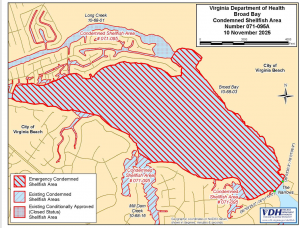
RICHMOND, Va. – The Virginia Department of Health announced today that portions of Broad Bay are closed to shellfish harvesting due to a sewage release that occurred on November 8, 2025.  Because these waters can be contaminated with pollutants such as pathogenic bacteria and viruses, shellfish taken from the area affected by the emergency closure are currently unacceptable for consumption.  The temporary emergency closure is set to be effective from November 10, 2025, through November 30, 2025.  However, the Shellfish Safety Division will be conducting sampling and will reopen earlier if it is safe to do so.

Ingesting shellfish taken from the closed areas at this time could cause gastrointestinal illnesses including Norovirus, Hepatitis A and Shigellosis. In addition, the Virginia Department of Health urges the public to minimize exposure to the water by rinsing or washing items that come into contact with the water, including fishing gear, life vests, ropes and paddles.

A map of the affected area is posted on the Division of Shellfish Safety’s home page at www.vdh.virginia.gov/Shellfish/.  The affected shellfish are filter-feeding bivalve mollusks including oysters and clams but not crabs or fin fish.

###


Central Shenandoah Health District Wellness 101: Your College Syllabus for a Safe and Healthy School Year

August 4, 2025
Media Contact: Rachel Dumene, Rachel.dumene1@vdh.virginia.gov, 540-480-4998

Central Shenandoah Health District Wellness 101: Your College Syllabus
for a Safe and Healthy School Year

STAUNTON, Va.– Going off to college is an exciting time for many young adults and learning to take care of your health is as important as any required course. The Central Shenandoah Health District (CSHD) is offering tips for physical, sexual, and mental wellness this school year.

Living in close quarters, often combined with poor diets and sleep schedules, puts college students at an increased risk for infections and diseases including:

  • Meningitis
  • Sinus infections
  • Cold and flu viruses
  • Sexually transmitted infections

Here are some ways to help students stay healthy:

Get Immunized

College students should be up to date on all school required immunizations. In addition, the Virginia Department of Health (VDH) recommends the following vaccines:

  • Meningococcal ACWY
  • Meningococcal B
  • Human Papillomavirus (HPV)
  • Hepatitis A
  • Influenza
  • COVID-19

Vaccines are available through your healthcare provider, pharmacies, and local health department during clinic hours.

Practice Healthy Hygiene Habits

  • Wash your hands frequently
  • Cover coughs and sneezes
  • Don’t share drinks
  • Stay home when you’re sick

Prioritize Sexual Wellness

  • Take steps to reduce your likelihood of coming in contact with a Sexually Transmitted Infection(STI):
    • Abstain from sexual activity or reduce your number of sexual partners.
    • Use condoms consistently and correctly every time.
  • If you are sexually active:
    • Get tested for STIs at least once a year.
    • Testing is free and confidential at certain CSHD locations throughout the year and through student health services at most colleges and universities.
    • Learn about free or low-cost medications that can prevent someone from becoming infected with HIV (PrEP) or STIs (DoxyPEP) if they are exposed.

Mental Health Matters

Think Before You Drink

Alcohol consumption affects your body and your mind. The National Institute on Alcohol Abuse (NIAA) estimates that alcohol use by college students is a factor in more than 1,500 deaths, nearly 700,000 assaults and most sexual assaults involving college students. If you choose to drink do so in moderation and understand the risks.

Mount Rogers Health District Launches Mobile Units to Expand Health Services

July 1, 2025
Media Contact: Brianne Kilbourne, Mount Rogers Health District 276-781-7450

Mount Rogers Health District Launches Mobile Units to Expand Health Services

MARION, Va. — Local officials, health professionals, and community partners recently gathered at Marion Senior High School to celebrate the official ribbon cutting of two new mobile health units that will bring essential services directly to communities across all eight localities of the Mount Rogers Health District.

The two mobile units were funded through a multi-year grant from the Opioid Abatement Authority (OAA) and represent a collaboration between all eight localities in the district as well as the Mount Rogers and Highlands Community Services Boards. The partnership to obtain the motorized vehicles mark a major step in addressing the region’s ongoing challenges related to substance use, behavioral health, and access to care.

“These units enable us to meet people where they are, especially in areas where transportation, stigma, or scheduling conflicts have made it difficult for individuals to access traditional clinic services,” said Dr. Meagan Helmick, Health Director for the Mount Rogers Health District.

Each mobile unit will be jointly staffed by the Mount Rogers Health District and Community Services Board personnel and will provide a wide range of services, including:

  • HIV, hepatitis A, B, and C, and STI testing
  • Harm reduction services (naloxone distribution and fentanyl/xylazine test strips)
  • Immunizations
  • Hepatitis C treatment
  • Mental health and substance use counseling
  • Psychiatric medication management
  • Referrals and wraparound case management

The region served by the Mount Rogers Health District has long faced elevated rates of substance use disorder, hepatitis C, poverty, and overdose burden compared to the rest of the state. In 2021 alone, the eight localities represented had a combined economic burden from opioids of nearly $96 million. The mobile units reflect a data-driven, community-informed response that emphasizes prevention, education, and connection to care.

Since the recent launch, health officials continue to refine operations as they learn during each stop. The program aims to be both responsive and sustainable, with services billed through existing clinical systems and continued pursuit of additional grant opportunities.

“This is just the beginning,” said Dr. Helmick. “We are deeply hopeful about what this can mean for individuals and families across our region.”

To learn more about the mobile units, including the staff and schedule for each, visit www.MRHD.org and click on “Integrative Health Servies-Mobile Unit.”

RHHD Encourages Testing for Hepatitis

May 19, 2025
Media Contact: Bryan Hooten, 804-807-1727, bryan.hooten@vdh.virginia.gov

 RHHD Encourages Testing for Hepatitis
Hepatitis Testing Day is May 19

RICHMOND, Va. —Richmond and Henrico Health Districts (RHHD) encourage community members to get tested for hepatitis. All adults 18 years and older should be screened for hepatitis B and C at least once in their lifetime. Pregnant people should get tested during each pregnancy. Hepatitis Testing Day is May 19.

Hepatitis means inflammation of the liver, a vital organ that processes nutrients, filters the blood, and fights infections. Heavy alcohol use, toxins, some medications, and certain medical conditions can affect liver function and can cause hepatitis. However, hepatitis is often caused by a virus. In the U.S., the most common types of viral hepatitis are hepatitis A, hepatitis B, and hepatitis C.

“For many people, getting tested is the only way to know you have hepatitis B or C – diseases that can have serious consequences for your overall health and can spread to those close to you,” said Richmond and Henrico Health Districts Deputy Director Melissa Viray, M.D. “The good news is that we have safe and effective vaccines and/or treatments for the most commonly seen types of viral hepatitis.”

Symptoms of all types of viral hepatitis are similar and can include one or more of the following:

  • Dark urine or clay-colored stools
  • Diarrhea (hepatitis A only)
  • Feeling tired
  • Fever
  • Joint pain
  • Loss of appetite
  • Nausea, stomach pain, throwing up
  • Yellow skin or eyes (jaundice)

Symptoms of chronic viral hepatitis can take decades to develop.

Individuals can reduce their risk of getting sick by taking the following precautions:

  • Get tested – all adults 18 years and older should be screened for hepatitis B and C at least once in their lifetime. Pregnant people should get tested during each pregnancy.
  • Avoid sharing or reusing needles, syringes or any other equipment used to prepare and inject drugs, steroids, hormones, or other substances.
  • Avoid using personal items that may have come into contact with an infected person’s blood, even in amounts too small to see, such as glucose monitors, razors, nail clippers, or toothbrushes.
  • Avoid getting tattoos or body piercings from an unlicensed facility or in an informal setting.

Individuals can receive vaccines for hepatitis A and B and can be screened for hepatitis B or C at their health care provider or at any of RHHD’s clinic locations. For more information about RHHD clinical services and to schedule an appointment, call 804-205-3500. Individuals can also find a testing site at the following link: CDC testing site locator. People who haven’t yet been screened for viral hepatitis or who are at additional risk for contracting the Hepatitis B or C should consult a medical provider about testing options.

Many people who become infected with hepatitis B or C do not experience symptoms and are unaware that they have the virus. CDC advises that for hepatitis C there are oral medications (pills) available called direct-acting antivirals (DAAs) that are easy to take, have very few side effects, and cure more than 95% of people in just 8–12 weeks.

Viral hepatitis can spread from a birthing parent to the infant. Infants born with a Hepatitis B infection have a 90% chance of developing a chronic version of the disease. If a pregnant person tests positive for Hepatitis B, their medical team can prepare to reduce the chance of the virus passing to the baby.

According to VDH data on communicable diseases, hepatitis C and B are in the top five most reported conditions in Virginia (excluding COVID-19) over the last five years. In Virginia, students are required to complete the hepatitis A and the hepatitis B vaccination series as part of routine school immunizations. There is no vaccine for hepatitis C.

For more health and safety information, visit rhhd.gov and sign up for RHHD’s monthly newsletter at rhhd.gov/news.

###

Halifax County Health Department Offering Hepatitis A Vaccine

October 7, 2024
Media Contact: Brookie Crawford, brookie.crawford@vdh.virginia.gov

Halifax County Health Department Offering Hepatitis A Vaccine

HALIFAX, Va. – The Halifax County Health Department has a limited number of hepatitis A vaccines that it is providing free to the public. If you are interested in obtaining a free hepatitis A vaccine, please contact the Halifax County Health Department at 434-476-4863.

Hepatitis A, sometimes referred to as viral hepatitis, is a disease of the liver caused by the hepatitis A virus (HAV). This contagious virus is spread through close person -to-person contact or by eating or drinking contaminated food or drink. Usually the virus, in healthy individuals, causes a mild, short-term illness which could last from several weeks to several months. However, in some individuals this virus can be very serious.

The best way to prevent hepatitis A is by getting vaccinated against the virus. The hepatitis A vaccine series consists of two injections six months apart.

Vaccination is highly recommended for individuals at high risk of hepatitis A infection, including:

  • Persons traveling to countries with high or intermediate endemicity of hepatitis A (e.g., tourists, immigrants and their children returning to their country of origin to visit friends or relatives, military personnel, missionaries, and others who work or study abroad),
  • MSM (men who have sex with men),
  • Injecting and non-injecting drug users,
  • Persons who live in communities with high rates of hepatitis A (e.g., American Indian, Alaska Native, and Pacific Islander communities and some religious communities),
  • Homeless individuals,
  • Persons who work with non-human primates,
  • Persons with clotting factor disorders, such as Hemophilia, or chronic liver disease,
  • People who have sexual contact with someone who has Hepatitis A, and
  • Any person who wishes to be immune to Hepatitis A.

For more information, please contact the Halifax County Health Department at 434-476-4863.

# # #

Mount Rogers Health District Offers Free Tetanus and Hepatitis A Vaccines  

October 2, 2024
Media Contact: Brianne Kilbourne, 276-781-7450

Mount Rogers Health District Offers Free Tetanus and Hepatitis A Vaccines

MARION, Va. – The Mount Rogers Health District is offering free Tetanus, Diphtheria, Pertussis (Tdap) and Hepatitis A vaccines to those adults 19 years and older affected by the flooding, responding to emergency situations, or those assisting with the recovery.

Tetanus, sometimes called “lockjaw,” can cause symptoms such as fever, jaw cramping, muscle spasms, and seizures. Tetanus bacteria is found naturally in soil. If you wade through flood water, you could encounter sharp objects and sustain an injury that allows the tetanus bacteria to enter your body. Although tetanus infection is rare, it can be very serious or even fatal.

The best way to prevent infection is to be vaccinated prior to exposure, which is why all adults should receive tetanus shots every 10 years. However, tetanus vaccination is still effective if given within 48 hours after an injury.

You may need a tetanus booster shot if:

  • It has been more than 10 years since your last tetanus vaccination.
  • You have a puncture wound and it has been more than five years since your last tetanus vaccination.
  • You have a wound that has come in contact with flood water, and it has been more than five years since your last tetanus vaccination.

Hepatitis A is a disease of the liver caused by the hepatitis A virus (HAV). HAV infection usually causes a mild, short-term illness, is contagious, and spreads through close person-to-person contact and eating contaminated food or drink. Vaccination is the best way to prevent infection.

You may need a dose of hepatitis A vaccine if:

  • You are living, working, or preparing food in a shelter.
  • You are providing medical or personal care to displaced residents.
  • You are working in a jail, prison, detention center, or law enforcement capacity.
  • You are functioning as a first responder.

Hepatitis A immunization is not indicated for those engaged in clean-up or those exposed to flood waters. There is no increased risk of hepatitis A in sewer workers or those working in flood waters. If you have had the two-dose series of hepatitis A, no booster is needed.

Vaccines will be offered during the following dates and times:

Tetanus and Hepatitis A Vaccines

Wednesday, October 2 and Thursday, October 3 – 11 a.m. – 2 p.m.

Grayson Highlands School, 6459 Troutdale Highway, Troutdale

Mount Rogers Fire and Rescue Building, 51 Firehouse Road, Whitetop

Brookside Baptist Church, 5523 Sugar Grove Highway (Highway 16), Sugar Grove


Wednesday, October 2 and Thursday, October 3 – 9 a.m. – 5 p.m.

Town Park, 202 South Beaver Dam Ave., Damascus


Thursday, October 3, Noon – 4:30 p.m. and Friday, October 4, 8 a.m. – 4:30 p.m.

Bristol City Health Department, 341 Piedmont Ave., Bristol

Bland County Health Department, 209 Jackson St., Bland

Carroll County Health Department, 605 Pine St., Suite 15, Hillsville

Galax City Health Department, 502 S. Main St., Galax

Grayson County Health Department, 186 West Main St., Independence

Smyth County Health Department., 201 Francis Marion Lane, Marion

Washington County Health Department, 15068 Lee Highway, Suite, 1000, Bristol

Wythe County Health Department, 290 S. 6th St., Suite 300, Wytheville

If you’re not sure if you need a tetanus or hepatitis A vaccine, contact your primary care provider or your local health department. For more information on immunization, visit: www.vdh.virginia.gov/immunization/.

VIRGINIA DEPARTMENT OF HEALTH CLOSES A PORTION OF COCKRELL’S CREEK TO SHELLFISH HARVESTING

January 16, 2023
Media Contact:
Larry Hill, Eastern Region PIO, larry.hill@vdh.virginia.gov

Virginia Department of Health Closes a Portion of Cockrell’s Creek to Shellfish Harvesting

(RICHMOND, Va.)— The Virginia Department of Health announced today that Cockrell’s Creek in Northumberland County is closed to shellfish harvesting due to a sewage release.  Because these waters can be contaminated with pollutants such as pathogenic bacteria and viruses, shellfish taken from the area affected by the emergency closure are currently unacceptable for consumption.  The temporary emergency closure is effective beginning January 12, 2024.

Ingesting shellfish taken from the closed areas at this time could cause gastrointestinal illnesses including Norovirus, Hepatitis A and Shigellosis. In addition, the Virginia Department of Health urges the public to minimize exposure to the water by rinsing or washing items that come into contact with the water, including fishing gear, life vests, ropes and paddles.

A map of the affected area is posted on the Division of Shellfish Safety’s home page at www.vdh.virginia.gov/Shellfish/.  The affected shellfish are filter-feeding bivalve mollusks including oysters and clams, but not crabs or fin fish.