
PrEP Works! Read About the Newly Released PrEP Study
A new, major, real-world study has confirmed that PrEP (pre-exposure prophylaxis) for HIV is good – and the more it is used the better!
The study is a large, long-term, state-by-state analysis published in the Lancet HIV. It measured PrEP use, viral suppression, and trends in HIV diagnoses in all U.S. states and the District of Columbia using a nationwide commercial pharmacy database. Then, they calculated PrEP coverage and HIV diagnoses by state for each year from 2012 through 2022. States were grouped into quintiles by their degree of change in HIV diagnoses rates.
After controlling for state-specific viral suppression, the authors calculated state- and national-level associations of PrEP coverage with HIV diagnoses rates.
Key Findings
-
- From 2012 to 2022, the average PrEP coverage across the U.S. increased significantly from 0.6% to 26.3%
- During the same time period, HIV diagnoses rates decreased from 13.0 to 10.6 per 100,000 population
- States with higher PrEP coverage experienced greater decreases in HIV diagnoses
- Geographic areas with greater PrEP coverage had gradually larger declines in HIV diagnoses
View a full analysis of the study from TheBodyPro.com that includes an expert analysis from a medical provider, practical takeaways, and impacts for the future.
For any questions or needs regarding the VDH PrEP Program, please contact Eric Mayes, PrEP Coordinator, at eric.mayes@vdh.virginia.gov or (804) 763-9506.
Updated CDC 2025 nPEP Guidelines
Updated guidelines for nonoccupational postexposure prophylaxis (nPEP) for HIV were released by the Centers for Disease Control and Prevention (CDC) on May 8.
Notable changes, highlights and considerations include:
-
- Preferred regimen options for those ≥ 12 years old
- Biktarvy (bictegravir, emtricitabine and tenofovir alafenamide), a single tablet of three antiretroviral medications OR
- Dolutegravir PLUS tenofovir disoproxil fumarate or tenofovir alafenamide PLUS emtricitabine or lamivudine
- This includes the previously preferred regimen of dolutegravir (Tivicay) PLUS emtricitabine and tenofovir disoproxil fumarate (Truvada).
- Timing of nPEP
- There is greater emphasis on the urgency to start nPEP as soon as possible, ideally within 24 hours of exposure, and up to 72 hours.
- Follow up testing is no longer recommended at 6 months
- After baseline testing is done, repeat testing is recommended at 4-6 weeks and at 3 months.
- HIV testing – add HIV-1 RNA testing to HIV Ag/Ab testing
- At 3 months follow up visit
- At baseline and 4-6 weeks follow up visit if the exposed person has been on long-acting injectable PrEP in the last 12 months.
- Exposed person
- If the exposed person was taking and adhering to PrEP, they may not need nPEP.
- If the exposed person has ongoing indications, make a transition plan to start PrEP when they complete their nPEP regimen at 4 weeks.
- Source person
- If the source person has HIV with an undetectable viral load (< 200 copies/ml for at least 6 months), they will not transmit HIV sexually, so nPEP may not be needed.
- If the source person does not know their HIV status and agrees to testing, if their HIV test comes back negative, the exposed person can stop taking nPEP.
- Preferred regimen options for those ≥ 12 years old
The CDC previously released nPEP guidelines in 2016 and 2005. For more details, please refer to the CDC Recommendations, 2025.
Jenny Calhoun, HIV/STI Nurse Consultant, is revising the VDH guidelines for nPEP to incorporate these updates. If you have any questions, please contact Jenny at jenny.calhoun@vdh.virginia.gov or (804) 910-7000.
Reminder: Order CDC Print Materials before Deadline
The Centers for Disease Control and Prevention (CDC) offered free printed materials to their partners and the public through a Publications Warehouse for many years. The demand for printed materials has declined and a focus on electronic materials has increased. As a result, CDC is ending this service and closing their warehouse.
The last day to place orders for printed materials from the CDC Publications Warehouse is August 15, 2025. The warehouse will close in September. Note: This is an update/clarification from last month’s e-bulletin.
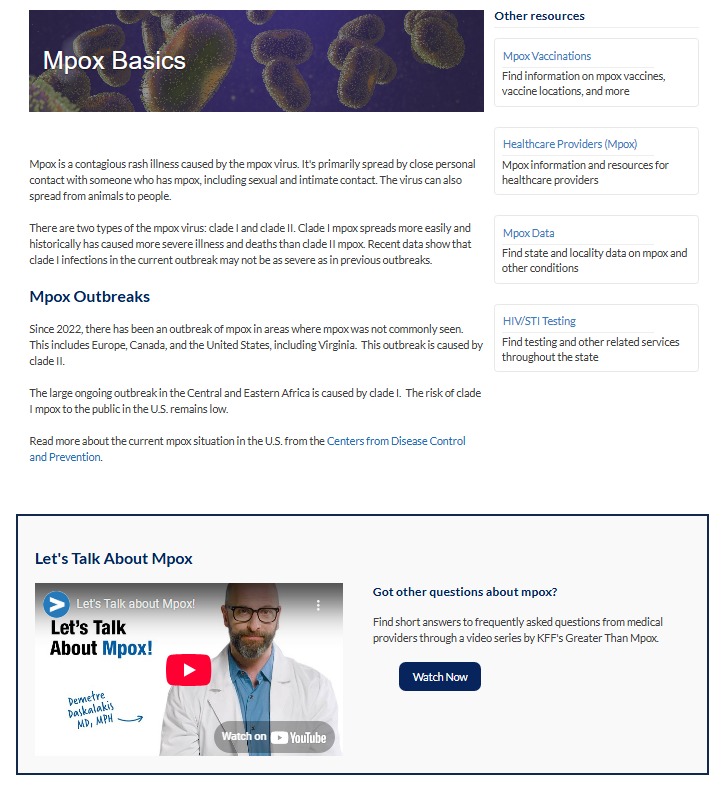
VDH Mpox Webpages to Join DDP Website
The mpox webpages will be joining the DDP website. The vanity URL of www.vdh.virginia.gov/mpox will continue to work and will redirect to the main mpox webpage. The new pages will have a new look and some may function differently. However, all information and resources will still be available. The projected timeframe for the new pages is by the end of June.
See a draft screen capture of the new site adjacent of this announcement.
New Web Link for Virginia Transgender Resource & Referral List
The Virginia Transgender Resource & Referral List has been updated and is now available on the DDP website. You can access the list via its direct link. The list is organized alphabetically and grouped by region.
Additionally, a link to the form for service providers who wish to be added to the Transgender Resource & Referral List can be found on the Transgender Health Services & Support page.
If you have any questions, please contact Ted Heck at ted.heck@vdh.virginia.gov or (804) 845-1722.
Personnel Announcements
Departures
Kaity Hauter departed VDH on June 3. She started with DDP in 2019, first with HIV and Hepatitis Prevention and then transitioned to STD Prevention and Surveillance. She spent the past three years with the Disease Intervention Specialist and Regional STD Program Coordinator team working on syphilis and HIV cases. She expressed how much she enjoyed her time at VDH and working with phenomenal teammates across many projects. DDP provided mentorship and growth that sparked more interests and skill-building opportunities than she could have anticipated when she began her VDH journey. Kaity expressed that her new role working with the Ministry of Health of Guyana is exciting, but bittersweet as she will miss her wonderful colleagues.
HIV and Hepatitis Surveillance Staff Updates
The CDC Medical Monitoring Project (MMP) has ended. Virginia was one of 23 jurisdictions funded to implement the project. MMP collected data on behavior, clinical outcome and barriers to care for PWH. The last day for all VDH MMP staff was May 31, 2025. The MMP team included Erik Jarvis, Moses Harris, Katie Kallenbach, Doug Kurnel, and Kywuan Bullock. For questions related to MMP please contact Jenny Kienzle at jennifer.kienzle@vdh.virginia.gov.
Miesha Houston’s last working day was May 30. Data to Care (D2C) will continue, but at a limited capacity. HHS will mainly rely on the sites that conduct their own follow up on the out of care lists that HHS provides. For questions related to D2C please reach out to Lauren Maxwell at L.maxwell@vdh.virginia.gov.
Alyssa McGinnis’ last day was May 15, 2025. Alyssa was supporting the HIV Data Support team. For HIV Data support questions please reach out to Margie Alexander at margie.carter@vdh.virginia.gov.
We thank these colleagues for their excellent work and dedication to DDP’s mission. We wish them much success in their futures.
![]()
Subscription Preferences
Join the DDP E-bulletin Mailing List
Manage Preferences | Subscriber Help