Consumer Confidence Reports (CCR)

Community waterworks must distribute an annual drinking water quality report, known as the CCR, to their customers and to the Office of Drinking Water, by July 1st each year.  Updated guidance on optional electronic delivery can be found in the CCR Electronic Delivery Guidelines and updated guidance on CCR Preparation can be found in the Preparation Guidelines.  The Office of Drinking Water will review draft CCRs sent to field offices before May 1.

The deadline for wholesalers to provide their CCR information to their consecutive waterworks is April 1st each year.

Each Community Waterworks must certify to the Office of Drinking Water how and when the CCR was distributed.  Certifications must be submitted to the Office of Drinking Water by October 1st each year.  Here is the link to the CCR certification form

For more information, visit our CCR webpage here.

Joint Cybersecurity Advisory: Iranian-Affiliated Cyber Actors Exploit Programmable Logic Controllers Across US Critical Infrastructure to Cause Disruption

Overview

The Federal Bureau of Investigation (FBI), Cybersecurity and Infrastructure Security Agency (CISA), National Security Agency (NSA), and Environmental Protection Agency (EPA) are urgently warning U.S. organizations of ongoing cyber exploitation of internet-connected operational technology (OT) devices, including Rockwell Automation/Allen-Bradley-manufactured programmable logic controllers (PLCs), across multiple U.S. critical infrastructure sectors.

Recommended Actions

EPA recommends water and wastewater systems review the tactics, techniques, and procedures (TTPs) and indicators of compromise (IOCs) in this advisory for indications of current or historical activity on their networks, and apply the recommended immediate steps to prevent the attack:

  • Limit PLC exposure to the public-internet
  • Ensure PLCs are in run mode to prevent remote modification
  • Replace all default passwords on PLCs and OT with strong, unique passwords

Water systems are encouraged to review and implement the additional follow-up steps included in the advisory to further strengthen their cybersecurity posture.

Technical Assistance

If you have questions about any of the information in this alert, including assistance with the mitigation steps, submit a request to EPA’s Cybersecurity Technical Assistance Program for the Water Sector.

Report an Incident

Organizations are encouraged to report information concerning suspicious or criminal activity to FBI Internet Crime Complaint Center (IC3) at IC3.gov or to CISA via CISA’s Incident Reporting System.

Access Advisory Here

Virtual Training for Small Systems

The Environmental Finance Center Network is hosting a small systems training on April 1st, 2026, if you would like to register, please fill out the following form here.

A brief description of the training can be found below or via their flyer from the link here.

Running a small system can be challenging. Along with meeting regulatory obligations and
satisfying customer expectations, you may have issues with aging infrastructure, lack of
personnel, and limited financial resources. Furthermore, small systems often cost more to
operate per capita than large systems because of economy of scale. This can further
complicate operations.
One strategy to address these challenges is to work with other utilities or consider
partnership options. In this training, we will discuss various regionalization models and
approaches to collaboration:
• Informal information sharing
• Sharing equipment or personnel
• Leveraging shared purchasing power
• Emergency planning and networking
• Joint Service Agreements

ODW Newsletter

The April 2026 ODW Newsletter goes over several important topics highlighted below:

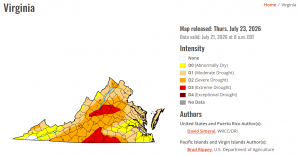
Drought and Fire Risk Information

2025 CCR Information: Due July 1st 2026

Lead and Copper News

VDEM Announces Application Period for FY24 and FY25 Building Resilient Infrastructure and Communities (BRIC)

ODW at VRWA Conference on April 20-22 in Roanoke, VA

More information on all these topics can be found in the April 2026 Newsletter.

A link to previous ODW Newsletters and bulletins can be found here.

Late Reporting of Monitoring Results

Reminder: Waterworks are required to submit monitoring results to ODW by the 10th of the month following the month during which the sample result was received, or the 10th of the month following the end of the monitoring period, whichever is shorter. (See 12VAC5-590-530 A of the Waterworks Regulations.) Laboratory reports are considered to be reported to ODW when they are successfully received in ODW’s Safe Drinking Water Information System (SDWIS) database. Laboratories are required to report sampling results through the Compliance Monitoring Data Portal (CMDP). Other attempted methods of reporting sampling results are not valid for compliance with the Waterworks Regulations.
To help prevent waterworks from receiving a Notice of Alleged Violation from ODW for late reporting, waterworks should communicate with their laboratory about the sample collection and reporting process. This includes engaging with the laboratory about when in the monitoring period samples should be taken so they can be analyzed and reported by the laboratory through CMDP prior to the deadline in the Waterworks Regulations. Ultimately, the waterworks is responsible for timely reporting.

Nationwide Verizon Outage

CIR: CIR 7.1.A – Cellular infrastructure outage, or imminent outage, impacting, or with the potential to impact, public safety, public health, and/or critical infrastructure

Incident Date/Time: 01-14-2026 12:27

Information Authority: SWIC

Localities Affected: United States (Country-Wide)

Incident Location: USA

Incident Summary: Verizon is experiencing an intermittent outage, impacting major cities nationwide. Approximately 177,000 users are affected, with many devices displaying SOS Mode. Unknown cause of the outage with unknown restoration time. Other US based cell carriers (T-Mobile, AT&T, and US cellular) are starting to service impacts to their customers.

Winter Weather Preparedness

Winter storms can bring a combination of freezing temperatures, snow, ice, and extended power outages that pose significant challenges to water systems. Even brief periods of extreme cold can impact treatment processes, freeze exposed equipment, limit staffing, and disrupt transportation and chemical deliveries. Preparing now helps ensure continued safe operation and reliable service throughout the winter season.

Key preparedness reminders for waterworks:

  • Inspect and protect vulnerable equipment such as exposed pipes, meters, chemical feed lines, and outdoor instrumentation.
  • Verify backup power systems and ensure fuel, generators, and transfer switches are ready for potential outages.
  • Confirm employee call-down lists and ensure staff understand inclement weather reporting procedures.
  • Review chemical inventory and resupply plans in case road conditions delay deliveries.
  • Coordinate with local emergency management and monitor updates from the National Weather Service.

Prepare for customer impacts such as frozen service lines and potential low-pressure events

Being proactive with winter storm readiness supports operational resilience, protects infrastructure, and ensures the continued delivery of safe drinking water to Virginia communities. More information on winter weather and emergency preparedness can be found here.

Lead and Copper Rule Revisions Guidance

EPA has introduced the Lead and Copper Rule Revisions (LCRR) and Lead and Copper Rule Improvements (LCRI). ODW staff have compiled resources for utilities to ensure they properly implement the rule changes and additions.

Information can be found here