
Paul Coverdell National Acute Stroke Program 
Named in honor of the late Senator Paul Coverdell of Georgia, the Paul Coverdell National Acute Stroke Program ("Coverdell") is funded by the Centers for Disease Control (CDC).
2024 - 2029 Grant Cycle
Virginia was awarded the 5-year Coverdell grant in summer 2024. This grant cycle aims to improve quality in stroke prevention and care along the stroke continuum of care with a focus on individuals at highest risk of stroke.
Strategies Include:
- Preventing strokes through hypertension detection and control,
- Improving stroke care through enhanced data collection, and
- Strengthening linkages between clinical and community resources for those at the highest risk of stroke.
Intended Outcomes:
- Lower number of stroke events in Virginia,
- Lower number of stroke events among African American males, and
- Increase the number of individuals at highest risk of stroke who are referred to and access social service and support needs.
Through Coverdell, the Virginia Department of Health is implementing the Virginia Stroke Continuum Program. This program will focus on strengthening continuity of stroke care within census tracts where the stroke crude prevalence is 150% greater than the stroke crude prevalence of the corresponding county or city.
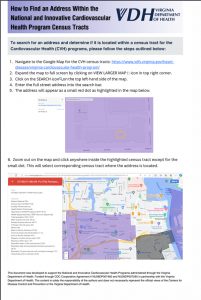
Click here to find a single address prioritized in the Coverdell grant in the map above:
The first cohort, starting in spring 2025, includes the cities of Newport News, Norfolk, and Richmond. VDH will expand to additional cities starting in grant year Year 2 (fall 2025). Click below to see each city's work within the Virginia Stroke Continuum Program.