Virginia Infection Prevention & Control Training Alliance (VIPTA)

Upcoming Events


Contact Precautions Featuring Acinetobacter Promotional Image with Smiling Woman and Microscope

Short Training Videos from Virginia Infection Prevention Training Center (VIPTC)

VIPTC developed a series of infection prevention and control (IPC) educational videos for healthcare workers.  

  • Short videos (3-6 minutes in length) 
  • Fun and visually engaging for a fresh take on IPC topics 

Ways to Share this Resource

  • Great nuggets to drop into quick meetings, huddles, emails, or trainings 
  • Perfect for sharing during International Infection Prevention Week (October 15-21) 

Target Audience: Foundational to Intermediate IPC Education Levels 

Videos


Guidance, Recommendations, & Regulatory Updates

VIPTA members track guidance and regulation resources to share source documents that guide infection prevention and control practices for public health staff and clinical and non-clinical healthcare personnel.

The date of the regulation or guidance update is included in each post.  Please check linked content to be sure it is the most up to date and recommended practice.

CDC: Conjunctivitis (09/11/2026)
CDC
Any Practice Setting
The CDC recommends excluding healthcare personnel with suspected or confirmed infectious conjunctivitis, including epidemic keratoconjunctivitis (EKC), from work for the duration of their symptoms. These recommendations emphasize strict hand hygiene, appropriate cleaning and disinfection of surfaces and shared medical equipment, and prompt identification and management of cases to prevent transmission and healthcare-associated outbreaks.
CDC: Viral Respiratory Infections (09/11/2026)
CDC
Any Practice Setting
The CDC provides updated recommendations for managing healthcare personnel exposed to or infected with viral respiratory infections, including work restrictions, symptom monitoring, and source control. Asymptomatic exposed personnel may continue working with source control through at least five days after their last exposure, while infected personnel should be excluded from work for at least three days and meet additional symptom-based return-to-work criteria, followed by source control through at least day seven.
CDC: Preventing Respiratory Infections in the Workplace (08/28/2026)
CDC
Any Practice Setting
The CDC provides recommendations to help employers prevent and respond to respiratory infections in the workplace through improved ventilation, engineering controls, environmental cleaning and disinfection, and policies that encourage sick employees to stay home.  These recommendations also emphasize using respiratory illness surveillance data to inform workplace prevention strategies, including masking and remote work, to reduce transmission and protect employee health.

Society for Healthcare Epidemiology of America (SHEA)

Infection Prevention and Control of Candida auris in Pediatric Settings (6/23/2026) The guidance recommends identifying at-risk pediatric patients through targeted screening, using appropriate isolation and room-placement precautions, and coordinating closely with infection prevention and public health partners when Candida auris is suspected or confirmed. It also emphasizes prevention through meticulous hand hygiene, effective environmental cleaning and disinfection, and careful...


Taking Antimicrobial Stewardship Beyond Hospital Walls: Community Outreach for Smarter Antibiotic Use 

In an innovative effort to extend antimicrobial stewardship beyond the hospital setting, Carilion Clinic’s Antimicrobial Stewardship (AMS) team launched a community outreach initiative aimed at educating families about appropriate antibiotic use. Patient expectations play a key role in outpatient antibiotic prescribing. Meaningful conversations between patients and providers around antibiotic necessity are needed. 

Carilion aimed to deliver accessible messaging through visually engaging billboards across southwest Virginia, reinforcing public health messages such as “Antibiotics don’t work on viruses” and “Antibiotics aren’t always the answer when you are sick.” Complementary posters in clinic waiting rooms provided patients and families with quick education, addressing common misconceptions about antibiotics for viral infections and raising awareness about potential antibiotic harms. 

To further support their youngest patients, the AMS team partnered with a large pediatric practice to distribute “fever care kits” to improve at-home temperature tracking and symptom relief. Each kit contained a thermometer, simple symptom relief items, and an educational bookmark on fever and infections. These tangible resources helped empower caregivers to manage mild illnesses confidently at home and understand when antibiotics and healthcare visits might be unnecessary.

Early feedback from clinicians has been overwhelmingly positive, many of whom reported that these initiatives facilitated more productive conversations with patients about antibiotics. By bringing stewardship principles directly into the community, this is one more way Carilion’s AMS team is helping to reduce antibiotic misuse, slow the development of resistance, and preserve antibiotics’ effectiveness for future generations. 
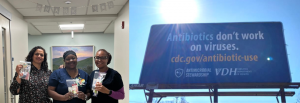
Carilion Clinic’s Antimicrobial Stewardship (AMS) team


IPC Education & Training Library

Search the VIPTA library of curated infection prevention and control (IPC) education and training resources. The IPC Education & Training Resource Library includes state and national resources related to healthcare-associated infections, antimicrobial resistance and/or IPC. Visit the VIPTA FAQ page to learn more about VIPTA library content.


Connect With VIPTA