Virginia Infection Prevention & Control Training Alliance (VIPTA)

Upcoming Events


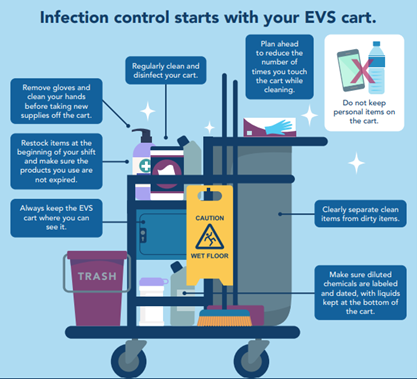
Infection Control Starts with your EVS Cart

It’s Not Just a Room Turnover: It’s Infection Prevention 

Did you know that patients admitted to rooms where the previous occupant had a multidrug-resistant organism (MDRO) face a higher risk of acquiring that same organism? Every day, environmental services (EVS) professionals work alongside frontline healthcare staff to reduce this risk and protect patients and residents. When we support EVS teams, we strengthen the entire infection prevention system.

What to Expect and How to Use It: With some EVS staff receiving as little as three days of training, and 83% learning on the job, education needs to be quick, practical, and built into their daily workflow.

  • Onboarding: Project Firstline Training Toolkit for Environmental Services (EVS) Staff – A comprehensive training plan that builds both the why and the how, helping EVS staff confidently step into their role as essential infection prevention team members.
  • New Refreshers: CDC EVS Microlearns – Quick, practical micro-learns covering key topics like contact time, when to change gloves, and maintaining clean and safe EVS carts, perfect for reinforcing skills in just a few minutes.
  • New Observation & Support: VDH Daily Room Cleaning Checklist – A simple, structured checklist to guide room cleaning from start to finish, helping standardize workflows and ensure no critical steps are missed.

Target Audience: Essential IPC Education Level


Guidance, Recommendations, & Regulatory Updates

VIPTA members track guidance and regulation resources to share source documents that guide infection prevention and control practices for public health staff and clinical and non-clinical healthcare personnel.

The date of the regulation or guidance update is included in each post.  Please check linked content to be sure it is the most up to date and recommended practice.

CDC: Conjunctivitis (09/11/2026)
CDC
Any Practice Setting
The CDC recommends excluding healthcare personnel with suspected or confirmed infectious conjunctivitis, including epidemic keratoconjunctivitis (EKC), from work for the duration of their symptoms. These recommendations emphasize strict hand hygiene, appropriate cleaning and disinfection of surfaces and shared medical equipment, and prompt identification and management of cases to prevent transmission and healthcare-associated outbreaks.
CDC: Viral Respiratory Infections (09/11/2026)
CDC
Any Practice Setting
The CDC provides updated recommendations for managing healthcare personnel exposed to or infected with viral respiratory infections, including work restrictions, symptom monitoring, and source control. Asymptomatic exposed personnel may continue working with source control through at least five days after their last exposure, while infected personnel should be excluded from work for at least three days and meet additional symptom-based return-to-work criteria, followed by source control through at least day seven.
CDC: Preventing Respiratory Infections in the Workplace (08/28/2026)
CDC
Any Practice Setting
The CDC provides recommendations to help employers prevent and respond to respiratory infections in the workplace through improved ventilation, engineering controls, environmental cleaning and disinfection, and policies that encourage sick employees to stay home.  These recommendations also emphasize using respiratory illness surveillance data to inform workplace prevention strategies, including masking and remote work, to reduce transmission and protect employee health.

Society for Healthcare Epidemiology of America (SHEA)

Infection Prevention and Control of Candida auris in Pediatric Settings (6/23/2026) The guidance recommends identifying at-risk pediatric patients through targeted screening, using appropriate isolation and room-placement precautions, and coordinating closely with infection prevention and public health partners when Candida auris is suspected or confirmed. It also emphasizes prevention through meticulous hand hygiene, effective environmental cleaning and disinfection, and careful...


Celebrating One Year Without a Catheter-Associated Urinary Tract Infection!

On Thursday October 12, 2023, the Infection Prevention and Nursing leadership teams at Henrico Doctors’ Hospital rounded on the nursing units to celebrate achieving one year without a catheter-associated urinary tract infection (CAUTI)!  Cupcakes (yellow frosted, of course) were distributed to all and many thanks shared with the teams. The entire hospital has been instrumental in reducing CAUTIs at Henrico Doctors’ Hospital.

It starts in the Emergency Department with urinary catheters only being placed when absolutely necessary, then responsibility moves to the inpatient units where daily conversations are held to assess the need for the catheter.  Infection Prevention reviews urinalysis and urine culture orders on patients with catheters, ensuring good culture stewardship.  Physicians are engaged with the infection prevention and nursing teams in the conversations about catheter and urine culture necessity. This excellent teamwork has led to a reduction in CAUTIs and the achievement of being one-year CAUTI free! 


IPC Education & Training Library

Search the VIPTA library of curated infection prevention and control (IPC) education and training resources. The IPC Education & Training Resource Library includes state and national resources related to healthcare-associated infections, antimicrobial resistance and/or IPC. Visit the VIPTA FAQ page to learn more about VIPTA library content.


Connect With VIPTA