Virginia Infection Prevention & Control Training Alliance (VIPTA)

Upcoming Events


Infection Control Starts with your EVS Cart

It’s Not Just a Room Turnover: It’s Infection Prevention 

Did you know that patients admitted to rooms where the previous occupant had a multidrug-resistant organism (MDRO) face a higher risk of acquiring that same organism? Every day, environmental services (EVS) professionals work alongside frontline healthcare staff to reduce this risk and protect patients and residents. When we support EVS teams, we strengthen the entire infection prevention system.

What to Expect and How to Use It: With some EVS staff receiving as little as three days of training, and 83% learning on the job, education needs to be quick, practical, and built into their daily workflow.

  • Onboarding: Project Firstline Training Toolkit for Environmental Services (EVS) Staff – A comprehensive training plan that builds both the why and the how, helping EVS staff confidently step into their role as essential infection prevention team members.
  • New Refreshers: CDC EVS Microlearns – Quick, practical micro-learns covering key topics like contact time, when to change gloves, and maintaining clean and safe EVS carts, perfect for reinforcing skills in just a few minutes.
  • New Observation & Support: VDH Daily Room Cleaning Checklist – A simple, structured checklist to guide room cleaning from start to finish, helping standardize workflows and ensure no critical steps are missed.

Target Audience: Essential IPC Education Level


Guidance & Regulation Updates

VIPTA members track guidance and regulation resources to share source documents that guide infection prevention and control practices for public health staff and clinical and non-clinical healthcare personnel.

The date of the regulation or guidance update is included in each post.  Please check linked content to be sure it is the most up to date and recommended practice.

CDC: Considerations for Reducing Risk – Water in Healthcare Facilities (2/6/2026)
CDC
Any Practice Setting
Water Management
Centers for Disease Control and Prevention (CDC) Considerations for Reducing Risk: Water in Healthcare Facilities (February 6, 2026) CDC recommends establishing a water management program that identifies risk areas in a facility’s water system and implements controls to prevent harmful pathogens like Legionella. The program should be routinely monitored, documented, and adjusted to ensure it remains effective and responsive to changing conditions.
ASHRAE: Ventilation of Healthcare Facilities (2/16/2026)
Any Practice Setting
Air Quality
Ventilator
The American Society of Heating, Refrigerating, and Air-Conditioning Engineers (ASHRAE)  Ventilation of Healthcare Facilities (02/16/2026)   The 2025 edition of ANSI/ASHRAE/ASHE Standard 170 outlines minimum ventilation requirements for health care facilities, emphasizing compliance and best practices for HVAC system design.  Key updates include the option for natural ventilation, total outdoor air calculations for combined spaces, and clarified requirements for imaging and outpatient areas. 
CDC: Updated 2026 National Healthcare Safety Network (NHSN) Surveillance Protocols (January 2026)
CDC
Any Practice Setting
Department of Health
Surveillance
CDC updated the NHSN Patient Safety Component Manual, including Antimicrobial Use and Resistance (AUR) Module protocols and data definitions used for facility reporting. These updates include new documentation and reporting guidance, effective for 2026 surveillance. A summary of updates is available on the CDC website. 
APIC: New White Paper on Centralized Health-Associated Infection Surveillance Programs and Micro-Credential to Advance Centralized HAI Surveillance and Patient Safety (1/20/2026)
APIC
Any Practice Setting
Department of Health
Surveillance
This paper offers guidance and expert perspectives on implementing centralized surveillance programs for healthcare-associated infections (HAI) data within health systems, a key step toward more standardized HAI measurement and prevention. It emphasizes improving surveillance accuracy, data use, and patient safety. 
VDH: Clinician Letter: Respiratory Illness and Measles Updates for Virginia (1/21/2026)
VDH
Acute Care Hospital
Ambulatory (Outpatient) Care
Department of Health
Outbreak Investigation
Standard Precautions
Vaccination
The clinician letter reports that respiratory illness activity in Virginia has declined but influenza-related hospitalizations remain elevated, and clinicians should continue vaccination, testing, and prompt antiviral treatment for high-risk patients.   The letter also warns of ongoing measles cases and exposures in Virginia, urging clinicians to maintain a high index of suspicion, immediately isolate suspected cases, notify public health, and ensure staff and patients have documented MMR immunity.  

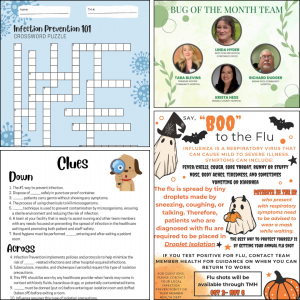
Pictures from creative skills infection prevention and control fun fair

Making Infection Prevention Fun: A Creative Skills Fair

Infection prevention is a critical topic in healthcare, but engaging staff in learning can often be challenging. Jennifer Kemp, RN, CRRN, CBIS, CIC, Infection Preventionist at Sheltering Arms Institute, a nationally ranked physical rehabilitation provider located in Richmond, Virginia, decided to break away from the traditional lecture style and bring a new level of energy and interaction to infection prevention education. Her solution? A Jeopardy-style game combined with hands-on demonstrations, and the feedback was overwhelmingly positive.

Turning Learning into a Game: With only a short time to capture attention and convey essential information, Jennifer opted for a format that encouraged participation and fun. The Jeopardy game included categories such as:

  • Isolation Signage and Precautions
  • Cleaning and Disinfection
  • Odds and Ends
  • Germ Matching 

This interactive approach kept participants engaged while reinforcing key infection prevention concepts.

Hands-On Demonstrations: To further enhance learning, Jennifer introduced practical demonstrations that allowed participants to apply their knowledge. Some highlights included:

  • Hand Hygiene with a Twist: Participants put on gloves, applied paint, closed their eyes, and sang “Happy Birthday” while performing their usual hand hygiene. The paint revealed commonly missed areas like between the fingers, around nails, and at the wrist driving home the importance of thorough technique.
  • Personal Protective Equipment (PPE) Donning and Doffing Challenge: Teams competed to correctly put on and remove PPE. This exercise exposed common errors such as incorrect sequencing and failure to tie gowns, emphasizing why attention to detail matters for safety.
  • Cleaning and Disinfection Drill: Participants cleaned shared medical equipment like vital signs monitors, learning why one wipe is not enough. This activity underscored the importance of using multiple wipes for different parts of the equipment to ensure complete disinfection.
  • Germ-to-Isolation Matching: Teams matched pathogens (e.g., MRSA, C. difficile, COVID-19) with the appropriate PPE and cleaning products. This reinforced understanding of isolation precautions and environmental cleaning requirements.

Why It Worked: The interactive format fostered teamwork, critical thinking, and practical application. Even seasoned nurses benefited by revisiting proper protocols and correcting habits that had drifted from best practice. Jennifer’s creative approach was so effective that participants called her booth the best skills fair of the year.

Jennifer’s innovative approach demonstrates that infection prevention education can be both fun and effective.


IPC Education & Training Library

Search the VIPTA library of curated infection prevention and control (IPC) education and training resources. The IPC Education & Training Resource Library includes state and national resources related to healthcare-associated infections, antimicrobial resistance and/or IPC. Visit the VIPTA FAQ page to learn more about VIPTA library content.


Connect With VIPTA