
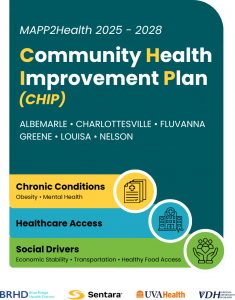
 The 2025-2028 Community Health Improvement Plan is the Blue Ridge Health District’s shared action plan for improving health across Albemarle, Charlottesville, Fluvanna, Greene, Louisa, and Nelson.
Developed in partnership with healthcare systems, local governments, community organizations, and residents, the CHIP identifies the region’s highest health priorities and outlines the collaborative strategies that partners will implement over the next three years.
The Plan is organized around three integrated goals:
- Improve Access to High-Quality, Affordable, and Responsive Health Services
- Integrate the Regional Mental Health Ecosystem
- Strengthen Community Supports for Wellbeing, Nutrition, and Economic Opportunity
Together, these goals guide 38 collaborative strategies led by healthcare systems, public health agencies, community organizations, and local partners throughout the Blue Ridge Health District.
The 2025-2028 CHIP launched on July 1, 2026, with implementation beginning immediately. This roadmap is a living, public-facing document that allows residents to stay apprised of updates in real-time. Progress updates will be published quarterly in October, January, and April, with a comprehensive annual report each July. All updates will be posted on this page and shared through the MAPP2Health newsletter.
From Community Assessment to Community Action
 Every Community Health Improvement Plan begins with a Community Health Assessment (CHA). The 2025-2028 CHIP was developed from the findings of the 2025 MAPP2Health Community Health Assessment, which identified the region’s most pressing health needs, barriers, and opportunities.
The CHA combined quantitative data from local health systems with more than 1,100 community inputs, including resident interviews, surveys, focus groups, a youth Photovoice project, and a randomized door-to-door household survey in rural Nelson County. Together, these findings showed that health is shaped not only by access to medical care, but also by transportation, food access, housing, economic stability, mental health, and other conditions that influence daily life.
To better understand where needs were greatest, the MAPP2Health Core Group — a longstanding partnership between the Blue Ridge Health District, UVA Health, Sentara Martha Jefferson Hospital, and the UVA Department of Public Health Sciences — used the Area Deprivation Index (ADI), a nationally validated measure of neighborhood socioeconomic disadvantage, to identify communities for deeper assessment and planning. Six census tracts were prioritized:
- Albemarle County: Branchlands/Squire Hill
- Charlottesville: Fifeville
- Fluvanna County: Columbia/Fork Union
- Greene County: Stanardsville
- Louisa County: Town of Louisa
- Nelson County: Arrington-Wingina
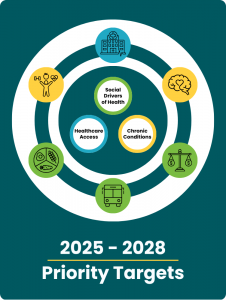
The assessment also identified three priority areas for the CHIP:
- Chronic conditions (with a focus on mental health and obesity)
- Healthcare access
- Social drivers of health (with a focus on transportation, healthy food access, and economic stability)
Community organizations, healthcare providers, local governments, residents, and other partners then worked together to develop evidence-informed strategies across these six focus areas. As planning progressed, however, it became clear that addressing each topic independently would create unnecessary silos. Residents consistently described these challenges as interconnected, and many proposed strategies advanced multiple priorities at once.
In response, the MAPP2Health Core Group organized the final CHIP around the three integrated goals shown above. This approach better reflects how people experience health in their daily lives while encouraging collaboration across healthcare, public health, and community organizations to improve multiple outcomes simultaneously.