
Virginians Encouraged to Get Annual Flu Vaccine, Immunizations to Protect Against Respiratory Illnesses During Event at Riverside Health
State Health Commissioner, Leaders from the Virginia Department of Health, Riverside Health, and the Virginia Hospital & Healthcare Association Gather to Promote Flu Vaccines as a Way to Protect Public Health, Families, and Communities
Update:
Each year, the dawn of fall coincides with the arrival of the cold, flu, and respiratory illness season that spans October through May, with peak illness typically occurring from December through February.
During the moderately severe 2025-2026 flu season, the Centers for Disease Control and Prevention (CDC) estimated that 32-57 million Americans contracted the flu, resulting in 15-25 million medical visits, 390,000-800,000 hospitalizations and 24,000-81,000 deaths. In addition to impacting public health, flu season also has a significant financial cost – a Global Healthy Living Foundation analysis found that the 2023-2024 flu season cost the U.S. economy nearly $29 billion in medical expenses and lost productivity.
Seasonal immunization against flu, as well as COVID-19 and respiratory syncytial virus (RSV), is an effective way for people to protect themselves and those around them from the harmful effects of illness during respiratory season. Virginia State Health Commissioner Dr. B. Cameron Webb, officials with the Virginia Department of Health, leaders from Riverside Health, and the Virginia Hospital & Healthcare Association (VHHA), shared that message during a joint event today in Newport News.
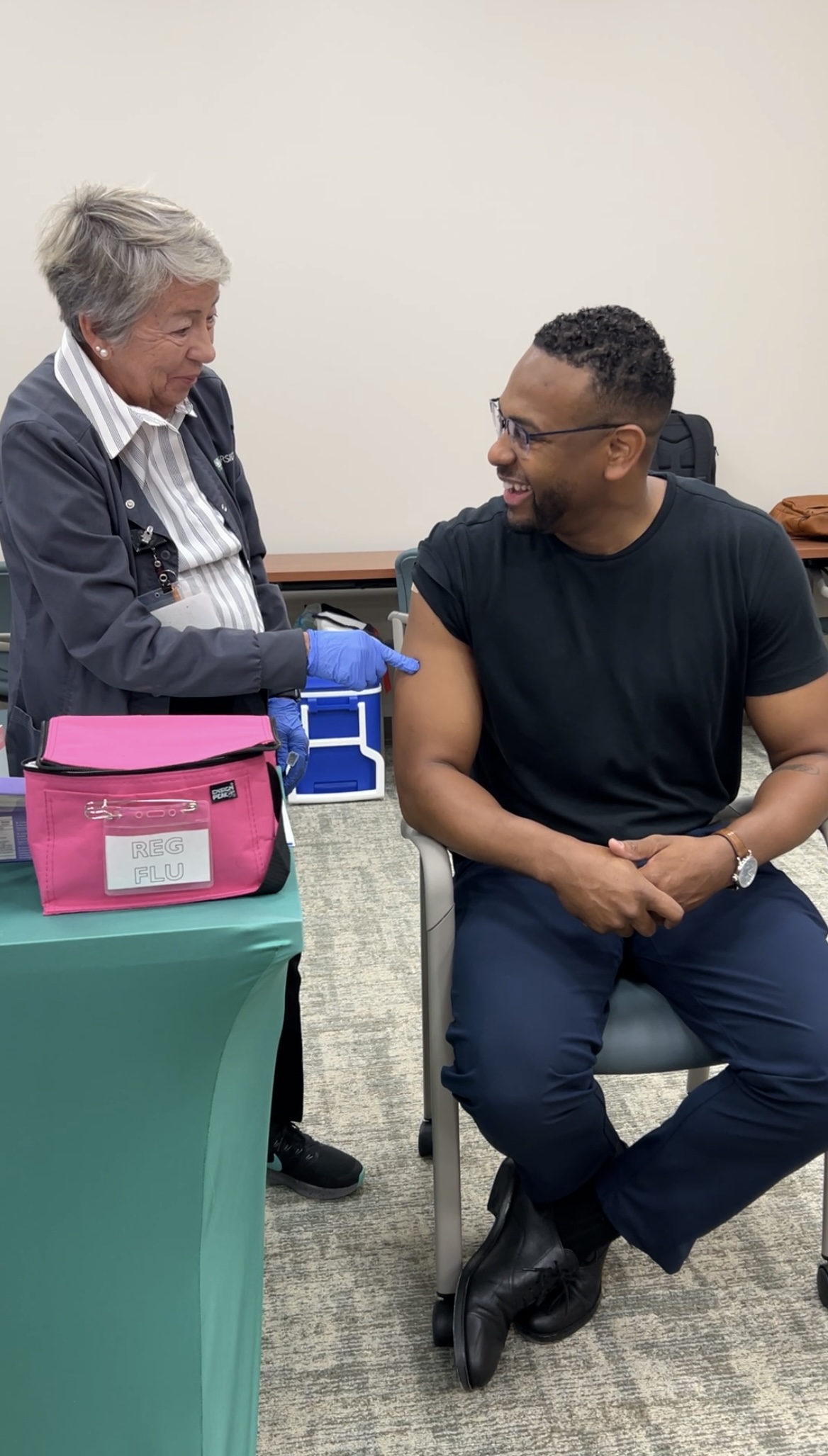 Dr. Webb was among those who rolled up his sleeve to receive a flu vaccine during the event held at the Riverside Internal Medicine Warwick facility to demonstrate that getting a flu vaccine is a quick, simple, and safe process. Everyone six months and older, with rare exceptions, should get a seasonal flu vaccine. Other healthcare leaders sharing that message at the Newport News event included Riverside Regional Medical Center President and Riverside Health Senior Vice President of the Acute Care Division Dr. Michael Oshiki, Riverside Medical Group Senior Vice President and Chief Operating Officer Sally Ryan, and VHHA President and CEO Sean T. Connaughton. A livestream video of the event can be viewed through this link.
“Flu, COVID-19, and RSV can have serious health impacts for our most vulnerable residents including older adults, young children, and anyone living with a chronic health condition,” said State Health Commissioner Dr. Cameron Webb. “Every year, these respiratory viruses account for tens of thousands of visits to urgent care and emergency rooms, resulting in longer waits, missed work and school, and a health system stretched thin right when families need it most. But we have tools that work. VDH recommends vaccination for children and adults this season to help protect themselves and the people around them.”
The flu is a contagious respiratory illness caused by influenza viruses. It can cause mild to severe illness and even death in some cases. Flu viruses can be detected year-round in the United States, however they are most common in the fall and winter. While anyone can contract the flu and develop serious illness, people at higher risk of developing serious flu-related complications include young children, people 65 years and older, and people with chronic illnesses or weakened immune systems. The flu can be spread to people through coughing, sneezing, or talking. People with the flu are most contagious in the first three to four days of their illness.
“Annual flu vaccines are a proven way to help protect against serious illness and reduce the impact of influenza on individuals, families and communities,” said Virginia Hospital & Healthcare Association President and CEO Sean T. Connaughton. “Getting vaccinated can also help reduce the strain on hospitals and healthcare providers during respiratory virus season. We encourage Virginians to make vaccination part of their fall health routine.”
Added Dr. Michael Oshiki, President of Riverside Regional Medical Center and Senior Vice President of the Acute Care Division for Riverside Health: “Influenza can have serious consequences, particularly for older adults, young children and people with underlying health conditions. We see firsthand the difference that prevention can make when patients are protected before they become seriously ill. Getting vaccinated before flu activity increases is an important way to reduce that risk and help keep our communities healthy.”
Vaccines are the best protection against respiratory viruses and widely available through healthcare providers, pharmacies, health departments, and other vaccination sites.
- A video of this flu event courtesy of VHHA can be found at: https://www.youtube.com/watch?v=k2xv1paZix4
- Photos of this flu event courtesy of VHHA can be found at: https://www.vhha.com/photos/2026-flu-shot-event/
Media Contacts:
VDH: Maria Reppas, Director of Communications, maria.reppas@vdh.virginia.gov
VHHA: Julian Walker, Vice President of Communications, jtwalker@vhha.com
ICYMI: Virginia Leads in Women’s and Children’s Health
America’s Health Rankings ranks Virginia 13th overall, with the Commonwealth ranking No. 1 in the nation for children’s food sufficiency and access to mental health treatment
Update:
Secretary of Health and Human Resources Marvin B. Figueroa recently announced that Virginia ranks among the nation’s leaders in the health of women and children, according to the 2026 Health of Women and Children Report from America’s Health Rankings, a project of the United Health Foundation.
Read the full update.
Media Contact: Charlotte.Gomer@governor.virginia.gov
Aquatic Facility Information Survey
Update:
The Virginia Department of Health (VDH) is conducting a statewide effort to update and improve records for all aquatic facilities, including pools, splash pads, aquatic centers, therapy pools, HOAs and gym pools, and similar venues. As part of this initiative, we are asking facilities to complete this short survey, to confirm their contact information, location, and venue type and be added to our email list for updates on regulatory processes, guidance, and other important announcements.
The survey takes only a few minutes, and your facility’s information will contribute directly to:
- Better statewide data for planning and safety efforts
- Faster notifications regarding regulatory updates, guidance, or inspection procedures
- More accurate outreach during emergencies or waterborne illness investigations
- Improved transparency and communication between VDH and aquatic facility operators
Stay informed. Complete the survey today: Aquatic Facility Information Survey.
Respiratory Season Vaccines
Update:
Vaccines are your best protection against severe disease from flu, COVID-19, and RSV. Talk to your healthcare provider to determine which 2026-27 seasonal vaccines are right for you.
Public Guidance:
Influenza (flu)
Virginia Department of Health recommends that everyone six months and older, with rare exceptions, should get an influenza (flu) vaccine every season.
While the best time to get the flu vaccine is by the end of October, it’s never too late. You can continue to get protection from the flu vaccine as long as flu viruses are circulating. Flu activity normally begins increasing in early October and continues to late May, often peaking in January or February.
The updated flu vaccine includes protection against three strains of flu virus, including the influenza A(H3N2) subclade K virus that spread widely during the 2025-2026 season.
COVID-19
COVID-19 vaccines are available for everyone six months and older and are especially recommended for those at high risk of severe disease, including older adults, infants, and during pregnancy.
The Virginia Department of Health recommends getting an updated COVID-19 vaccine, if eligible, because vaccine protection decreases over time.
Respiratory Syncytial Virus (RSV)
VDH recommends that all adults aged 75 years and older receive a single dose of one RSV vaccine. If you are 50-74 years old with a health condition, speak with your healthcare provider to decide if the RSV vaccine is the right choice for you; some health conditions can cause you to be at higher risk for severe RSV illness. If an adult 50 years and older has already received an RSV vaccine in a previous season, they do not need a dose this season.
All babies should be protected from severe RSV by one of two immunization options. A maternal RSV vaccine can be given during pregnancy, or an RSV monoclonal antibody can be given to your baby. These immunization products have been shown to cut the risk of hospitalization significantly for infants going into their first RSV season. Pregnant people and parents of newborns should talk with their healthcare providers about RSV immunizations.
ICYMI: Protect Yourself and Your Pets
Rabies Awareness Week is Sept. 27- Oct. 3
Update:
Rabies Awareness Week, September 27 - October 3, is a longstanding campaign sponsored by the Virginia Department of Health and The Virginia Veterinary Medical Association. As the “other family doctor,” animal healthcare providers play a critical role in rabies prevention by educating pet owners about how vaccinating their pets for rabies protects everyone in the family.
Public Guidance:
Rabies is a virus that is commonly found in Virginia’s wildlife, especially in certain wild animals such as raccoons, skunks, and foxes. It’s important to remember that any mammal can get rabies and that rabies kills almost any mammal that gets sick from it. That’s why it’s important to take some basic precautions to help protect you and your pets from being infected.
One of the best ways you can protect yourself and your animals is by having your veterinarian vaccinate your pets for rabies and keeping their vaccinations up to date. Vaccinating domestic animals like dogs, cats, and horses creates a protective barrier between wildlife and humans. By protecting them, we also protect ourselves.
You can also protect yourself and your pets by:
- Appreciating wildlife from a distance
- Never adopting wild animals as pets
- Keeping your animals on your property
- Keeping garbage and pet food inside
For more information about rabies, please visit the Virginia Department of Health website at https://www.vdh.virginia.gov/animal-contact-human-health/rabies-control/ and to find a veterinarian, go to https://vvma.org/.
Have a Safe Halloween with these Tips
Update:
For a safe Halloween, the Virginia Department of Health (VDH) recommends that parents check children's Halloween treats before they eat them. Watch for treats that may be dangerous choking hazards. Stick with commercially wrapped treats.
Public Guidance:
If you or your children have food allergies, VDH reminds you of the importance of reading Halloween candy labels.
- Read the ingredient label before eating the treat.
- Do not eat a product if you are unsure what is in it.
- Children with food allergies should avoid homemade treats when the ingredients are unknown.
- Parents should check each piece of candy, even if the child has eaten that type before.
For more information about food safety, visit the VDH Food Safety webpage.
Breast Cancer Awareness
Update:
October is Breast Cancer Awareness Month. Breast cancer is the most common cancer diagnosed in Virginia. In the United States, 1 in 8 women will get breast cancer in their lifetime. Early detection is key. VDH offers free breast screening services through the Every Woman’s Life program.
Breast Cancer in Virginia
- Breast cancer in women is the top cancer in Virginia.
- The American Cancer Society estimates that there will be over 8,000 new breast cancer diagnoses in Virginia this year.
- It’s also expected that over 1,100 people will die of breast cancer this year in Virginia.
Breast Cancer Screening
- Breast cancer screening is checking a woman’s breasts for cancer before there are signs or symptoms of the disease.
- Screening is the best way to detect breast cancer early.
- Finding breast cancer early:
- Improves treatment options
- Greatly increases survival
- From 1975-2020 in the United States, 250,000 breast cancer deaths were prevented because of mammography screening.
Getting Screened
- Women at average risk for breast cancer should start screening at age 40.
- Women who are at increased risk may need to start screening earlier and have them done more frequently.
- Check with your healthcare provider if screening is recommended for you and how often you should be screened.
Cost of Screening
- The Virginia Department of Health’s (VDH) Every Woman’s Life (EWL) program helps uninsured, low-income women gain access to free breast cancer screening services.
- Learn more to see if you qualify and to find an EWL provider near you.
- If you don’t qualify, call 1-866-EWL-4YOU or 1-866-395-4968 for assistance.
- Women with private insurance should check to see if breast cancer screenings are covered.
For More Information
Respiratory Season Vaccines
Update:
Vaccines are your best protection against severe disease from flu, COVID-19, and RSV. Talk to your healthcare provider to determine which 2026-27 seasonal vaccines are right for you.
Public Guidance:
Influenza (flu)
Virginia Department of Health recommends that everyone six months and older, with rare exceptions, should get an influenza (flu) vaccine every season.
While the best time to get the flu vaccine is by the end of October, it’s never too late. You can continue to get protection from the flu vaccine as long as flu viruses are circulating. Flu activity normally begins increasing in early October and continues to late May, often peaking in January or February.
The updated flu vaccine includes protection against three strains of flu virus, including the influenza A(H3N2) subclade K virus that spread widely during the 2025-2026 season.
COVID-19
COVID-19 vaccines are available for everyone six months and older and are especially recommended for those at high risk of severe disease, including older adults, infants, and during pregnancy.
The Virginia Department of Health recommends getting an updated COVID-19 vaccine, if eligible, because vaccine protection decreases over time.
Respiratory Syncytial Virus (RSV)
VDH recommends that all adults aged 75 years and older receive a single dose of one RSV vaccine. If you are 50-74 years old with a health condition, speak with your healthcare provider to decide if the RSV vaccine is the right choice for you; some health conditions can cause you to be at higher risk for severe RSV illness. If an adult 50 years and older has already received an RSV vaccine in a previous season, they do not need a dose this season.
All babies should be protected from severe RSV by one of two immunization options. A maternal RSV vaccine can be given during pregnancy, or an RSV monoclonal antibody can be given to your baby. These immunization products have been shown to cut the risk of hospitalization significantly for infants going into their first RSV season. Pregnant people and parents of newborns should talk with their healthcare providers about RSV immunizations.
ICYMI: Protect Yourself and Your Pets
Rabies Awareness Week is Sept. 27- Oct. 3
Update:
Rabies Awareness Week, September 27 - October 3, is a longstanding campaign sponsored by the Virginia Department of Health and The Virginia Veterinary Medical Association. As the “other family doctor,” animal healthcare providers play a critical role in rabies prevention by educating pet owners about how vaccinating their pets for rabies protects everyone in the family.
Public Guidance:
Rabies is a virus that is commonly found in Virginia’s wildlife, especially in certain wild animals such as raccoons, skunks, and foxes. It’s important to remember that any mammal can get rabies and that rabies kills almost any mammal that gets sick from it. That’s why it’s important to take some basic precautions to help protect you and your pets from being infected.
One of the best ways you can protect yourself and your animals is by having your veterinarian vaccinate your pets for rabies and keeping their vaccinations up to date. Vaccinating domestic animals like dogs, cats, and horses creates a protective barrier between wildlife and humans. By protecting them, we also protect ourselves.
You can also protect yourself and your pets by:
- Appreciating wildlife from a distance
- Never adopting wild animals as pets
- Keeping your animals on your property
- Keeping garbage and pet food inside
For more information about rabies, please visit the Virginia Department of Health website at https://www.vdh.virginia.gov/animal-contact-human-health/rabies-control/ and to find a veterinarian, go to https://vvma.org/.
VDH Internship Academy Named a 2026 Internships Virginia Top Employer
Update:
The Virginia Department of Health (VDH) Internship Academy has earned new recognition for the experience it provides to emerging professionals.
The Academy was named a 2026 Internships Virginia Top Employer by the Virginia Economic Development Partnership (VEDP). The recognition honors Virginia employers that provide high-quality, paid internships designed to give students real-world opportunities to learn and contribute while strengthening the Commonwealth’s talent pipeline.
Hands-on experience across public health
At VDH, interns do more than observe. They work alongside VDH staff and contribute to projects across a wide range of fields, including public health, environmental health, communications, finance, human resources, information technology and more.
That exposure helps interns see how different roles and disciplines work together to support VDH’s mission to protect the health and promote the well-being of all people in Virginia.
This year, 34 interns were selected from 1,274 applicants for the Academy’s fourth cohort. Since the program began, 127 interns representing 47 colleges and universities across 19 states and Washington, D.C. have participated.
An agencywide investment in interns
The Internship Academy depends on VDH employees throughout the agency who create meaningful assignments, supervise projects, mentor interns and help them build skills they can take into their careers.
The Top Employer designation reflects that commitment to providing interns with valuable professional development while introducing students and recent graduates to VDH as a place where they can put their skills to work for public health.
Learn more about VDH’s Internship Academy.
Read more from the Governor’s Office: Governor Spanberger Recognizes Virginia’s Top Employers for Interns.
Respiratory Season Vaccines
Update:
Vaccines are your best protection against severe disease from flu, COVID-19, and RSV. Talk to your healthcare provider to determine which 2026-27 seasonal vaccines are right for you.
Public Guidance:
Influenza (flu)
Virginia Department of Health recommends that everyone six months and older, with rare exceptions, should get an influenza (flu) vaccine every season.
While the best time to get the flu vaccine is by the end of October, it’s never too late. You can continue to get protection from the flu vaccine as long as flu viruses are circulating. Flu activity normally begins increasing in early October and continues to late May, often peaking in January or February.
The updated flu vaccine includes protection against three strains of flu virus, including the influenza A(H3N2) subclade K virus that spread widely during the 2025-2026 season.
COVID-19
COVID-19 vaccines are available for everyone six months and older and are especially recommended for those at high risk of severe disease, including older adults, infants, and during pregnancy.
The Virginia Department of Health recommends getting an updated COVID-19 vaccine, if eligible, because vaccine protection decreases over time.
Respiratory Syncytial Virus (RSV)
VDH recommends that all adults aged 75 years and older receive a single dose of one RSV vaccine. If you are 50-74 years old with a health condition, speak with your healthcare provider to decide if the RSV vaccine is the right choice for you; some health conditions can cause you to be at higher risk for severe RSV illness. If an adult 50 years and older has already received an RSV vaccine in a previous season, they do not need a dose this season.
All babies should be protected from severe RSV by one of two immunization options. A maternal RSV vaccine can be given during pregnancy, or an RSV monoclonal antibody can be given to your baby. These immunization products have been shown to cut the risk of hospitalization significantly for infants going into their first RSV season. Pregnant people and parents of newborns should talk with their healthcare providers about RSV immunizations.
ICYMI: Protect Yourself and Your Pets
Rabies Awareness Week is Sept. 27- Oct. 3
Update:
Rabies Awareness Week, September 27 - October 3, is a longstanding campaign sponsored by the Virginia Department of Health and The Virginia Veterinary Medical Association. As the “other family doctor,” animal healthcare providers play a critical role in rabies prevention by educating pet owners about how vaccinating their pets for rabies protects everyone in the family.
Public Guidance:
Rabies is a virus that is commonly found in Virginia’s wildlife, especially in certain wild animals such as raccoons, skunks, and foxes. It’s important to remember that any mammal can get rabies and that rabies kills almost any mammal that gets sick from it. That’s why it’s important to take some basic precautions to help protect you and your pets from being infected.
One of the best ways you can protect yourself and your animals is by having your veterinarian vaccinate your pets for rabies and keeping their vaccinations up to date. Vaccinating domestic animals like dogs, cats, and horses creates a protective barrier between wildlife and humans. By protecting them, we also protect ourselves.
You can also protect yourself and your pets by:
- Appreciating wildlife from a distance
- Never adopting wild animals as pets
- Keeping your animals on your property
- Keeping garbage and pet food inside
For more information about rabies, please visit the Virginia Department of Health website at https://www.vdh.virginia.gov/animal-contact-human-health/rabies-control/ and to find a veterinarian, go to https://vvma.org/.
Nursing Home Oversight Advisory Panel Meeting
Update:
Members of accredited media are invited to attend an informative meeting on the Commonwealth’s Nursing Home Oversight Plan and newly enacted nursing home administrative sanctions guidance.
- Sept. 30, 1 p.m., Nursing Home Oversight Advisory Panel
Office of the Chief Medical Examiner
8850 Times Dispatch Blvd, Ste 200
Mechanicsville, VA 23116
Meeting Agenda
The focus of the public meeting is nursing home quality improvement and regulatory enforcement. It will include presentations by three nursing home industry associations about their role in quality improvement, followed by a panel discussion.
Secretary Figueroa, Dr. Webb, and VDH’s Office of Licensure and Certification Director, April Dovel, will be available to the media following the meeting.
Media outlets that wish to attend need to RSVP to Logan.Anderson@vdh.virginia.gov.
Pediatric Flu Death
Update:
The Virginia Department of Health (VDH) is reporting the third confirmed influenza-associated pediatric death for the 2025–26 influenza (flu) season in Virginia. Sadly, a preschool-age child (0-4 years) in VDH’s Eastern Region died from complications associated with flu. This case was identified using a retrospective records search and will be reported on the Respiratory Illness Dashboard as of September 29. To protect the family’s privacy, VDH will not provide any additional information about the child.
As of September 19, the level of respiratory illnesses is low and stable in Virginia. The 2025-26 season ends October 3. 2026. The 2026-2027 influenza season begins on October 4.
Public Guidance:
The Virginia Department of Health recommends the following tips to prevent the flu:
- Everyone six months and older, with rare exceptions, should get an influenza (flu) vaccine every season. An annual seasonal flu vaccine is the best way to help reduce the risk of getting flu and any of its potentially serious complications.
- Wash your hands with soap and water or use an alcohol-based sanitizer.
- Cover coughs and sneezes with a tissue or the inside of your elbow rather than your open hand.
- Stay at home when you feel sick.
Respiratory Season Vaccines
Update:
Vaccines are your best protection against severe disease from flu, COVID-19, and RSV. Talk to your healthcare provider to determine which 2026-27 seasonal vaccines are right for you.
Public Guidance:
Influenza (flu)
Virginia Department of Health recommends that everyone six months and older, with rare exceptions, should get an influenza (flu) vaccine every season.
While the best time to get the flu vaccine is by the end of October, it’s never too late. You can continue to get protection from the flu vaccine as long as flu viruses are circulating. Flu activity normally begins increasing in early October and continues to late May, often peaking in January or February.
The updated flu vaccine includes protection against three strains of flu virus, including the influenza A(H3N2) subclade K virus that spread widely during the 2025-2026 season.
COVID-19
COVID-19 vaccines are available for everyone six months and older and are especially recommended for those at high risk of severe disease, including older adults, infants, and during pregnancy.
The Virginia Department of Health recommends getting an updated COVID-19 vaccine, if eligible, because vaccine protection decreases over time.
Respiratory Syncytial Virus (RSV)
VDH recommends that all adults aged 75 years and older receive a single dose of one RSV vaccine. If you are 50-74 years old with a health condition, speak with your healthcare provider to decide if the RSV vaccine is the right choice for you; some health conditions can cause you to be at higher risk for severe RSV illness. If an adult 50 years and older has already received an RSV vaccine in a previous season, they do not need a dose this season.
All babies should be protected from severe RSV by one of two immunization options. A maternal RSV vaccine can be given during pregnancy, or an RSV monoclonal antibody can be given to your baby. These immunization products have been shown to cut the risk of hospitalization significantly for infants going into their first RSV season. Pregnant people and parents of newborns should talk with their healthcare providers about RSV immunizations.
ICYMI: Protect Yourself and Your Pets
Rabies Awareness Week is Sept. 27- Oct. 3
Update:
Rabies Awareness Week, September 27 - October 3, is a longstanding campaign sponsored by the Virginia Department of Health and The Virginia Veterinary Medical Association. As the “other family doctor,” animal healthcare providers play a critical role in rabies prevention by educating pet owners about how vaccinating their pets for rabies protects everyone in the family.
Public Guidance:
Rabies is a virus that is commonly found in Virginia’s wildlife, especially in certain wild animals such as raccoons, skunks, and foxes. It’s important to remember that any mammal can get rabies and that rabies kills almost any mammal that gets sick from it. That’s why it’s important to take some basic precautions to help protect you and your pets from being infected.
One of the best ways you can protect yourself and your animals is by having your veterinarian vaccinate your pets for rabies and keeping their vaccinations up to date. Vaccinating domestic animals like dogs, cats, and horses creates a protective barrier between wildlife and humans. By protecting them, we also protect ourselves.
You can also protect yourself and your pets by:
- Appreciating wildlife from a distance
- Never adopting wild animals as pets
- Keeping your animals on your property
- Keeping garbage and pet food inside
For more information about rabies, please visit the Virginia Department of Health website at https://www.vdh.virginia.gov/animal-contact-human-health/rabies-control/ and to find a veterinarian, go to https://vvma.org/.
Stay Safe at the Fair with these Food Safety Tips
Update:
As the State Fair of Virginia begins, people can stay safe by keeping food and animals separate with these important tips.
Public Guidance:
- Always wash your hands after using the bathroom or changing diapers and before eating or drinking.
- Don’t eat or drink around animals.
- Don’t share your food with animals, no matter how cute they are!
- Don’t eat or drink raw (unpasteurized) products.
- The most common symptoms of foodborne illness are nausea, vomiting, diarrhea, and abdominal cramps.
If you think something you ate made you sick, contact your healthcare provider and report your illness to the Virginia Department of Health by submitting an online report at MyMealDetective.com.
Protect Yourself and Your Pets: Rabies Awareness Week is Sept. 27- Oct. 3
Update:
Rabies Awareness Week, September 27 - October 3, is a longstanding campaign sponsored by the Virginia Department of Health and The Virginia Veterinary Medical Association. As the “other family doctor,” animal healthcare providers play a critical role in rabies prevention by educating pet owners about how vaccinating their pets for rabies protects everyone in the family.
Public Guidance:
Rabies is a virus that is commonly found in Virginia’s wildlife, especially in certain wild animals such as raccoons, skunks, and foxes. It’s important to remember that any mammal can get rabies and that rabies kills almost any mammal that gets sick from it. That’s why it’s important to take some basic precautions to help protect you and your pets from being infected.
One of the best ways you can protect yourself and your animals is by having your veterinarian vaccinate your pets for rabies and keeping their vaccinations up to date. Vaccinating domestic animals like dogs, cats, and horses creates a protective barrier between wildlife and humans. By protecting them, we also protect ourselves.
You can also protect yourself and your pets by:
- Appreciating wildlife from a distance
- Never adopting wild animals as pets
- Keeping your animals on your property
- Keeping garbage and pet food inside
For more information about rabies, please visit the Virginia Department of Health website at https://www.vdh.virginia.gov/animal-contact-human-health/rabies-control/ and to find a veterinarian, go to https://vvma.org/.
Respiratory Season Vaccines
Update:
Vaccines are your best protection against severe disease from flu, COVID-19, and RSV. Talk to your healthcare provider to determine which 2026-27 seasonal vaccines are right for you.
Public Guidance:
Influenza (flu)
Virginia Department of Health recommends that everyone six months and older, with rare exceptions, should get an influenza (flu) vaccine every season.
While the best time to get the flu vaccine is by the end of October, it’s never too late. You can continue to get protection from the flu vaccine as long as flu viruses are circulating. Flu activity normally begins increasing in early October and continues to late May, often peaking in January or February.
The updated flu vaccine includes protection against three strains of flu virus, including the influenza A(H3N2) subclade K virus that spread widely during the 2025-2026 season.
COVID-19
COVID-19 vaccines are available for everyone six months and older and are especially recommended for those at high risk of severe disease, including older adults, infants, and during pregnancy.
The Virginia Department of Health recommends getting an updated COVID-19 vaccine, if eligible, because vaccine protection decreases over time.
Respiratory Syncytial Virus (RSV)
VDH recommends that all adults aged 75 years and older receive a single dose of one RSV vaccine. If you are 50-74 years old with a health condition, speak with your healthcare provider to decide if the RSV vaccine is the right choice for you; some health conditions can cause you to be at higher risk for severe RSV illness. If an adult 50 years and older has already received an RSV vaccine in a previous season, they do not need a dose this season.
All babies should be protected from severe RSV by one of two immunization options. A maternal RSV vaccine can be given during pregnancy, or an RSV monoclonal antibody can be given to your baby. These immunization products have been shown to cut the risk of hospitalization significantly for infants going into their first RSV season. Pregnant people and parents of newborns should talk with their healthcare providers about RSV immunizations.
VDH Launches Revised Student Immunization Data
Update:
The Virginia Department of Health Division of Immunization is launching revised versions of our Student Immunization Status (SIS) Dashboard.
The dashboards provide statewide and local insights into reported student immunization coverage and exemptions to inform public health planning and outreach.
Changes reflected in revised versions of the SIS Dashboard include:
- SIS data is now displayed on two different dashboards: immunization and exemptions.
- SIS dashboards provide rates in ranges rather than exact numbers and have supplied suppression logic for all schools and grades with fewer than 20 students.
- SIS immunization coverage for kindergarten now includes rates by vaccine group (i.e. DTaP, Polio, HepB, etc.) in addition to a combined “adequately immunized’ rate.
- SIS dashboards will display data beginning with the 2025/2026 school year. Previous year SIS dashboards can be found here: Annual School Self-Reports of Immunization Coverage - Immunization
The Immunization Dashboard includes school self-reported immunization data for students in kindergarten, 7th grade, and 12th grade.
- Kindergarten and 7th-grade data are currently available. 12th grade data is forthcoming.
- The immunization dashboard now includes kindergarten data by vaccine group, collected for the first time during the 2025/2026 school year. That is, rather than just a combined “adequately immunized” rate, the school reported coverage by each vaccine group also. For example, whether a student has 4DTaP or student has 3Polio.
The Exemption Dashboard includes school self-reported exemption data for kindergarten, 7th grade, and 12th grade, including religious and medical exemptions.
- Kindergarten and 7th-grade data are currently available. 12th grade data is forthcoming.
Student Immunization Status Report:
- The SIS is a census, school-based survey conducted for students in kindergarten, 7th grade, and 12th grade.
- Data reflect students' immunization status as of the first day of school.
- SIS data are self-reported by school personnel and are not independently verified by VDH.
- The dashboards should be interpreted as a representation of reported immunization and exemption data, rather than a verified assessment of every student's immunization status.
Data Representation:
Public Schools:
- Approximately 95% of public schools report data.
- These schools represent approximately 82% of Virginia's student population.
- The listing of public schools are reported to VDH by the Virginia Department of Education (VDOE).
Private Schools:
- Approximately 50% of private schools report data.
- These schools represent approximately 14% of Virginia's student population.
- The listing of private schools is reported to VDH by the Virginia Council for Private Education (VCPE).
- Some non-VCPE-accredited private schools report directly through SIS.
- VDH cannot verify that all private schools are represented in the dataset.
Homeschooled Students:
- Homeschooled students are not included in the SIS dataset.
- Homeschooled students account for approximately 4% of Virginia's student population.
Data Limitation:
- Because SIS data are self-reported and not independently verified by VDH, users should exercise caution when interpreting differences between schools or localities.
National Forensic Science Week, September 20-26, 2026: Honoring the Experts Behind Virginia’s Medicolegal Death Investigations
Update:
Public Guidance:
At the Virginia Department of Health, we are proud to shine a spotlight on the dedicated experts within the Office of the Chief Medical Examiner – Medical Examiners, Medicolegal Death Investigators, Forensic Autopsy Technician and support staff. Their scientific work and public service are essential to understanding deaths, supporting families and strengthening the safety and wellbeing of communities across the Commonwealth. Virginia OCME is one of only sixteen centralized statewide Medical Examiner systems in the country.
Whether they are responding to and investigating death scenes, performing forensic autopsies, or collecting and preserving evidence, OCME staff transform complex questions into meaningful answers. And when those answers matter in court, they provide clear, scientifically grounded expert testimony that helps ensure the truth is understood.
“Our commitment to public service guides every examination—we pursue the truth with compassion and science, because every answer supports a safer Virginia,” said Chief Medical Examiner, William Gormley, M.D.
For additional information on the work of the experts behind medicolegal death investigations in Virginia, visit The Office of the Chief Medical Examiner of Virginia.
Respiratory Season Vaccines
Update:
Vaccines are your best protection against severe disease from flu, COVID-19, and RSV. Talk to your healthcare provider to determine which 2026-27 seasonal vaccines are right for you.
Public Guidance:
Influenza (flu)
Virginia Department of Health recommends that everyone six months and older, with rare exceptions, should get an influenza (flu) vaccine every season.
While the best time to get the flu vaccine is by the end of October, it’s never too late. You can continue to get protection from the flu vaccine as long as flu viruses are circulating. Flu activity normally begins increasing in early October and continues to late May, often peaking in January or February.
The updated flu vaccine includes protection against three strains of flu virus, including the influenza A(H3N2) subclade K virus that spread widely during the 2025-2026 season.
COVID-19
COVID-19 vaccines are available for everyone six months and older and are especially recommended for those at high risk of severe disease, including older adults, infants, and during pregnancy.
The Virginia Department of Health recommends getting an updated COVID-19 vaccine, if eligible, because vaccine protection decreases over time.
Respiratory Syncytial Virus (RSV)
VDH recommends that all adults aged 75 years and older receive a single dose of one RSV vaccine. If you are 50-74 years old with a health condition, speak with your healthcare provider to decide if the RSV vaccine is the right choice for you; some health conditions can cause you to be at higher risk for severe RSV illness. If an adult 50 years and older has already received an RSV vaccine in a previous season, they do not need a dose this season.
All babies should be protected from severe RSV by one of two immunization options. A maternal RSV vaccine can be given during pregnancy, or an RSV monoclonal antibody can be given to your baby. These immunization products have been shown to cut the risk of hospitalization significantly for infants going into their first RSV season. Pregnant people and parents of newborns should talk with their healthcare providers about RSV immunizations.
Respiratory Season Vaccines
Update:
Vaccines are your best protection against severe disease from flu, COVID-19, and RSV. Talk to your healthcare provider to determine which 2026-27 seasonal vaccines are right for you.
Public Guidance:
Influenza (flu)
Virginia Department of Health recommends that everyone six months and older, with rare exceptions, should get an influenza (flu) vaccine every season.
While the best time to get the flu vaccine is by the end of October, it’s never too late. You can continue to get protection from the flu vaccine as long as flu viruses are circulating. Flu activity normally begins increasing in early October and continues to late May, often peaking in January or February.
The updated flu vaccine includes protection against three strains of flu virus, including the influenza A(H3N2) subclade K virus that spread widely during the 2025-2026 season.
COVID-19
COVID-19 vaccines are available for everyone six months and older and are especially recommended for those at high risk of severe disease, including older adults, infants, and during pregnancy.
The Virginia Department of Health recommends getting an updated COVID-19 vaccine, if eligible, because vaccine protection decreases over time.
Respiratory Syncytial Virus (RSV)
All adults aged 75 years and older are recommended to receive a single dose of one RSV vaccine. If you are 50-74 years old with a health condition, speak with your healthcare provider to decide if the RSV vaccine is the right choice for you. If an adult 50 years and older has already received an RSV vaccine in a previous season, they do not need a dose this season.
All babies should be protected from severe RSV by one of two immunization options. A maternal RSV vaccine can be given during pregnancy, or an RSV monoclonal antibody can be given to your baby. These immunization products have been shown to cut the risk of hospitalization significantly for infants going into their first RSV season. Pregnant people and parents of newborns should talk with their healthcare providers about RSV immunizations.
Virginia is Strengthening Sickle Cell Care
Update:
September marks Sickle Cell Awareness Month. As part of this public health awareness month, the Virginia Department of Health (VDH) is highlighting our work with clinical partners across the Commonwealth to connect children and adults living with sickle cell disease to specialized care, treatment, disease management and support.
Virginia’s pediatric clinical partners include Virginia Commonwealth University (VCU), University of Virginia (UVA), Carilion, Children’s Hospital of The King’s Daughters (CHKD) and Pediatric Specialists of Virginia (PSV). Adult clinical partners include UVA, VCU, Carilion, Inova and Eastern Virginia Medical School (EVMS).
These clinical partners provide access to specialists with expertise in the diagnosis, treatment and management of sickle cell disease. Babies identified through newborn screening are referred to appropriate care in their region. As children grow, coordination between pediatric and adult providers helps support their transition to adult care and continued access to the treatment and services they need throughout their lives.
Virginia also maintains a statewide sickle cell registry, housed within VDH’s Office of Family Health Services. The registry supports public health efforts to better understand the needs of Virginians living with sickle cell disease and strengthen services across the Commonwealth.
Send all questions and interview requests to Cheryle Rodriguez, Cheryle.rodriguez@vdh.virginia.gov
ICYMI: Increases in Recent Animal Rabies Activity and Associated Human Exposures
Update:
Local health departments across Virginia have reported an increase in the number of potential rabies exposures this season, many of which are related to bat encounters. In addition, some of Virginia’s health districts have reported an increase in the number of people undergoing rabies post-exposure vaccinations. On September 10, 2026, the Centers for Disease Control and Prevention issued a health alert reporting a nationwide increase in human rabies exposures.
State Public Health Veterinarian Julia Murphy is available for interviews during the week of September 21. To schedule an interview, please contact Brookie Crawford at brookie.crawford@vdh.virginia.gov this week.
Public Guidance:
In the Case of an Animal Bite
- Don’t panic, but don’t ignore the bite either. To decrease the chance of infection, wash the wound thoroughly with soap and lots of water. Give first aid as you would for any wound.
- If it can be done safely, capture or confine the animal that bit you, or at least identify it before it runs away. Don’t try to pick the animal up. If the animal is owned, get the name and contact information for the owner. Call your local health department or animal protection office for further instructions.
- Don’t damage the head of any animal that might need to be tested for rabies. The brain will be needed for the test.
- Notify your doctor promptly and explain how and when you were bitten. Tell your doctor whether or not the bite has been reported to local authorities.
- Your doctor may call the health department to discuss whether or not you need to start the rabies vaccine series and will help address other concerns about the bite. Rabies treatment no longer involves injections in the abdomen and most are given in the arm.
Take Special Care Around Bats
People can be exposed to rabies by bats without knowing they were bitten. Seek medical advice even in the absence of an obvious bite wound if you have direct contact with a bat or find a bat in a room with a:
- Sleeping person
- Unattended, small child
- Someone mentally or physically challenged
- Intoxicated person
Bats that may have exposed people or animals to rabies should be collected safely for possible testing (or at least not released). Bats may be contained in a room by closing windows and door(s). Use caution if you try to capture a bat yourself by wearing gloves and using a container (like a coffee can or a box) to place over the bat and then sliding and securing a piece of cardboard between the container and the bat. Call your local health department for advice about testing and medical care. A local health department directory can be found at vdh.virginia.gov/local-health-districts/
For more information about rabies, go to:
https://www.vdh.virginia.gov/animal-contact-human-health/rabies-control/
For more information about bats, go to:
2026 Food Regulations Update
Update:
The Virginia Department of Health announces that updated Virginia Food Regulations will take effect on September 10, 2026. These revisions align portions of the state regulations with the most recent United States Food and Drug Administration (FDA) Food Code.
A key focus of the update is enhanced allergen safety. The new requirements strengthen protections for individuals with food allergies and establish clearer expectations for communicating major food allergens found in food across the Commonwealth.
Please note that these changes are separate from additional regulatory updates that will be required because of actions taken during the 2026 Virginia legislative session. Information on those forthcoming updates is available online here.
For full details on the 2026 Food Regulations update, visit: https://www.vdh.virginia.gov/environmental-health/food-safety-in-virginia/food-regulations-update-2…
Note: these are different than the future updates required per the 2026 Virginia legislative session. For information on these future regulatory updates, see here.
For additional information, visit: https://www.vdh.virginia.gov/environmental-health/food-safety-in-virginia/food-regulations-update-2026/.
Increases in Recent Animal Rabies Activity and Associated Human Exposures
Update:
Local health departments have reported an increase in the number of potential rabies exposures this season, many of which are related to bat encounters. In addition, some of Virginia’s health districts have reported an increase in the number of people undergoing rabies post-exposure vaccinations. On September 10, 2026, the Centers for Disease Control and Prevention issued a health alert reporting a nationwide increase in human rabies exposures.
Public Guidance:
In the case of an animal bite:
- Don’t panic, but don’t ignore the bite either. To decrease the chance of infection, wash the wound thoroughly with soap and lots of water. Give first aid as you would for any wound.
- If it can be done safely, capture or confine the animal that bit you, or at least identify it before it runs away. Don’t try to pick the animal up. If the animal is owned, get the name and contact information for the owner. Call your local health department or animal protection office for further instructions.
- Don’t damage the head of any animal that might need to be tested for rabies. The brain will be needed for the test.
- Notify your doctor promptly and explain how you were bitten. Tell your doctor whether or not the bite has been reported to local authorities.
- Your doctor may call the health department to discuss whether or not you need to start the rabies vaccine series and will help address other concerns about the bite. Rabies treatment no longer involves injections in the abdomen and most are given in the arm.
Take Special Care Around Bats:
People can be exposed to rabies by bats without knowing they were bitten. Seek medical advice even in the absence of an obvious bite wound if you have direct contact with a bat or find a bat in a room with a:
- Sleeping person
- Unattended, small child
- Someone mentally or physically challenged
- Intoxicated person
Bats that may have exposed people or animals to rabies should be collected safely for possible testing (or at least not released). Bats may be contained in a room by closing windows and door(s). Use caution if you try to capture a bat yourself by wearing gloves and using a container (like a coffee can or a box) to place over the bat and then sliding and securing a piece of cardboard between the container and the bat. Call your local health department for advice about testing and medical care. A local health department directory can be found at vdh.virginia.gov/local-health-districts/
For more information about rabies, go to: https://www.vdh.virginia.gov/animal-contact-human-health/rabies-control/
For more information about bats, go to:
Food Safety
Update:
Most foodborne illnesses are caused by a variety of bacteria, viruses, and parasites. The most common symptoms are nausea, vomiting, diarrhea, and abdominal cramps. People should practice food safety during their Labor Day cookouts in order to prevent foodborne illness.
Public Guidance:
To minimize the risk of foodborne illness people should:
CLEAN
- Always wash your hands thoroughly before and after handling food, and after using the bathroom or changing diapers.
- Use clean utensils and cutting boards and wash and sanitize them in between use.
- Wash all fruits and vegetables thoroughly under running water before eating, cutting, or cooking.
SEPARATE
- Keep raw meats separate from ready-to-eat fruits and vegetables and other cooked foods to avoid cross contamination.
COOK
- Cook foods to the right temperatures to kill harmful germs. Check temperatures using a food thermometer.
- 165°F for poultry products
- 160°F for egg products and ground meats
- 145°F for fish, pork, beef, and other red meats
CHILL
- Refrigerate leftovers at 40°F or colder within 2 hours of cooking to prevent food poisoning.
- Never thaw or marinate foods on the counter. The safest way to thaw or marinate meat, poultry, and seafood is in the refrigerator.
- If you think something you ate made you sick, contact your health care provider and report your illness to the Virginia Department of Health by submitting an online report at MyMealDetective.com.
ICYMI: Virginia Department of Health Backs Trusted Vaccine Recommendations for Respiratory Virus Season
Read the full news release.
Send all questions and interview requests to Logan Anderson at logan.anderson@vdh.virginia.gov
ICYMI: Virginia Marks Sickle Cell Awareness Month with a Focus on Knowing Your Status, Newborn Screening and Connecting to Care
VDH highlights the importance of knowing your status, newborn screening and connecting to care
Update:
This September, the Virginia Department of Health (VDH) recognizes Sickle Cell Awareness Month and Newborn Screening Awareness Month with a simple message: Know. Screen. Connect. Know your sickle cell status. Understand the lifesaving role of newborn screening. And connect people and families living with sickle cell disease (SCD) to the specialized care and support they need.
Read the full news release.
Send all questions and interview requests to Cheryle Rodriguez, Cheryle.rodriguez@vdh.virginia.gov
Back-to-School Preparation
Update:
- As back to school preparation is underway, the Virginia Department of Health (VDH) encourages families to talk to their healthcare provider to ensure their children are up to date on their routine immunizations.
- Virginia immunization requirements for school entrance remain unchanged.
- Vaccinations play a critical role in protecting the health of children, their families, and their communities.
- This is particularly important as Virginia has experienced an increase in measles cases with an active measles outbreak in Central Virginia.
Public Guidance:
- Learn about the school vaccine requirements on our webpage.
- Find a Vaccine Provider
- Virginia Vaccines for Children (VVFC) - VDH manages over 750 VVFC locations which include our local health departments. These locations provide routine vaccines at little to no cost to children without health insurance or who are on Medicaid.
- Local health districts partner with school divisions and communities to offer convenient options for vaccine clinics at schools or community events for families.
- Get Immunization Records
- The Immunization Records Request Portal allows you to view, download, and print immunization records for yourself or your family.
- Spread the Word
- Share VDH’sback to school information and resources with your communities. We have handouts and social media content in multiple languages.
Send all questions and interview requests to Logan Anderson at logan.anderson@vdh.virginia.gov
Heat Safety
Update:
Between May 1 and August 30, 3,706 emergency visits for heat-related illness were reported in Virginia, which is higher than the (year-to-date average of 2,621 visits by this time each year. Later this week, heat index values are expected to be in the low 100s for parts of Virginia.
Public Guidance:
The best way to protect yourself and your loved ones from heat stroke and heat exhaustion is to know your risk. The CDC’s HeatRisk tool allows you to track heat risk for the week by zip code.
When the risk is elevated, follow these tips to prevent heat-related illnesses:
- Drink water throughout the day, not just when you are thirsty. Avoid drinks with caffeine and alcohol as they can cause you to become dehydrated.
- Limit outdoor activity between 11 a.m. and 4 p.m., the hottest time of day. If you must be outside, take breaks when you can and stay in the shade as much as possible.
- Keep cool indoors with air conditioning and fans. If you do not have air conditioning go to a public place such as a library, store or cooling center.
Individuals 65 years and older, young children and individuals with underlying health conditions, such as heart disease, are more vulnerable to heat-related illnesses. Their bodies are less efficient at regulating body temperature and often they cannot protect themselves. Check on elderly family members and neighbors.
Never leave a child or pets alone in a car. Always check your car, especially the back seat, before you get out. Place your cell phone, wallet or keys in the backseat as a reminder.
Send all questions and interview requests to Brookie Crawford at Brookie.Crawford@vdh.virginia.gov.
Mosquito Bite Prevention
Update:
- The Virginia Department of Health (VDH) encourages Virginians to take steps to reduce their risk for mosquito-borne diseases.
- Some mosquito-borne diseases, such as West Nile virus (WNV), can be locally transmitted in Virginia. More information about mosquitoes in Virginia and the diseases they can spread is available at https://www.vdh.virginia.gov/mosquitoes/.
-
- VDH is currently reporting 9 WNV cases statewide. This number changes over time as new cases develop and are reported to us.
-
- If you live in a jurisdiction with a mosquito control district, be alert to positive mosquito virus activity reports to take extra prevention precautions.
- Travelers should be aware of the transmission risk of mosquito-borne diseases in regions they plan to visit. You can learn about health risks and recommendations specific to your travel destination by visiting the CDC Traveler’s Health website.
- For most mosquito-borne diseases, there are no vaccines or specific medicines available.
- Preventing mosquito bites is the best protection against mosquito-borne diseases.
Public Guidance:
You can prevent mosquito bites and help prevent mosquitoes from breeding by following mosquito prevention tips:
- Use EPA-registered insect repellent. Always follow instructions on the product label.
- An insecticide called permethrin can also be used to treat clothing ahead of time and will last on clothing, socks, and shoes for several months.
- The American Academy of Pediatrics recommends:
-
- Using products containing no greater than 30% DEET on children.
-
- Do not use insect repellent on babies under 2 months of age.
-
- Oil of lemon eucalyptus and para-menthane-diol should never be used for children under 3 years of age.
- Wear protective clothing such as long-sleeved shirts and long pants when outside.
- Use screens on windows and doors. Repair holes in screens to keep mosquitoes outdoors.
- Stop mosquitoes from laying eggs in or near water. “Tip and toss” containers around your home that may hold water, like flower pots or buckets.
- More mosquito prevention tips are available at https://www.vdh.virginia.gov/mosquitoes/prevention/
Send all questions and interview requests to Logan Anderson at logan.anderson@vdh.virginia.gov
Tick Safety
Update:
Bites from ticks can be both irritating and harmful to your health. Ticks can spread a number of diseases that affect humans. Luckily, there are many ways to protect yourself and your family against tick bites.
Public Guidance:
Consider using the following tick prevention tips:
- When outdoors in forested tick habitats, use an EPA-approved insect repellant.
- The insecticide called "permethrin" can also be used to treat clothing ahead of time and will last on clothing, socks and, shoes for several uses.
-
- Do not wear clothing that is still wet from permethrin spray.
-
- Read the label carefully before applying permethrin at home.
-
- You may still see ticks on clothing when using permethrin, but when used properly it will kill the ticks before they bite. It's a professional's go-to product when entering tick habitats
Tuck your pant legs into your socks for best practice tick avoidance.
- Ticks do not climb high on vegetation or fly, so they must hitch a ride by first climbing up your shoes or socks. They can move very fast when on a host!
- Forcing ticks to climb up the outside of your clothing will help you spot and remove ticks before they can reach your upper body, and if your shoes, socks and pants are treated with permethrin, any tick that reaches your upper body will be too intoxicated to bite you.
Repellant Application for Kids.
- Follow the recommendations provided by the American Academy of Pediatrics:
-
- Use products containing no greater than 30% DEET on children.
-
- Do not use insect repellent on babies under 2 months old.
-
- Oil of lemon eucalyptus and para-menthane-diol should never be used for children under 3 years of age.
Check your body for ticks.
- Check clothing during and after spending time in tick habitats.
-
- When returning indoors: use a mirror, friend, partner, or spouse to help check your body for ticks.
-
-
- Remember to check in armpits, groin area, in and around ears and hair line, belly button, backs of knees, and between legs.
-
- Remember to inspect children, gear, and pets for ticks as well!
If you find a tick on yourself, another person, or on a pet follow these steps for proper removal; you can submit that tick to the Virginia Department of Health for identification through the Virginia Tick Survey!
For more tick safety information, visit: Ticks. Send all questions and interview requests to Logan Anderson at logan.anderson@vdh.virginia.gov
Back-to-School Preparation
Update:
- As back to school preparation is underway, the Virginia Department of Health (VDH) encourages families to talk to their healthcare provider to ensure their children are up to date on their routine immunizations.
- Virginia immunization requirements for school entrance remain unchanged.
- Vaccinations play a critical role in protecting the health of children, their families, and their communities.
- This is particularly important as Virginia has experienced an increase in measles cases with an active measles outbreak in Central Virginia.
Public Guidance:
- Learn about the school vaccine requirements on our webpage.
- Find a Vaccine Provider
- Virginia Vaccines for Children (VVFC) - VDH manages over 750 VVFC locations which include our local health departments. These locations provide routine vaccines at little to no cost to children without health insurance or who are on Medicaid.
- Local health districts partner with school divisions and communities to offer convenient options for vaccine clinics at schools or community events for families.
- Get Immunization Records
- The Immunization Records Request Portal allows you to view, download, and print immunization records for yourself or your family.
- Spread the Word
- Share VDH’s back to school information and resources with your communities. We have handouts and social media content in multiple languages.
Send all questions and interview requests to Logan Anderson at logan.anderson@vdh.virginia.gov
ICYMI: Virginia Public Health Officials Investigating a Potential Measles Exposure in Northern Virginia
Virginia Department of Health is Working to Identify People Who Are at Risk
Update:
The Virginia Department of Health (VDH) was notified of a confirmed measles case involving a person who traveled through Northern Virginia Sunday, August 16, while infectious. The person is a resident of another state. To protect the patient’s privacy, VDH will not release additional information. Health officials are working to identify and notify people who may have been exposed.
Listed below are the dates, times, and locations of the potential exposure sites in Virginia:
- Sheraton Reston Hotel, located at 11810 Sunrise Valley Drive in Reston, Sunday, August 16.
- MOTW Coffee and Pastries, located at 11830 Sunrise Valley Drive, Suite 200 in Reston, Sunday, August 16.
- 7-Eleven, located at 11854 Sunrise Valley Drive in Reston, Sunday, August 16.
- Barber & Men’s Spa, located at 11830 Sunrise Valley Dr, Unit 900 in Reston, between 4:30 p.m. and 5 p.m. Sunday, August 16.
Any additional exposure sites identified in Virginia will be posted to the VDH Measles website.
Read the full news release. Send all questions and interview requests to Brookie Crawford, brookie.crawford@vdh.virginia.gov
Rabies
Update:
Bat activity in the environment increases in the spring and summer months, and that is when health departments and local animal protection partners also receive more reports of bat encounters. Bats play an important role in the ecosystem and should not be proactively removed from the environment, and, like all wildlife, should be observed and enjoyed from a distance, and never adopted as pets. Bats are, however, considered a high-risk species for rabies, so when people and pets have direct physical contact with a bat, there is a concern about the potential for exposure to rabies.
Public Guidance:
Anyone who has been bitten by a bat or who has had direct contact with a bat and can’t be sure he was not bitten is considered potentially exposed to rabies.
Domestic animals, like dogs and cats, might be exposed to rabies if they have direct contact with a bat. People and pets can also be exposed to rabies by bats without being aware of the bite and bite marks may not be obvious.
Contact your local health department and seek medical advice, even in the absence of an obvious bite wound, if you find a bat in a room with a:
- Sleeping person
- Unattended, small child
- Someone mentally or physically challenged
- Intoxicated person
- Pet
Bats that may have exposed people or animals to rabies should be collected safely for possible testing (or at least not released until after you have talked with the local health department).
Bats can be contained in a room by closing the windows and door(s). Use caution if you try to capture a bat yourself by wearing gloves and using a container (like a coffee can or a box) to place over the bat and then sliding and securing a piece of cardboard between the container and the bat. Never handle a bat barehanded.
Call your local health department for advice about testing and medical care after you or your pet have come into contact with a bat. A local health department directory can be found at vdh.virginia.gov/local-health-districts.
Send all questions and interview requests to Logan Anderson at logan.anderson@vdh.virginia.gov
OCME Missing Persons Program
Update:
The Office of the Chief Medical Examiner (OCME) is working to raise awareness and generate new leads that may help identify eight unidentified individuals whose remains were discovered following the devastation caused by Hurricane Camille in August 1969 in Nelson County, Virginia.
The flooding caused by Hurricane Camille produced one of the worst natural disasters to ever strike Virginia. In total, 124 people died in Nelson County and eight fatalities are still unidentified. The Long Term Unidentified Coordinator with the OCME is hoping that this information can reach individuals who may have historical knowledge or family connections. Any information, no matter how small, can make a meaningful difference in helping us identify these individuals.
For additional information regarding these cases and other unidentified cases in Virginia, visit: https://www.vdh.virginia.gov/medical-examiner/looking-for-a-missing-person/ or contact Lara Newell, long term unidentified coordinator for the OCME at lara.newell@vdh.virginia.gov.
Quote -
“Every unidentified person represents a family waiting for answers,” said Lara Newell, long term unidentified coordinator for the Office of the Chief Medical Examiner. “By sharing this story, you are helping us reach someone who might simply remember something that could finally give these individuals their name back. Public awareness is often the key that unlocks cases like this.”
Send all questions and interview requests to Tristen Franklin at Tristen.Franklin@vdh.virginia.gov
Virginia Department of Health Highlights Overdose Prevention and Treatment Efforts
ED Bridge to Treatment Program and Overdose Needs Assessment Tool strengthen Virginia's data-driven approach to overdose prevention, treatment and recovery
Update:
The Virginia Department of Health (VDH) is highlighting two of many key efforts supporting the Commonwealth's response to drug overdose:
- Drug Overdose Needs Assessment Tool
These efforts use healthcare partnerships and data-driven strategies to identify communities with more need. They:
- connect individuals to treatment, and
- strengthen overdose prevention efforts.
While there is still much work to be done, recent VDH data show encouraging progress in reducing fatal drug overdoses in Virginia. Drug overdose deaths decreased 37% in 2024 compared with 2023. Preliminary data for 2025 show a continued decreasing trend.
VDH’s Drug Overdose Needs Assessment Tool uses data to guide prevention resources to communities at higher need for drug overdose prevention.
VDH also supports the Emergency Department (ED) Bridge to Treatment Program. The VDH Office of Family Health Services and Carilion Clinic partnered to launch the program in 2018. The program connects patients in the ED with appropriate follow up care. This includes people who present to the ED with:
- non-fatal overdose,
- acute withdrawal, or
- Requests for substance use treatment.
Care may include prescriptions, peer recovery support, case management, and access to treatment providers.
As part of its work to replicate this model statewide, VDH and Carilion continue to share its effective model with hospitals and health systems across Virginia. For more information visit VDH.
Note: International Overdose Awareness Day is observed August 31.
Send all questions and interview requests to Cheryle Rodriguez at Cheryle.Rodriguez@vdh.virginia.gov
Back-to-School Preparation
Update:
- As back to school preparation is underway, the Virginia Department of Health (VDH) encourages families to talk to their healthcare provider to ensure their children are up to date on their routine immunizations.
- Virginia immunization requirements for school entrance remain unchanged.
- Vaccinations play a critical role in protecting the health of children, their families, and their communities.
- This is particularly important as Virginia has experienced an increase in measles cases with an active measles outbreak in Central Virginia.
Public Guidance:
- Learn about the school vaccine requirements on our webpage.
- Find a Vaccine Provider
- Virginia Vaccines for Children (VVFC) - VDH manages over 750 VVFC locations which include our local health departments. These locations provide routine vaccines at little to no cost to children without health insurance or who are on Medicaid.
- Local health districts partner with school divisions and communities to offer convenient options for vaccine clinics at schools or community events for families.
- Get Immunization Records
- The Immunization Records Request Portal allows you to view, download, and print immunization records for yourself or your family.
- Spread the Word
- Share VDH’s back to school information and resources with your communities. We have handouts and social media content in multiple languages.
Send all questions and interview requests to Logan Anderson at logan.anderson@vdh.virginia.gov
COVID-19 Activity Starts to Increase
Update:
COVID-19 activity in Virginia is low but is beginning to increase. Each year, COVID-19 activity has increased in late-summer, with summer activity peaking at lower levels each subsequent year.
Public health officials monitor several indicators to track viral respiratory activity.
- More people are seeking care at emergency rooms and urgent cares for diagnosed COVID-19. During the week ending August 22, 2026, 0.6% of all emergency room and urgent care visits were for diagnosed COVID-19 in Virginia. While low, this proportion has tripled since mid-July.
- There have also been increases in the amount of SARS-CoV-2 (the virus that causes COVID-19) detected in wastewater.
- There have not been increases in hospitalizations for COVID-19 in Virginia. Hospitalizations are a lagging indicator, meaning increases in hospitalizations typically take time to see after other indicators increase.
- These trends are consistent with the national picture and may signal the start of a late summer wave of COVID-19 activity.
Public Guidance:
- Practice good hygiene. Wash your hands frequently or use hand sanitizer when handwashing is not available. Cover coughs and sneezes.
- Avoid contact with people who are sick, and if you get infected yourself, stay at home and away from others, especially those who may be at higher risk for severe disease.
- Stay up to date with all recommended vaccinations. Talk to your healthcare provider about the COVID-19 vaccine. The updated 2026-2027 COVID-19 vaccine is expected to be widely available in the upcoming weeks.
- Monitor respiratory illness trends in Virginia: https://www.vdh.virginia.gov/epidemiology/respiratory-diseases-in-virginia/data/
Send all questions and interview requests to Logan Anderson at logan.anderson@vdh.virginia.gov
2026 Virginia Infrastructure Report Card
Update:
The American Society of Civil Engineers (ASCE) recently released the 2026 Report Card for Virginia’s infrastructure. ASCE evaluates each section using eight criteria: capacity, condition, funding, future need, operations and maintenance, public safety, resilience, and innovation. Overall, Virginia received a G.P.A. of C, with Drinking Water earning a C+.
The Virginia Department of Health’s Office of Drinking Water regulates more than 2,860 public water systems across the Commonwealth, some of which are more than 200 years old. More than 98% of Virginia’s community water systems consistently meet water quality standards. However, as noted in the Report Card, growth increases maintenance and infrastructure demands, which can impact service reliability. Funding is a key priority to ensure adequate maintenance and infrastructure. According to the U.S. EPA’s 7th Drinking Water Infrastructure Needs Survey and Assessment (2021), Virginia has more than $9.3 billion in drinking water infrastructure needs over the next 20 years.
Since 2021, Virginia’s drinking water programs have provided $100 million in American Rescue Plan Act funding and $75 million in General Funds for water infrastructure projects. The Office of Drinking Water also prioritizes funding for disadvantaged communities across the state.
Quote:
“Ensuring a safe, dependable, and affordable drinking water supply is essential to the well-being of every community,” said Dwayne Roadcap, director, Office of Drinking Water. “By caring for the critical infrastructure beneath our feet—often unseen but always vital—we protect public health and empower strong, thriving communities across our state.”
Send all questions and interview requests to Tristen Franklin at Tristen.Franklin@vdh.virginia.gov
Back-to-School Preparation
Update:
- As back to school preparation is underway, the Virginia Department of Health (VDH) encourages families to talk to their healthcare provider to ensure their children are up to date on their routine immunizations.
- Virginia immunization requirements for school entrance remain unchanged.
- Vaccinations play a critical role in protecting the health of children, their families, and their communities.
- This is particularly important as Virginia has experienced an increase in measles cases with an active measles outbreak in Central Virginia.
Public Guidance:
- Learn about the school vaccine requirements on our webpage.
- Find a Vaccine Provider
- Virginia Vaccines for Children (VVFC) - VDH manages over 750 VVFC locations which include our local health departments. These locations provide routine vaccines at little to no cost to children without health insurance or who are on Medicaid.
- Local health districts partner with school divisions and communities to offer convenient options for vaccine clinics at schools or community events for families.
- Get Immunization Records
- The Immunization Records Request Portal allows you to view, download, and print immunization records for yourself or your family.
- Spread the Word
- Share VDH’s back to school information and resources with your communities. We have handouts and social media content in multiple languages.
Send all questions and interview requests to Logan Anderson at logan.anderson@vdh.virginia.gov
West Nile Virus
Update:
Virginia has 11 mosquito control districts operating throughout the Commonwealth that monitor mosquito populations, engage in mosquito control activities, and test vector species for diseases of human importance like West Nile virus (WNV), which is our most reported endemic mosquito-borne disease in Virginia.
Positive mosquito reports of WNV indicate that the virus is active in the environment, something that we generally see in the late summer and early fall in Virginia.
Currently, Virginia is reporting six human cases of WNV. Take precautions to protect yourself and your loved ones from mosquito bites by using an EPA-approved insect repellant, wearing protective clothing, and by removing any opportunities for mosquito breeding sites on or around your property.
See our media toolkit here: https://www.vdh.virginia.gov/news/toolkits/mosquitoes/.
Back-to-School Preparation
Update:
- As back to school preparation is underway, the Virginia Department of Health (VDH) encourages families to talk to their healthcare provider to ensure their children are up to date on their routine immunizations.
- Virginia immunization requirements for school entrance remain unchanged.
- Vaccinations play a critical role in protecting the health of children, their families, and their communities.
- This is particularly important as Virginia has experienced an increase in measles cases with an active measles outbreak in Central Virginia.
Public Guidance:
- Learn about the school vaccine requirements on our webpage.
- Find a Vaccine Provider
- Virginia Vaccines for Children (VVFC) - VDH manages over 750 VVFC locations which include our local health departments. These locations provide routine vaccines at little to no cost to children without health insurance or who are on Medicaid.
- Local health districts partner with school divisions and communities to offer convenient options for vaccine clinics at schools or community events for families.
- Get Immunization Records
- The Immunization Records Request Portal allows you to view, download, and print immunization records for yourself or your family.
- Spread the Word
- Share VDH’s back to school information and resources with your communities. We have handouts and social media content in multiple languages.
Send all questions and interview requests to Logan Anderson at logan.anderson@vdh.virginia.gov
August 18, 2026
Measles
Update:
The Virginia Department of Health (VDH) is declaring the end of the 2026 measles outbreak in Buckingham and Cumberland Counties. The last confirmed outbreak-associated case was reported June 29. An outbreak is considered over after 42 days, or two incubation periods, pass without a new outbreak-associated case. The outbreak resulted in 154 measles cases since May 5. All cases were in people who were not vaccinated or had an unknown vaccination status. Over a third of cases (38%) were in adults 18 years of age or older. Four people were hospitalized with measles-related complications during this outbreak. No deaths were reported.
VDH Response:
- VDH announces the end of this outbreak with cautious optimism.
- Piedmont Health District and other local health departments will continue to monitor for measles activity and respond quickly to any suspect cases. The VDH measles dashboard shows key information to help Virginians see measles trends, understand the impact, and know their risk of exposure. The dashboard is updated every Tuesday and Thursday around noon ET.
- Send all questions and interview requests to Logan Anderson at Logan.Anderson@vdh.virginia.gov
Public Guidance:
- Check Your Vaccination Status: To check your vaccination status, call your healthcare provider or request records through the VDH Record Request Portal. If you have received two doses of a measles-containing vaccine, or were born before 1957, you are considered protected.
- Get Vaccinated if you are not up-to-date: The best way to protect against measles is with the measles, mumps, and rubella (MMR) vaccine. If you or a loved one are not up to date with routine MMR vaccinations, contact a healthcare provider or your local health department to schedule a vaccine appointment today.
- If you think you might have measles, stay home and call a healthcare provider or your local health department right away. If you need to seek healthcare, call ahead to notify them. This call will help protect other patients and staff.
For more information about measles, visit www.vdh.virginia.gov/measles/. For additional questions, contact VDH’s Call Center at 877-829-4682 (Option 2). The VDH Call Center is available Monday–Friday (except holidays) from 8 a.m. to 5 p.m.
Back-to-School Preparation
Update:
- As back to school preparation is underway, the Virginia Department of Health (VDH) encourages families to talk to their healthcare provider to ensure their children are up to date on their routine immunizations.
- Virginia immunization requirements for school entrance remain unchanged.
- Vaccinations play a critical role in protecting the health of children, their families, and their communities.
- This is particularly important as Virginia has experienced an increase in measles cases with an active measles outbreak in Central Virginia.
Public Guidance:
- Learn about the school vaccine requirements on our webpage.
- Find a Vaccine Provider
-
- Virginia Vaccines for Children (VVFC) - VDH manages over 750 VVFC locations which include our local health departments. These locations provide routine vaccines at little to no cost to children without health insurance or who are on Medicaid.
-
- Local health districts partner with school divisions and communities to offer convenient options for vaccine clinics at schools or community events for families.
- Get Immunization Records
-
- The Immunization Records Request Portal allows you to view, download, and print immunization records for yourself or your family.
- Spread the Word
-
- Share VDH’s back to school information and resources with your communities. We have handouts and social media content in multiple languages.
Send all questions and interview requests to Logan Anderson at logan.anderson@vdh.virginia.gov
August 14, 2026
Back-to-School Preparation
Update:
- As back to school preparation is underway, the Virginia Department of Health (VDH) encourages families to talk to their healthcare provider to ensure their children are up to date on their routine immunizations.
- Virginia immunization requirements for school entrance remain unchanged.
- Vaccinations play a critical role in protecting the health of children, their families, and their communities.
- This is particularly important as Virginia has experienced an increase in measles cases with an active measles outbreak in Central Virginia.
Public Guidance:
- Learn about the school vaccine requirements on our webpage.
- Find a Vaccine Provider
- Virginia Vaccines for Children (VVFC) - VDH manages over 750 VVFC locations which include our local health departments. These locations provide routine vaccines at little to no cost to children without health insurance or who are on Medicaid.
- Local health districts partner with school divisions and communities to offer convenient options for vaccine clinics at schools or community events for families.
- Get Immunization Records
- The Immunization Records Request Portal allows you to view, download, and print immunization records for yourself or your family.
- Spread the Word
- Share VDH’s back to school information and resources with your communities. We have handouts and social media content in multiple languages.
Send all questions and interview requests to Logan Anderson at logan.anderson@vdh.virginia.gov
ICYMI: Virginia Department of Health Commits to Evidence-Based Vaccine Recommendations and Ensuring Access to Childhood Vaccinations
In response to the recent Presidential Executive Order pertaining to childhood vaccine recommendations, the Virginia Department of Health (VDH) is reaffirming its previously stated commitment to vaccines as an essential tool in protecting the health of children, their families, and their communities.
The Presidential Executive Order does not change vaccine recommendations or school immunization requirements in Virginia. VDH continues to recommend that children are vaccinated in accordance with the American Academy of Pediatrics (AAP) 2026 Child and Adolescent Immunization Schedule. VDH expects that healthcare providers will continue to rely on their clinical training and professional judgment and consult information published by the American Academy of Pediatrics and the American Academy of Family Physicians when engaging in shared clinical decision-making with parents, caregivers, and patients.
“Virginia’s families should be able to trust that our vaccine recommendations are grounded in the best available science and focused on protecting the health and well-being of their children,” said State Health Commissioner Dr. Cameron Webb. “The evidence supporting the AAP immunization schedule is extensive, and we remain confident that following it is one of the best ways to protect children from serious, preventable diseases. VDH will continue to follow the evidence, work with trusted clinical partners, and ensure families have access to the vaccines and reliable information they need.”
Read the full news release.
Cyclosporiasis
Update:
The Centers for Disease Control and Prevention (CDC), Food and Drug Administration (FDA), and several state public health officials continue to investigate a multistate outbreak of Cyclospora infections linked to shredded iceberg lettuce in 15 states. On July 17, Taylor Farms de Mexico announced that they are voluntarily recalling all iceberg lettuce sourced from central Mexico from the U.S. market. Recalled lettuce was distributed and sold in multiple states to consumers, restaurants, and retailers, including in Virginia.
CDC and FDA anticipate that the number of confirmed cases associated with this outbreak will rise, despite the recall, due to the fact that it can take several weeks for CDC and state health officials to determine if a sick person is part of this outbreak.
CDC is also investigating other outbreaks and illnesses of cyclosporiasis nationally that are unrelated to this outbreak.
As of August 10, 197 cases of cyclosporiasis have been reported to the Virginia Department of Health (VDH); this is an increase of 35 cases since last week. VDH is closely monitoring and investigating reported cyclosporiasis cases. Some Virginia cyclosporiasis cases have reported travel to and exposures in states impacted by the large multistate cyclosporiasis outbreak. Virginia is experiencing an increase in cyclosporiasis cases which is expected during the summer months.
The VDH Cyclosporiasis webpage page will be updated on Mondays by 10 AM and will include data through the previous Thursday. Data are preliminary and subject to change.
The cumulative numbers shown on this webpage will not match the number displayed in VDH Monthly Morbidity Surveillance Reports Dashboard. Additionally, it is expected that case counts on the VDH Cyclosporiasis webpage may not match data reported on the CDC webpage due to known lags in case reports, investigations, and differences in data workflows.
VDH Response:
- When VDH receives a report of a potential cyclosporiasis case, the local health department talks with the ill person to gather information on when they became sick, their travel history, events attended, restaurants/grocery stores or where the person purchased their foods, and what the person ate before they became sick.
- This epidemiologic information is then reviewed for any commonalities among cases, which is how we are able to detect outbreaks or foods to investigate further.
- VDH coordinates with state and federal partners on epidemiologic investigations.
- Send all questions and interview requests to Logan Anderson at Logan.Anderson@vdh.virginia.gov
Public Guidance:
Consumers, restaurants, and retailers who purchased or received recalled iceberg lettuce distributed by Taylor Fresh Foods should discard it immediately and not consume it. Full refunds are also available at the location of purchase.
To reduce the risk of cyclosporiasis:
- Do not eat any recalled lettuce.
-
- If purchased from a retail store (e.g., grocery store), throw it away or return it to where you bought it.
-
- At restaurants, if you do not know the source of the lettuce, ask the restaurant staff.
- Wash items and surfaces that may have touched the recalled lettuce using hot soapy water or a dishwasher.
- Consumers, restaurants, and retailers who purchased or received recalled iceberg lettuce from Taylor Farms de Mexico or distributed by Taylor Fresh Foods should discard it immediately and not consume it.
- Wash all fruits and vegetables thoroughly under running water before eating, cutting, or cooking.
- Wash hands carefully with soap and water before and after food preparation, and after using the bathroom or changing diapers.
- Travelers, especially to tropical areas, should avoid eating raw or undercooked foods or drinking untreated water.
Anyone experiencing symptoms of cyclosporiasis should visit a healthcare provider. They can test for Cyclospora and prescribe the correct treatment if indicated.
People who have diarrhea should rest and drink plenty of fluids.
Dengue
Update:
In collaboration with the Fairfax County and Loudoun County Health Departments, the Virginia Department of Health (VDH) is investigating a confirmed case of dengue virus infection in a resident who did not have known travel outside of Virginia prior to illness onset. This is the first documented case of locally acquired dengue in Virginia. The patient is known to have been in close proximity to a recent internationally acquired case in a Virginian who was diagnosed a couple weeks prior. Dengue viruses are spread to people through the bites of infected Aedes species mosquitoes. Transmission of the virus likely occurred when a local mosquito bit the internationally acquired case while infectious and subsequently infected the second case. There is no evidence of continued transmission and no additional reports of locally acquired dengue cases at this time. The potential risk for acquiring dengue virus in Virginia remains low.
VDH Response:
- VDH is working with local partners to monitor for any additional dengue cases and conduct surveillance of mosquitoes that can carry dengue viruses.
- VDH is promoting mosquito bite prevention messages. Preventing mosquito bites is the best way to protect yourself from dengue and other more common mosquito-borne diseases in Virginia.
- VDH sent a clinician letter to healthcare providers on August 4, 2026. This letter shares awareness of the locally acquired dengue case, asks providers to share prevention messages with their patients, and to consider dengue testing in people with compatible illness, even if they have not travelled to an area where dengue is known to be endemic.
Public Guidance:
- The best way to prevent dengue, and other more common mosquito-borne disease in Virginia, is to prevent mosquito bites.
- Aedes mosquitoes, which can transmit dengue virus, breed in water-filled containers that may be as small as a bottle cap. People should “tip and toss” containers around their homes and businesses that may hold water.
Measles
Update:
The Virginia Department of Health (VDH) is reporting no additional measles cases since the July 10 measles dashboard update. As of August 11, VDH is reporting a total of 177 cases of measles in 2026, with 154 outbreak-associated cases.
VDH Response:
- VDH has one active measles outbreak in Buckingham and Cumberland counties.
- Piedmont Health District continues efforts to identify any additional cases, connect people with testing and care, host local vaccination clinics, and provide health education to the community.
- The VDH measles dashboard shows key information to help Virginians see measles trends, understand the impact, and know their risk of exposure. The dashboard is updated every Tuesday and Thursday around noon ET.
- Send all questions and interview requests to Logan Anderson at Logan.Anderson@vdh.virginia.gov
Public Guidance:
There is a confirmed outbreak of measles in Buckingham and Cumberland Counties.
- All residents and visitors to Buckingham County and Cumberland County should take additional steps to assess their immunity.
- In addition to routine vaccination recommendations, people who live in or visit the Buckingham and Cumberland County area should talk with a healthcare provider about additional outbreak vaccination recommendations.
- People who are not vaccinated against measles should avoid large gatherings in the outbreak area.
Back-to-School Preparation
Update:
- As back to school preparation is underway, the Virginia Department of Health (VDH) encourages families to talk to their healthcare provider to ensure their children are up to date on their routine immunizations.
- Virginia immunization requirements for school entrance remain unchanged.
- Vaccinations play a critical role in protecting the health of children, their families, and their communities.
- This is particularly important as Virginia has experienced an increase in measles cases with an active measles outbreak in Central Virginia.
Public Guidance:
- Learn about the school vaccine requirements on our webpage.
- Find a Vaccine Provider
- Virginia Vaccines for Children (VVFC) - VDH manages over 750 VVFC locations which include our local health departments. These locations provide routine vaccines at little to no cost to children without health insurance or who are on Medicaid.
- Local health districts partner with school divisions and communities to offer convenient options for vaccine clinics at schools or community events for families.
- Get Immunization Records
- The Immunization Records Request Portal allows you to view, download, and print immunization records for yourself or your family.
- Spread the Word
- Share VDH’s back to school information and resources with your communities. We have handouts and social media content in multiple languages.
Send all questions and interview requests to Logan Anderson at logan.anderson@vdh.virginia.gov
Dengue
Update:
In collaboration with the Fairfax County and Loudoun County Health Departments, the Virginia Department of Health (VDH) is investigating a confirmed case of dengue virus infection in a resident who did not have known travel outside of Virginia prior to illness onset. This is the first documented case of locally acquired dengue in Virginia. The patient is known to have been in close proximity to a recent internationally acquired case in a Virginian who was diagnosed a couple weeks prior. Dengue viruses are spread to people through the bites of infected Aedes species mosquitoes. Transmission of the virus likely occurred when a local mosquito bit the internationally acquired case while infectious and subsequently infected the second case. There is no evidence of continued transmission and no additional reports of locally acquired dengue cases at this time. The potential risk for acquiring dengue virus in Virginia remains low.
VDH Response:
- VDH is working with local partners to monitor for any additional dengue cases and conduct surveillance of mosquitoes that can carry dengue viruses.
- VDH is promoting mosquito bite prevention messages. Preventing mosquito bites is the best way to protect yourself from dengue and other more common mosquito-borne diseases in Virginia.
- VDH sent a clinician letter to healthcare providers on August 2, 2026. This letter shares awareness of the locally acquired dengue case, asks providers to share prevention messages with their patients, and to consider dengue testing in people with compatible illness, even if they have not travelled to an area where dengue is known to be endemic.
Public Guidance:
- The best way to prevent dengue, and other more common mosquito-borne disease in Virginia, is to prevent mosquito bites.
- Aedes mosquitoes, which can transmit dengue virus, breed in water-filled containers that may be as small as a bottle cap. People should “tip and toss” containers around their homes and businesses that may hold water.
Measles
Update:
The Virginia Department of Health (VDH) is reporting no additional measles cases since the July 10 measles dashboard update. As of August 4, VDH is reporting a total of 177 cases of measles in 2026, with 154 outbreak-associated cases.
VDH Response:
- VDH has one active measles outbreak in Buckingham and Cumberland counties.
- Piedmont Health District continues efforts to identify any additional cases, connect people with testing and care, host local vaccination clinics, and provide health education to the community.
- The VDH measles dashboard shows key information to help Virginians see measles trends, understand the impact, and know their risk of exposure. The dashboard is updated every Tuesday and Thursday around noon ET.
- Send all questions and interview requests to Logan Anderson at Logan.Anderson@vdh.virginia.gov
Public Guidance:
There is a confirmed outbreak of measles in Buckingham and Cumberland Counties.
- All residents and visitors to Buckingham County and Cumberland County should take additional steps to assess their immunity.
- In addition to routine vaccination recommendations, people who live in or visit the Buckingham and Cumberland County area should talk with a healthcare provider about additional outbreak vaccination recommendations.
- People who are not vaccinated against measles should avoid large gatherings in the outbreak area.
Back-to-School Preparation
Update:
- As back to school preparation is underway, the Virginia Department of Health (VDH) encourages families to talk to their healthcare provider to ensure their children are up to date on their routine immunizations.
- Virginia immunization requirements for school entrance remain unchanged.
- Vaccinations play a critical role in protecting the health of children, their families, and their communities.
- This is particularly important as Virginia has experienced an increase in measles cases with an active measles outbreak in Central Virginia.
Public Guidance:
- Learn about the school vaccine requirements on our webpage.
- Find a Vaccine Provider
-
- Virginia Vaccines for Children (VVFC) - VDH manages over 750 VVFC locations which include our local health departments. These locations provide routine vaccines at little to no cost to children without health insurance or who are on Medicaid.
-
- Local health districts partner with school divisions and communities to offer convenient options for vaccine clinics at schools or community events for families.
- Get Immunization Records
-
- The Immunization Records Request Portal allows you to view, download, and print immunization records for yourself or your family.
- Spread the Word
-
- Share VDH’s back to school information and resources with your communities. We have handouts and social media content in multiple languages.
Send all questions and interview requests to Logan Anderson at logan.anderson@vdh.virginia.gov
Mosquito Bite Prevention
Update
- During the summer months, the Virginia Department of Health (VDH) encourages Virginians to take steps to reduce their risk for mosquito-borne diseases.
- Some mosquito-borne diseases, such as West Nile Virus, can be locally transmitted in Virginia. More information about mosquitoes in Virginia and the diseases they can transmit is available at https://www.vdh.virginia.gov/mosquitoes/.
- Travelers should be aware of the transmission risk of mosquito-borne diseases in regions they plan to visit. You can learn about health risks and recommendations specific to your travel destination by visiting the CDC Traveler’s Health website.
- For most mosquito-borne diseases, there are no vaccines or specific medicines available.
- Preventing mosquito bites is the best protection against mosquito-borne diseases .
Public Guidance
You can prevent mosquito bites and help prevent mosquitoes from breeding by following mosquito prevention tips:
- Use EPA-registered insect repellent.
- When outdoors, use insect repellent containing either DEET, picaridin, IR 3535, 2-undecanone, or oil of lemon eucalyptus on skin or clothing. Always follow instructions on the product label.
- An insect repellent called permethrin can also be used to treat clothing ahead of time and will last on clothing, socks, and shoes for several months.
- The American Academy of Pediatrics recommends using products containing no greater than 30% DEET on children.
- Do not use insect repellent on babies under 2 months of age.
- Oil of lemon eucalyptus and para-menthane-diol should never be used for children under 3 years of age.
- Wear protective clothing such as long-sleeved shirts and long pants when outside.
- Use screens on windows and doors. Repair holes in screens to keep mosquitoes outdoors.
- Stop mosquitoes from laying eggs in or near water. Check for water-holding containers both indoors and outdoors. “Tip and toss” containers around your home that may hold water, like flower pots or buckets.
- More mosquito prevention tips are available at https://www.vdh.virginia.gov/mosquitoes/prevention/
Send all questions and interview requests to Logan Anderson at logan.anderson@vdh.virginia.gov
Virginia Department of Health Implements “Roadmap” to Improve Regulatory Oversight for Nursing Homes in the Commonwealth
Update:
In order to protect the most vulnerable Virginians, the Virginia Department of Health (VDH) and its Office of Licensure and Certification (OLC) are implementing a “roadmap” to improve regulatory oversight for nursing homes in the Commonwealth by addressing facility recertification inspections and complaint investigations.
The goals of the plan are multi-pronged:
- Stabilize long-term care survey operations,
- Reduce the nursing facility recertification backlog,
- Standardize enforcement decision-making processes, and
- Construct internal infrastructure to sustain these gains over the long term.
Implementation will occur over three phases: immediate stabilization and recertification workload reduction; consistent enforcement and engagement framework; and building out a strengthened training, onboarding, quality assurance, workforce sustainability, and data systems regimented to support OLC’s overall mission.
Read the full news release.
Send all questions and interview requests to Logan Anderson at Logan.Anderson@vdh.virginia.gov
Measles
Update:
The Virginia Department of Health (VDH) is reporting no additional measles cases since the July 10 measles dashboard update. As of July 30, VDH is reporting a total of 177 cases of measles in 2026, with 154 outbreak-associated cases.
VDH Response:
- VDH has one active measles outbreak in Buckingham and Cumberland counties.
- Piedmont Health District continues efforts to identify any additional cases, connect people with testing and care, host local vaccination clinics, and provide health education to the community.
- The VDH measles dashboard shows key information to help Virginians see measles trends, understand the impact, and know their risk of exposure. The dashboard is updated every Tuesday and Thursday around noon ET.
- Send all questions and interview requests to Logan Anderson at Logan.Anderson@vdh.virginia.gov
Public Guidance:
There is a confirmed outbreak of measles in Buckingham and Cumberland Counties.
All residents and visitors to Buckingham County and Cumberland County should take additional steps to assess their immunity. In addition to routine vaccination recommendations, people who live in or visit the Buckingham and Cumberland County area should talk with a healthcare provider about additional outbreak vaccination recommendations.
People who are not vaccinated against measles should avoid large gatherings in the outbreak area.
Measles
Update:
The Virginia Department of Health (VDH) is reporting no additional measles cases since the July 10 measles dashboard update. As of July 28, VDH is reporting a total of 177 cases of measles in 2026, with 154 outbreak-associated cases.
VDH Response:
- VDH has one active measles outbreak in Buckingham and Cumberland counties.
- Piedmont Health District continues efforts to identify any additional cases, connect people with testing and care, host local vaccination clinics, and provide health education to the community.
- The VDH measles dashboard shows key information to help Virginians see measles trends, understand the impact, and know their risk of exposure. The dashboard is updated every Tuesday and Thursday around noon ET.
- Send all questions and interview requests to Logan Anderson at Logan.Anderson@vdh.virginia.gov
Public Guidance:
There is a confirmed outbreak of measles in Buckingham and Cumberland Counties.
- All residents and visitors to Buckingham County and Cumberland County should take additional steps to assess their immunity.
- In addition to routine vaccination recommendations, people who live in or visit the Buckingham and Cumberland County area should talk with a healthcare provider about additional outbreak vaccination recommendations.
- People who are not vaccinated against measles should avoid large gatherings in the outbreak area.
Cyclosporiasis
Update:
The Centers for Disease Control and Prevention (CDC), Food and Drug Administration (FDA), and several state public health officials continue to investigate a multistate outbreak of Cyclospora infections linked to shredded iceberg lettuce in nine states. On July 17, Taylor Farms de Mexico announced that they are voluntarily recalling all iceberg lettuce sourced from central Mexico from the U.S. market. Recalled lettuce was distributed and sold in multiple states to consumers, restaurants, and retailers, including in Virginia.
Recalled products include Marketside-brand products available at Walmart described as “Iceberg Salad 12-oz or 24-oz" and “Shredded Lettuce 8-oz or 16-oz" with Best if Used By dates of July 18 to August 3, 2026. The recall from Walmart stores is in several states, including Virginia.
Other recalled products were distributed to food service customers, and a complete list of those products is included in the recall notice.
CDC is also investigating other outbreaks and illnesses of cyclosporiasis nationally that are unrelated to this outbreak.
As of July 2, 126 cases of cyclosporiasis have been reported to the Virginia Department of Health (VDH); this is an increase of 47 cases since last week. VDH is closely monitoring and investigating reported cyclosporiasis cases. Some Virginia cyclosporiasis cases have reported travel to and exposures in states impacted by the large multistate cyclosporiasis outbreak. Virginia is experiencing an increase in cyclosporiasis cases which is expected during the summer months.
The VDH Cyclosporiasis webpage page will be updated on Mondays by 10 AM and will include data through the previous Thursday. Data are preliminary and subject to change.
The cumulative numbers shown on this webpage will not match the number displayed in VDH Monthly Morbidity Surveillance Reports Dashboard. Additionally, it is expected that case counts on the VDH Cyclosporiasis webpage may not match data reported on the CDC webpage due to known lags in case reports, investigations, and differences in data workflows.
VDH Response:
- When VDH receives a report of a potential cyclosporiasis case, the local health department talks with the ill person to gather information on when they became sick, their travel history, events attended, restaurants/grocery stores or where the person purchased their foods, and what the person ate before they became sick.
- This epidemiologic information is then reviewed for any commonalities among cases, which is how we are able to detect outbreaks or foods to investigate further.
- VDH coordinates with state and federal partners on epidemiologic investigations.
- Send all questions and interview requests to Logan Anderson at Logan.Anderson@vdh.virginia.gov
Public Guidance:
Consumers, restaurants, and retailers who purchased or received recalled iceberg lettuce distributed by Taylor Fresh Foods should discard it immediately and not consume it. Full refunds are also available at the location of purchase.
To reduce the risk of cyclosporiasis:
- Do not eat any recalled lettuce.
- If purchased from a retail store (e.g., grocery store), throw it away or return it to where you bought it.
- At restaurants, if you do not know the source of the lettuce, ask the restaurant staff.
- Wash items and surfaces that may have touched the recalled lettuce using hot soapy water or a dishwasher.
- Consumers, restaurants, and retailers who purchased or received recalled iceberg lettuce from Taylor Farms de Mexico or distributed by Taylor Fresh Foods should discard it immediately and not consume it.
- Wash all fruits and vegetables thoroughly under running water before eating, cutting, or cooking.
- Wash hands carefully with soap and water before and after food preparation, and after using the bathroom or changing diapers.
- Travelers, especially to tropical areas, should avoid eating raw or undercooked foods or drinking untreated water.
Anyone experiencing symptoms of cyclosporiasis should visit a healthcare provider. They can test for Cyclospora and prescribe the correct treatment if indicated.
People who have diarrhea should rest and drink plenty of fluids.
Back to School Preparation
Update:
- As back to school preparation is underway, the Virginia Department of Health (VDH) encourages families to talk to their healthcare provider to ensure their children are up to date on their routine immunizations.
- Virginia immunization requirements for school entrance remain unchanged.
- Vaccinations play a critical role in protecting the health of children, their families, and their communities.
- This is particularly important as Virginia has experienced an increase in measles cases with an active measles outbreak in Central Virginia.
Public Guidance:
- Learn about the school vaccine requirements on our webpage.
- Find a Vaccine Provider
- Virginia Vaccines for Children (VVFC) - VDH manages over 750 VVFC locations which include our local health departments. These locations provide routine vaccines at little to no cost to children without health insurance or who are on Medicaid.
- Local health districts partner with school divisions and communities to offer convenient options for vaccine clinics at schools or community events for families.
- Get Immunization Records
- The Immunization Records Request Portal allows you to view, download, and print immunization records for yourself or your family.
- Spread the Word
- Share VDH’s back to school information and resources with your communities. We have handouts and social media content in multiple languages.
Send all questions and interview requests to Logan Anderson at logan.anderson@vdh.virginia.gov.
Drought and Private Wells
Update:
Despite recent rain, severe drought conditions continue across much of Virginia. Due to ongoing dry soils, low stream flows and groundwater levels, the Drought Monitoring Task Force (DMTF) has continued the existing drought advisory statuses for Virginia.
All of Virginia is in a drought warning, except for Isle of Wight County, and the cities of Chesapeake, Norfolk, Portsmouth, Suffolk, and Virginia Beach in southeast Virginia, which remain in a drought watch.
A drought warning advisory is intended to increase awareness that the onset of a significant drought event is imminent. A drought watch advisory is intended to help Virginians prepare for a potential drought.
VDH Response:
- Our team is participating in DEQ’s Virginia Drought Monitoring Task Force to review stream and groundwater data throughout the state.
- The Office of Drinking Water (ODW) is messaging the 2,860 waterworks across the Commonwealth to increase awareness of drought conditions and help them prepare for any voluntary or mandatory water restrictions that may be necessary to implement.
- ODW has set up webpages to provide information on drought conditions to the waterworks:
- The Office of Environmental Health Services (OEHS) has updated its webpage to provide current information on drought conditions to private well owners. OEHS is monitoring the number of replacement well applications to watch for any upward trends occurring in well failures.
- Send all questions and interview requests to Linda Scarborough at Linda.Scarborough@vdh.virginia.gov.
Public Guidance:
Virginians can help conserve water by:
- Reducing lawn and garden watering schedules to alternating days, only watering between dusk and dawn
- Turning off ornamental fountains
- Limit washing of vehicles and paved surfaces unless addressing public health and safety
- Limit filling of swimming pools
Private well owners should follow the same water conservation recommendations above and the information available here for Managing Your Private Well During a Drought.
If the well runs dry:
- Stop drawing water immediately to rest the well.
- Have a professional make adjustments to your pump and assess the water system.
- Never attempt to do it yourself. There are serious injury hazards.
Ryan White HIV/AIDS Program
Update:
The Virginia Department of Health (VDH) announced that it is distributing $6.6 million annually in state funding to support the Ryan White HIV/AIDS Program Part B. The Virginia General Assembly played an essential part of this success by appropriating these funds to boost Virginia’s statewide network of HIV care services. Read more.
Contact Logan Anderson for interview requests at Logan.Anderson@vdh.virginia.gov.
Office of Vital Records
Update:
Adult adoptees born in Virginia can now request a copy of their original birth certificate without obtaining a court order, following the enactment of House Bill 301, which took effect July 1, 2026. Previously, adoptees were required to secure a court order before accessing their original birth records. Read more.
Contact Tristen Franklin for interview requests at Tristen.Franklin@vdh.virginia.gov.
Measles
The Virginia Department of Health (VDH) is reporting no additional measles cases since the July 10 measles dashboard update. As of July 23, VDH is reporting a total of 177 cases of measles in 2026, with 154 outbreak-associated cases.
VDH Response:
- VDH has one active measles outbreak in Buckingham and Cumberland counties.
- Piedmont Health District continues to identify any additional cases, connecting people with testing and care, holding local vaccination clinics, and providing health education to the community.
- The VDH measles dashboard shows key information to help Virginians see measles trends, understand the impact, and know their risk of exposure. The dashboard will be updated every Tuesday and Thursday around noon ET.
- Send all questions and interview requests to Logan Anderson at Logan.Anderson@vdh.virginia.gov
Public Guidance: There is a confirmed outbreak of measles in Buckingham and Cumberland Counties.
All residents and visitors to Buckingham County and Cumberland County should take additional steps to assess their immunity. In addition to routine vaccination recommendations, people who live in or visit the Buckingham and Cumberland County area should talk with a healthcare provider about additional outbreak vaccination recommendations.
People who are not vaccinated against measles should avoid large gatherings in the outbreak area.
Cyclosporiasis
Update:
The CDC, FDA, and public health officials in several states are working together to investigate a multistate outbreak of Cyclospora infections linked to shredded iceberg lettuce in five states. On July 17, Taylor Farms de Mexico announced that they are voluntarily recalling all iceberg lettuce sourced from central Mexico from the U.S. market. Recalled lettuce was distributed and sold in multiple states to consumers, restaurants, and retailers, including in Virginia.
Recalled products include Marketside-brand products available at Walmart described as “Iceberg Salad 12-oz or 24-oz" and “Shredded Lettuce 8-oz or 16-oz" with Best if Used By dates of July 18 to August 3, 2026. The recall from Walmart stores is in several states, including Virginia.
Other recalled products were distributed to food service customers, and a complete list of those products is included in the recall notice.
As of July 16, 79 cases of cyclosporiasis have been reported to the Virginia Department of Health. There is not currently evidence that Virginia is experiencing an outbreak. Virginia is experiencing an increase in cyclosporiasis cases which is expected during the summer months.
The Cyclosporiasis - Surveillance and Investigation page will be updated on a weekly basis on Mondays by 10 AM and will include data through the previous Thursday. Data are preliminary and subject to change.
The cumulative numbers shown in the table above will not match the number displayed in monthly surveillance reports. The VDH Monthly Morbidity Surveillance Reports Dashboard is updated once a month, whereas this table will be updated once a week. Additionally, please note that it is expected that case counts on the VDH webpage may not match data reported on the CDC webpage due to known lags in case reports, investigations, and differences in data workflows.
VDH Response:
- When VDH receives a report of a potential cyclosporiasis case, the local health department talks with the ill person to gather information on when they became sick, their travel history, events attended, restaurants/grocery stores or where the person purchased their foods, and what the person ate before they became sick.
- This epidemiologic information is then reviewed for any commonalities among cases, which is how we are able to detect outbreaks or foods to investigate further.
- VDH coordinates with state and federal partners on epidemiologic investigations.
- Send all questions and interview requests to Logan Anderson at Logan.Anderson@vdh.virginia.gov
Public Guidance:
Consumers, restaurants, and retailers who purchased or received recalled iceberg lettuce distributed by Taylor Fresh Foods should discard it immediately and not consume it. Full refunds are also available at the location of purchase.
Don’t eat recalled lettuce at any restaurant. If you don’t know the source of the iceberg lettuce, ask the restaurant.
To reduce the risk of cyclosporiasis:
- Do not eat any recalled lettuce. If purchased from a retail store (e.g., grocery store), throw it away or return it to where you bought it. At restaurants, if you do not know the source of the lettuce, ask the restaurant staff.
- Wash items and surfaces that may have touched the recalled lettuce using hot soapy water or a dishwasher.
- Consumers, restaurants, and retailers who purchased or received recalled iceberg lettuce from Taylor Farms de Mexico or distributed by Taylor Fresh Foods should discard it immediately and not consume it.
- Wash all fruits and vegetables thoroughly under running water before eating, cutting, or cooking.
- Wash hands carefully with soap and water before and after food preparation, and after using the bathroom or changing diapers.
- Travelers, especially to tropical areas, should avoid eating raw or undercooked foods or drinking untreated water.
Anyone experiencing symptoms of cyclosporiasis should visit a healthcare provider. They can test for Cyclospora and prescribe the correct treatment if indicated. People who have diarrhea should rest and drink plenty of fluids.
Drought
Update:
The Department of Environmental Quality (DEQ) monitors drought conditions in the Commonwealth.
For the assessment period ending July 7, DEQ reported that 66.21% of the state is experiencing severe or worse drought conditions. Groundwater levels are at emergency status for nearly 70% of Virginia.
These impacts from the drought have the potential to greatly impact homes and businesses that rely on groundwater from private wells as their source of drinking water.
VDH Response:
- Our team is participating in DEQ’s Virginia Drought Monitoring Task Force to review stream and groundwater data throughout the state.
- The most recent meeting was today, Monday, July 21.
Public Guidance:
Private well owners can protect themselves and other groundwater users by implementing commonsense conservation measures to restrict non-essential water uses. These activities include:
- Irrigation of lawns.
- Irrigation of golf courses.
- Irrigation of athletic fields.
- Washing paved surfaces.
- Washing automobiles, trucks, trailers, and boats.
- Ornamental uses of water (e.g. fountains).
Well owners can also help reduce excess water use by fixing plumbing leaks quickly.
If your well begins to run dry, stop drawing water immediately to rest the well. Never attempt to make your own pump adjustments; call a professional. These adjustments can result in a significant risk of injury without the proper knowledge and equipment. If your well is dry and you need assistance in obtaining a permit to construct a replacement well, please contact your local health department.
Wildfires and Air Quality
Update:
On Friday, July 17, the number of emergency room visits with a chief complaint of asthma was 60 statewide, which is above the expected count of 36. Visits associated with overall respiratory complaints remained stable.
Over the weekend, ED and urgent care visits associated with asthma returned to expected number of visits and overall respiratory conditions remained stable.
Smoke from the Canadian wildfires will continue to sporadically affect the air quality in Virginia.
The biggest health threat from smoke is from fine particles. These small particles can get into your eyes, nose, and throat, where they can cause itching or burning eyes and coughing. Fine particles also can worsen chronic heart and lung diseases.
Send all questions and interview requests to Brookie Crawford at brookie.crawford@vdh.virginia.gov
Public Guidance:
People should continue to check current conditions in your neighborhood using the Virginia Department of Environmental Quality Air Quality Forecast.
People, especially those at higher risk, can take steps to protect themselves and others from wildfire smoke.
For more information, visit VDH's Wildfire Smoke webpage.
Measles
Update:
The Virginia Department of Health (VDH) is reporting no additional measles cases since the July 16 measles dashboard update. As of July 21, VDH is reporting a total of 177 cases of measles in 2026, with 154 outbreak-associated cases.
VDH Response:
- VDH has one active measles outbreak in Buckingham and Cumberland counties.
- Piedmont Health District continues to identify any additional cases, connecting people with testing and care, holding local vaccination clinics, and providing health education to the community.
- The VDH measles dashboard shows key information to help Virginians see measles trends, understand the impact, and know their risk of exposure. The dashboard will be updated every Tuesday and Thursday around noon ET.
- Send all questions and interview requests to Logan Anderson at Logan.Anderson@vdh.virginia.gov
Public Guidance:
There is a confirmed outbreak of measles in Buckingham County. This outbreak has been expanded to include Cumberland County.
All residents and visitors to Buckingham County and Cumberland County should take additional steps to assess their immunity. In addition to routine vaccination recommendations, people who live in or visit the Buckingham and Cumberland County area should talk with a healthcare provider about additional outbreak vaccination recommendations.
People who are not vaccinated against measles should avoid large gatherings in the outbreak area.
Cyclosporiasis
Update:
As of July 4, 37 cases of cyclosporiasis have been reported to the Virginia Department of Health. Although this is more than double the five-year average number of cases reported year to date, there is not currently evidence that Virginia is experiencing an outbreak.
The number of cyclosporiasis cases reported to VDH typically increases in the spring and summer months, and it is expected that case counts may increase in the coming weeks due to the seasonal nature of this illness. In 2025, VDH reported 116 cases of cyclosporiasis. In 2024, VDH reported 191 cases of cyclosporiasis.
Due to the heightened interest in this topic, beginning the week of July 20, 2026, weekly case counts in Virginia will be posted on the VDH Cyclosporiasis webpage.
VDH issued a July 17 Clinician Letter with more information about cyclosporiasis.
VDH Response:
- When VDH receives a report of a potential cyclosporiasis case, the local health department talks with the ill person to gather information on when they became sick, their travel history, events attended, restaurants/grocery stores or where the person purchased their foods, and what the person ate before they became sick.
- This epidemiologic information is then reviewed for any commonalities among cases, which is how we are able to detect outbreaks or foods to investigate further.
- VDH coordinates with state and federal partners on epidemiologic investigations.
- Send all questions and interview requests to Brookie Crawford at brookie.crawford@vdh.virginia.gov
Public Guidance:
To reduce the risk of cyclosporiasis:
- Wash all fruits and vegetables thoroughly under running water before eating, cutting, or cooking.
- Wash hands carefully with soap and water before and after food preparation and after using the bathroom or changing diapers.
- Travelers, especially to tropical areas, should avoid eating raw or undercooked foods or drinking untreated water.
On July 16, the Centers for Disease Control and Prevention (CDC) and the US Food and Drug Administration (FDA) reported that shredded iceberg lettuce served at Taco Bell locations in Indiana, Kentucky, Michigan, Ohio, and West Virginia has been identified as a likely exposure source; consumers should avoid eating shredded iceberg lettuce at Taco Bell locations in these states.
Anyone experiencing symptoms of cyclosporiasis should visit a healthcare provider. They can test for Cyclospora and prescribe the correct treatment if indicated.
People who have diarrhea should rest and drink plenty of fluids.
Quote:
“While we continue to monitor cyclosporiasis cases across Virginia, the recommended steps to reduce risk should be part of our everyday food handling practices. Practicing good hand hygiene and thoroughly washing all fresh produce under running water before eating or cooking are fundamental food safety habits that can help keep you and your families safe year-round.”
- Virginia State Health Commissioner Dr. Cameron Webb
Drought
Update:
Despite recent rain, severe drought conditions continue across most of Virginia due to ongoing dry soils and low streamflows and groundwater levels, the Drought Monitoring Task Force (DMTF) has continued the existing drought advisory statuses for Virginia.
All of Virginia is in a drought warning, except for Isle of Wight County, and the cities of Chesapeake, Norfolk, Portsmouth, Suffolk, and Virginia Beach in southeast Virginia, which remain in a drought watch.
A drought warning advisory is intended to increase awareness that the onset of a significant drought event is imminent. A drought watch advisory is intended to help Virginians prepare for a potential drought.
VDH Response:
- Our team is participating in DEQ’s Virginia Drought Monitoring Task Force to review stream and groundwater data throughout the state. The next meeting is scheduled for Monday, July 21.
- The Office of Drinking Water is messaging the 2,860 waterworks across the Commonwealth to increase awareness of drought conditions and help them prepare for any voluntary or mandatory water restrictions that may be necessary to implement.
- ODW has set up to webpages to provide information on drought conditions to the waterworks
- Send all questions and interview requests to Brookie Crawford at brookie.crawford@vdh.virginia.gov.
Public Guidance:
Virginian can help conserve water by:
- Reduce lawn and garden watering schedules to alternating days, only watering between dusk and dawn
- Turn off ornamental fountains
- Limit washing of vehicles and paved surfaces unless addressing public health and safety
- Limit filling of swimming pools
Private well owners should follow these water conservation measures. If a private well begins to run dry, stop drawing water immediately to rest the well. Never attempt to make your own pump adjustments; call a professional. There are serious injury hazards.
Wildfires and Air Quality
Update:
Virginia is experiencing haze due to smoke from Canadian wildfires. Take precautions now for diminished air quality and more widespread impacts.
The biggest health threat from smoke is from fine particles. These small particles can get into your eyes, nose, and throat, where they can cause itching or burning eyes and coughing. Fine particles also can worsen chronic heart and lung diseases.
People mostly likely to be affected are:
- People with heart or lung disease, including asthma and chronic obstructive pulmonary disease (COPD)
- Children, especially babies and toddler, and teenagers
- Older adults
- People who are obese or have diabetes might be at increased risk.
- Expectant mothers may also want to take precautions to protect the health of their babies.
VDH Response:
- The Virginia Department (VDH) of Health monitors the health effects. VDH is conducting surveillance of emergency departments and urgent care centers to monitor respiratory illnesses.
- Send all questions and interview requests to Brookie Crawford at brookie.crawford@vdh.virginia.gov.
Public Guidance:
People, especially those at higher risk, can take steps to protect themselves and others from wildfire smoke.
- Check the air quality in your community by monitoring the AirNow website or the news.
- AirNow is a website run by the U.S. Environmental Protection Agency and other agencies, to see current and forecasted air quality for your area. It uses the Air Quality Index to tell you if air quality is healthy or not and steps to take.
- Sign up for Virginia Department of Environmental Quality (DEQ) Air Quality Health Alerts.
- Limit your time outdoors, taking breaks from the outdoors, avoiding strenuous activities while outdoors, or wearing an N95 respirator while outdoors. Cloth masks or “dust” masks trap large particles but will not protect your lungs from smoke. An “N95” mask (respirator), properly worn, will offer some protection.
- If you are advised to stay indoors, keep indoor air as clean as possible by:
- Keeping windows and doors closed
- Use air conditioning and/or an air filter if you have one
- Do not vacuum
- Do not use anything that burns, such as candles, fireplaces, gas stoves, or tobacco products
Pets and livestock can also be affected by wildfire smoke. Watch pets and livestock closely for symptoms and takes steps to reduce their exposure.
Speak with a healthcare provider if you have concerns or if your symptoms worsen.
- If you have asthma or another lung disease, follow your doctor's directions about taking your medicines and following your asthma management plan. Call your doctor if your symptoms worsen.
- If you have heart or lung disease, if you are an older adult, or if you have children, talk with your doctor about whether and when you should leave the area. When smoke is heavy for a prolonged period, fine particles can build up indoors, even though you may not be able to see them. If you have chest pain, pounding heat, or dizziness, get medical help.
For more information, visit VDH's Wildfire Smoke webpage.
Measles
Update:
The Virginia Department of Health (VDH) is reporting no change in total measles cases since the July 10 measles dashboard update. As of July 14, VDH is reporting a total of 177 cases of measles in 2026, with 154 outbreak-associated cases.
VDH Response:
- VDH has one active measles outbreak in Buckingham and Cumberland counties. Piedmont Health District continues to identify any additional cases, connecting people with testing and care, holding local vaccination clinics, and providing health education to the community.
- The VDH measles dashboard shows key information to help Virginians see measles trends, understand the impact, and know their risk of exposure. The dashboard will be updated every Tuesday and Thursday around noon ET.
- Send all questions and interview requests to Brookie Crawford at brookie.crawford@vdh.virginia.gov
Public Guidance:
Measles is highly contagious and can spread to others through coughing and sneezing. Vaccination remains the best protection against measles.
People who live in or visit Buckingham County, Cumberland County, and surrounding areas should talk with their healthcare provider about outbreak vaccination recommendations, which includes considering an early MMR dose for infants older than six months to provide protection while measles is circulating in the community.
People who are not vaccinated against measles should avoid attending large or crowded events in the Buckingham and Cumberland County area during the outbreak to protect themselves and help stop the spread of measles.
Vital Records Implements Fee Adjustment
Update:
VDH implemented a fee adjustment increasing the cost of obtaining a vital record certificate to $15, effective July 1, 2026. Vital Records are also available at the Department of Motor Vehicles (DMV). The DMV fee is also $15 for the vital record plus a $2 additional processing fee. This change is required under Chapter 616 of the 2026 Virginia Acts of Assembly.
The updated fee applies to each certified copy of a vital record issued, as well as each search of the vital records system when no certified copy is produced. Vital records include birth, death, marriage, and divorce certificates.
For more information on obtaining Virginia vital record documents, visit the VDH Office of Vital Records website or call the Vital Records Call Center at 804-662-6200.
Measles
Update:
The VDH measles dashboard will be updated to show cases at the locality-level rather than the health district-level on the case map. The map will continue to include the same filtering feature to view cases by ‘Year to Date’, ‘Past Three Months’, and ‘Past Month’.
The Virginia Department of Health (VDH) is reporting 10 additional measles cases since the July 7 measles dashboard update. As of July 9, VDH is reporting a total of 177 cases of measles in 2026, with 154 outbreak-associated cases.
VDH Response:
- On June 25, VDH expanded the Buckingham County measles outbreak geographically to include Cumberland County.
- VDH has one active measles outbreak in Buckingham and Cumberland counties. Piedmont Health District continues to identify any additional cases, connecting people with testing and care, holding local vaccination clinics, and providing health education to the community.
- The VDH measles dashboard shows key information to help Virginians see measles trends, understand the impact, and know their risk of exposure. The dashboard will be updated every Tuesday and Thursday around noon ET.
- Send all questions and interview requests to Brookie Crawford at brookie.crawford@vdh.virginia.gov
Public Guidance:
Measles is highly contagious and can spread to others through coughing and sneezing. Vaccination remains the best protection against measles.
People who live in or visit Buckingham County, Cumberland County, and surrounding areas should talk with their healthcare provider about outbreak vaccination recommendations, which includes considering an early MMR dose for infants older than six months to provide protection while measles is circulating in the community.
People who are not vaccinated against measles should avoid attending large or crowded events in the Buckingham and Cumberland County area during the outbreak to protect themselves and help stop the spread of measles.
Severe Weather and Flooding
Update:
Virginia could potentially see flooding and severe weather today and tomorrow.
Public Guidance:
Thunderstorms can form quickly, bringing strong winds and dangerous lightning. Lightning can strike up to 10 miles from a storm.
To stay safe:
- Trim trees and secure loose outdoor items before storms.
- Go indoors at the first sign of thunder or lightning and bring pets inside.
- Stay away from windows.
- Avoid using electronics or anything plugged into an outlet.
- Stay out of showers and away from plumbing.
- Remain indoors for at least 30 minutes after the last thunder.
- If you cannot get indoors, avoid water, tall trees, and metal objects such as fences or bleachers.
- If someone is struck by lightning, call 911 immediately.
Floods are the most common disaster in the United States. Floodwater can contain debris, chemicals, and other hazards.
Key safety reminders:
- Never walk, swim, or drive through floodwater. Turn Around, Don’t Drown!
- Six inches of moving water can knock you down; one foot can sweep away a vehicle.
- Avoid bridges over fast‑moving water.